
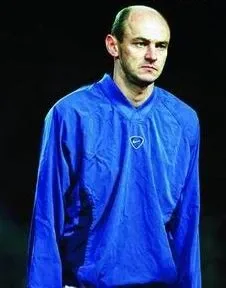
The Fate of a Footballer
Onopko has an interesting fate. He debuted in the top league for Shakhtar in 1988, and before that he had been effective in the miners' reserve team, scoring 15 goals over three seasons. In 1989, he was called up to Dynamo Kyiv, where Viktor spent a year in the reserves, and then returned to Donetsk, although Valery Lobanovsky wanted to keep the player in Kyiv. But it was too early for him to join Dynamo's main squad, and he had already outgrown the reserve level. Moreover, before leaving for Kyiv, Onopko had promised Shakhtar coach Anatoly Konkov that he would return. And he keeps his word.
Over two seasons in the top league, the young player managed to earn respect among specialists. At the end of 1991, representatives of Moscow Spartak approached him. At a family council, the homebody Onopko spoke against moving to the capital. His wife Natasha was in favor of Moscow. The decisive voice, as they say, was that of his father-in-law, the former well-known defender of Shakhtar and Dynamo Kyiv, Viktor Zvyagintsev. The father-in-law, who had considerable experience, turned out to be right. A great future awaited Onopko in Moscow.
In Spartak, Viktor immediately started playing. It was as if he had grown up in this team. In his very first season he was named the best footballer of the year, and eyewitnesses still recall his performance at the European Championship in Sweden against the famous Dutchman Gullit. After several seasons that were triumphant for Spartak, an offer came to the Muscovites to sell Onopko. In the autumn of 1995, Spartak swept through Europe like a hurricane, crushing English Blackburn, Norwegian Rosenborg, and Polish Legia in the Champions League, earning 18 out of a possible 18 points. And despite losing Russian gold for the first time, the demand for Spartak players was enormous. Oleg Romantsev, without thinking twice, sold almost half of the squad (Onopko was among them), and then with the remnants of the guard lost in the quarterfinal to Nantes. By the way, for a long time there was a living legend according to which Onopko decided to move to Spain the day after his luxurious jeep was stolen from right under his doorway in Moscow. But the footballer himself refuted this story, noting that the theft did take place, but not a day, but a year after the move.
Two Homelands
Be that as it may, Viktor began a new chapter in his career and life — the Spanish one. Over eight years spent in the Pyrenees, the usually slow-to-move ex-Luhansk resident became thoroughly attached to Spain. So much so that in the summer of 2003, when the question of a possible return to Russia arose, he deliberated for a long time, weighing all the pros and cons. There were no visible buyers in Europe for the 34-year-old Russian defender, and Viktor clearly had no intention of ending his career.
"It was difficult not so much physically as psychologically," Onopko himself says. "Especially in the summer, when I was left without a team. There were offers, of course, but in Spain the clubs that called were not from the first division. And the terms offered did not suit me either. In Alania, however, I felt comfortable, which is why I prepared for the national team matches with particular enthusiasm."
Many advised Viktor to give up football, to stop active performances. And they tried to send him off from the national team with honors, arranging a farewell match for him and giving him a Porsche of the latest model. But when the national team had problems in defense, they immediately remembered that there was such an irreplaceable person. Reliable and proven over the years. In the national team he had outlasted Byshovets, Sadyrin, Ignatiev, Romantsev, and Gazzaev (some of them twice), and now he was playing under the leadership of Yartsev, who trusted him. Onopko is not without sin on the field, but besides his shortcomings, he also has advantages. And they outweigh the disadvantages. This was proven in the important final matches of the Euro 2004 qualification, as well as in the playoff games against Wales.
Europe duly appreciated the veteran's contribution to the success of the Russian national team. The resuscitation had taken place. Onopko, who in the summer of 2003 was himself looking for a job, by autumn had begun receiving interesting propositions again.
"In Vladikavkaz they offered me to stay, but I wanted to play closer to my family. Even if not in Spain, then in another European country. The most realistic options arose in England — with Everton and Bolton. In the first case, I was not satisfied with the contract terms. In the second, everything seemed to be going well, but the English were dragging out the final decision too long. I confess, I was tired of endless trips and daily negotiations.
And the offers from Russia were extremely clear and specific — with terms and conditions. I am grateful for how the leaders of Alania, Krylia Sovetov, and Spartak treated me, but I made my choice in favor of Saturn. Why exactly the club from Ramenskoye near Moscow? Family is very important to me, and in the capital one can find a Spanish school for the children, which means the family can live in Moscow with me. At least a year, and I don't dare to plan further — that's too long a period for me."
As we can see, Spain has become something like a second homeland for the Onopko family. And the city of Oviedo, located at the foot of the Cantabrian Mountains in northern Spain almost on the shore of the Bay of Biscay, has become a real home. First of all for Viktor and Natalya's children — ten-year-old Vitalik and eight-year-old Zhenya, who are more Spanish than Russians or Ukrainians.
It is not surprising that Onopko worries so much about having a Spanish school for the children. After all, in any other school they would have a very hard time. And the father of the family did not even have the thought of uprooting the children from their established place. He played in Vladikavkaz, while his wife and children lived in Oviedo. By the way, Natalya is also a sporty person: in Spain she worked as a coach in rhythmic gymnastics.
On the Spanish Side
As part of Oviedo, Onopko played for seven years. The team did not try to reach for the stars, and in 2001 it even parted ways with the elite division. That is why Viktor's move to Rayo Vallecano in the summer of 2002 surprised few.
"When I was parting with Oviedo, I had plenty of advantageous options to continue my career. The most attractive was Deportivo's offer - a three-year contract. But at the last moment they demanded such a sum for me that it scared off all buyers. In the end, I ended up in the third most important club in Madrid - after Real and Atlético."
The absence of a large group of fans at this modest club was even a joy for Onopko: "Such a situation is very convenient for footballers. No one prevents preparing for matches, fans don't bother with excessive attention."
Interestingly, the well-known Serbian specialist Radomir Antić suggested leaving Oviedo a bit earlier, even before the team's relegation. But Onopko took the risk.
"My conditions were improved," the footballer said at the time. "But not as much as I would have liked. For a long time now, not everything in Oviedo has been decided by the club president, for whom I had mutual sympathy and respect. The final word, as I understand it, belongs not to him, but to businessmen who hold a solid percentage of the club's shares. During negotiations regarding my contract, we reached a compromise that suited Oviedo's owners more than me. Nevertheless, I put my signature."
He extended the contract when the club still had chances of survival in the elite. Soon they evaporated, and for the first time in his career Onopko went on vacation as a player of a non-elite division team. Not in the best mood.
"During the vacation I tried to throw bad thoughts out of my head. This was helped by family and friends, whose support I needed in those days perhaps more than ever. Among relatives, including the family of my brother Sergei, we spent ten days in Bor near Moscow - an amazing picturesque place where the national team now constantly prepares. Then for about two weeks my wife and I, in the company of the Karpins and Mostovois, had a great rest at the Spanish resort in Marbella.
And at that time we discussed the pressing question - to stay in Oviedo and play in the first division or to leave. Spanish journalists called about ten times a day. The press published information that, they say, Malaga is ready to buy Onopko, Espanyol, Alavés, Zaragoza, Deportivo... Internally I was ready to leave. If only for the reason that in Oviedo I was not paid the money due under the contract for two years. I was fed up with promises and, naturally, took offense at the club, to which I served faithfully for five years. So, on the one hand, I was ripe to leave Oviedo, and on the other - neither my wife nor my children wanted to leave a place we had settled into..."
Onopko stayed. The team's coach stood like a wall in the way of the management, which was tempted to sell the footballer, and argued that anyone could be sold. But not the Russian defender.
Victor began preparing for the season, but there was still no money. The club promised to sell several footballers and settle with Onopko. The press and fans remained on the side of the player, who was even ready to turn to the Spanish union for the protection of footballers' rights with a request to terminate the contract, become a free agent, and receive financial compensation from the treasury of the new club.
But the move to Rayo Vallecano still took place in a civilized manner. Onopko said goodbye to the team, visited his partners (who had already become former) at training, and sadly went to pack his suitcases. In order to head to the last Spanish club in his career, to leave the nice but provincial Oviedo for the capital - Madrid.
In one of the interviews of that time, Victor said: "My wife and I packed our things and decided that flying by plane made no sense. I'll get in the car and in three and a half hours I'll be in Madrid. The family will stay in Oviedo for now. After all, my wife works, and before joining me, she must sort out all her affairs. In addition, we need to find a school in Madrid where our children will continue their studies. Finally, we need to choose an apartment where we will live. For now I will stay in a hotel where a room is prepared for me. I hope that in a few weeks Natasha and the children will move to Madrid."
Who could have guessed then that within a year Victor would again have to search for an apartment, and at a distance much greater than can be covered by car in three and a half hours? And without the prospect of moving his family - after all, there is no Spanish school in Vladikavkaz. And who could have imagined that Onopko would climb out of the pit and again become the formidable defender who instilled additional strength in his partners, as he had been throughout the 90s? Victor is a real dinosaur who has outlived many of his peers in football. You could make nails out of people like him...