
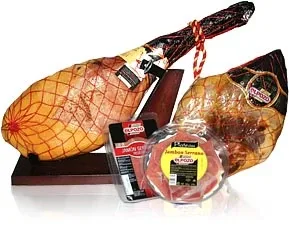
Of course, specialists usually have something to tell about - telecommunications satellites, weather forecasting, orbital monitoring of the Earth's surface... But the European Space Agency (ESA) has found an even more original way to demonstrate the results of its work. Now, to the question of economic effect, one can simply point to the display case of the meat department in a deli, where a piece of dry-cured Spanish ham - jamón - lies.
One of the most famous delicacies of the Iberian Peninsula, which has become fashionable in recent years, requires careful control during preparation. In particular, proper jamón must contain a certain percentage of water. It is not allowed to under-dry or over-dry Spanish ham - the quality will be irreparably damaged. However, to determine the moisture level of the product, a well-trained and experienced specialist is needed. But the ESA stated that with 'space technologies,' one can do without such an expert.
For testing jamón, they adapted a medical device developed for astronauts spending long periods in low Earth orbit. There is nothing fundamentally new in this technique; its basic principle is measuring resistance when passing weak electrical discharges through the human body. The data obtained show, in particular, the amount of water contained in human soft tissues. This is needed to prevent medical problems associated with reduced gravity.
The device, designed by order of the ESA, worked quite effectively in orbit. However, this technique is in principle indifferent to what and where it measures. You can test a human in space, or an animal on the Earth's surface. True, the moisture content in the tissues of live cows or pigs does not concern anyone, but for preparing proper jamón, this device turned out to be just right. It only had to be recalibrated for pork.
To adapt space technologies for earthly needs, the European Space Agency has a special firm that establishes contacts with industrialists. With its help, the meat moisture measurement device was installed on the ham production line of one Spanish producer. Conveyor testing of the delicacy automatically filters out substandard pieces, sending them for reprocessing. According to the ESA statement, using the space device allowed the producer to increase profit by 3%.
True, it remains unclear why such a device had to be first developed for an orbital station and then 're-export' the technology for the needs of the European food industry. The engineering solution, as already mentioned, is quite simple, and it is unlikely that the creation of an electrical tester for muscle tissues required any significant estimates and investments. Therefore, it is not very clear what prevented the jamón producers from ordering the development of a similar device themselves, without waiting for a state structure to carry out this project for them.