
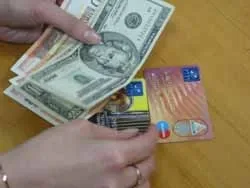
Let's start with the fact that if something goes wrong on the road, no one will return your cash. But with a card and a check, you can protect your money from fraudsters. If you lose your plastic card, you just need to call the bank and block the account. If you lose your check, contact the nearest payment system office and report what happened – your check will be restored a little later. By the way, no one can use a lost check: to present it for payment, you need to sign directly on the check.
Another plus of plastic is that it does not need to be declared at the border. This means that you can spend as much money during your trip as you have in your account. “No customs office requires you to declare funds held in your card account, and no border guards can force you to declare cards (unlike checks, bonds and other monetary paper). If just before departure you suddenly remember that you forgot your certificate for customs, find an ATM with a cash acceptance device at the airport, put the excess into the special receiving compartment of the ATM, and the money will instantly appear on your card,” explains banker Pavel Ivanov. As with plastic cards, you can carry any amount in checks abroad, but they must be declared at customs. Feel the difference: cash also needs to be declared, but you are allowed to take out no more than $10,000 in cash.
Card benefits
In developed countries, there are no problems with the use of plastic cards – they are accepted for payment in many hotels, travel agencies, cafes, restaurants and shops, and ATMs for withdrawing cash can be found not only in large shopping centers but also on the street. Last year in the Czech Republic, even the traffic police were required to accept cards by installing special card terminals on police cars.
Ordering a card is not difficult – you just need to fill out an application to open it. To do this, you can either visit a branch or find the form on the bank’s website. The card will take from one to five days to produce. To avoid losing money on conversion when paying for purchases or withdrawing cash abroad, it is better to open a card immediately in the currency of the zone you are traveling to.
Domestic banks offer cards from various payment systems: VISA International, Eurocard/Mastercard, American Express (AmEx), Cirrus/Maestro, and Diners Club. Not every card will suit a trip abroad – much depends on the country you intend to visit. In North and Latin America, VISA and American Express are more common, while in Europe both American VISA and European MasterCard are equally widespread. However, in the eurozone it is more profitable to pay with MasterCard if your account is in euros. This way you will save on conversion. Of course, you can open a euro account with a VISA card, but this payment system conducts all transactions in dollars, so when transferring funds from one currency to another (double conversion), losses are inevitable.
Diners Club cards are a special type of plastic, making it more convenient to travel throughout the civilized world. This product differs from VISA and MasterCard in that it is not just a payment instrument for cashless payments. “The cardholder becomes a client not only of a specific bank but of the entire service network of Diners Club International, whose representative offices operate in 200 countries worldwide. This plastic belongs to the so-called T&E (Travel and Entertainment) cards, intended for travel and entertainment,” says Svetlana Gentschke, head of the bank's client service support department. Clients receive special benefits and discounts: access to airport VIP lounges, exclusive tours, and rooms in the best hotels. By paying with the card, its owners earn bonus points that can then be exchanged for special gifts.
“Plastic” disadvantages
But paying with cards is not always convenient. Although payment systems prohibit merchants from inflating prices for cardholders, small merchants sometimes fail to comply with these requirements. For example, in Greece and Turkey, shop owners charge special commissions for cashless payments – about 2-5% of the cost of goods. Merchants explain this policy by the need to pay for banking services and the unprofitability of such payments, because they receive real money only after interbank settlements. Therefore, it is more profitable to buy a fur coat in such places with cash. And you can only haggle with cash in hand.
It is also unprofitable to withdraw cash from ATMs abroad – in this case, commissions can range from 1.5% to 4.5% of the amount cashed. Another piece of advice: prudent travelers should stock up on at least two cards from different systems – if one ATM refuses one, the second can save you.
Do not pay with cards in small shops and restaurants – you can be scammed there. If the card is swiped through the terminal in front of the buyer, problems can be avoided, but if the plastic is taken away and returned with a receipt, you should be wary – during this time a cunning merchant or waiter could swipe the card twice, thereby increasing the amount of the bill.
“In every country you can safely pay with a plastic card if you do so in hotels and large shopping centers. In small shops and stalls it is better to pay in cash, especially in Southeast Asian countries (India, Thailand), Turkey and Egypt. In European Union countries you can pay by card even in small shops. In addition, you should not let your card out of your sight, allowing it to be taken somewhere to a back room for a transaction. In decent shops, card payment terminals are located at the checkout, in full view of customers,” says banker Andrei Kuptsov. “Always have the phone number of the customer support service of the bank that issued the card with you. In case of loss or theft, you must immediately call the bank and block the card to prevent its unauthorized use,” adds Svetlana Gentshke.
Unauthorized credit
You can take both a debit and a credit card on a trip. With the latter, if you lack funds in your account, you can “borrow” from the bank. But even if your card is a debit card (you can only pay with it if you have money in your account) and you suddenly find yourself broke during your trip, there is a way out. Before leaving for home, you can make one or several inexpensive purchases – as a rule, stores do not request information from the issuing bank about the availability of funds in the account when the check amount is less than $100. Thus, you can get into the bank's pocket without its permission, that is, get an unauthorized overdraft (short-term credit). However, the money from your account will not be debited on the same day; as a rule, the chain of transmitting information about an international transaction is quite long and slow. For example, if the payment was made on Friday, the information may reach your bank only on Tuesday, taking into account weekends. If you manage to return home within this time and, by promptly visiting the bank, deposit money onto your card, then no penalties will be imposed on you for “going into the red.”
And if your card account is in national currency, you do not have to rush home to repay the debt. Anyone can deposit money into the account in national currency – you just need to dictate your details and card number.
With millions on the road
If abroad you plan to pay in cash, and in particularly large amounts, but want to protect them as much as possible, you cannot do without traveler's checks. It is with their help that it is convenient to transport large sums. “A card is the most convenient means of paying for a hotel, car rental and purchases. You can also easily get cash with it – there are many ATMs in all countries today. If you have a particularly expensive purchase ahead, for example, a car, it is better to take traveler's checks, cash them on the spot and pay for the purchase,” explains banker Valery Torkhov.
In our country, American Express and Citicorp checks can be purchased at almost any large bank. However, as with cards, the choice of payment system will depend on the country of stay. Those planning to visit America and European countries would be better off taking AmEx checks; it is better to bring Citicorp to Asia. This way you will have more opportunities to cash these “money substitutes.” One of the authors of this material, having arrived in Budapest, had to run around half the city in search of a point accepting AmEx checks. Difficulties arose even at the office of the “daughter” of the American “Citibank.” In the end, it was possible to cash the “valuable” paper only at the central office of one of the large local banks.
You cannot always pay for purchases with checks – they are accepted for payment only by expensive boutiques and car rental points located in hotels or large shopping centers. Moreover, they may charge customers a large commission. Therefore, it is better to take “named money” on a trip if you intend to cash it, rather than use it as a means of payment.
When purchasing a check, you will only need an identity document and cash, which you will have to exchange. “The procedure itself is simple and takes very little time – it all depends on the number of checks purchased, since the customer signs them at the time of purchase,” says Valery Torkhov. For the purchase you will have to pay about 0.5-2% of the amount you give for the check.
It is not recommended to put a second signature on checks unnecessarily, otherwise if they are stolen, a thief can easily receive money on them. In case of loss of a check, you should immediately contact the payment system that issued it by phone numbers given in the “Purchase Agreement.” It is drawn up and given to the client upon sale of a traveler's check, and it must be taken with you on the trip as the only document confirming ownership of traveler's checks.
Plastic traveler's check
Those who are too lazy to open a card account or look for points to buy traveler's checks can use the VISA TravelMoney Cash Passport (VTM Cash Passport) card, issued by tour operator Travelex together with the VISA payment system.
VTM Cash Passport is an analog of a traveler's check in the form of a plastic card with a magnetic stripe, a kind of hybrid of two products. Its difference from “plastic” is that the deposited funds are not tied to a bank account, but immediately go to the VISA International payment system – it is the guarantor of their safety. The card does not have the owner's name, but the “plastic” is protected by a PIN code. On the reverse side there is the card number and a list of phone numbers in different countries that you can contact in case of loss of the valuable piece of plastic.
You can put from $100 to $10 thousand on the card, but you can only cash it out at VISA network ATMs. But the machine will not be able to block or confiscate such a card. It is indefinite and ends when the funds are completely spent, however, it is usually issued for a period of three years. The downside is that it is denominated only in dollars, but money can be withdrawn in local currency, though at the local exchange rate. Within one day, you are allowed to cash out no more than $1 thousand. In addition, a commission of $2 is charged for each transaction.
Good old cash
However, you should not completely give up cash. If you can choose a payment method, funds are spent more efficiently during travel. “It is better to divide the total amount into two parts – have 30% in cash on you, 70% in traveler's checks or on a card. After all, it is impossible to 100% rule out possible failures in the banking systems. It may also turn out that the nearest ATM or card service point will be 80 km from the hotel. Cash will be useful when paying for taxis, tips, and buying small souvenirs. In some Latin American countries, ATMs operate only during bank working hours. When the working day ends, the ATM window is closed with a special plate,” says banker Anatoly Kraynikov.
Those traveling abroad independently, without being tied to a tour package and a specific hotel, should take note of the following aspect. At the hotel, you may be asked for a plastic card to guarantee payment for additional expenses (mini-bar, room service, etc.). Taking the card, the hotel blocks a certain amount of money as a deposit. The money is debited only upon check-out, but the blocked funds will be unavailable for use. The more expensive the hotel, the higher the “guarantee” amount. Therefore, it may happen that when paying, the remaining money on the card will not be enough. The block will be removed only after a few days or even weeks. Experienced tourists advise that it is better to leave 200-300 euros or dollars in cash at the reception and collect them upon check-out, and not risk the card.