
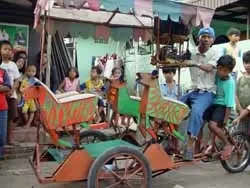
Moreover, the Indonesian representative of our company, Mr. Suharto, turned out not to be the best guide in the world. His calm confidence that I would be killed by locals in the old city of Jakarta, the Sunda Kelapa district, ruined the entire experience. He stubbornly did not want to walk through the ancient colorful market, did not want to look into the abandoned city port, showed no enthusiasm to accompany me on excursions through the city slums, and in general, I think, he felt noticeable relief every time he saw me off to the airport.
Therefore, the decision to have an independent vacation in Indonesia was inevitable. Guidebooks recommended waiting for the dry season for that, but you can wait for it all year, because in Indonesia dryness is a big problem overall. Even if there is no immediate rain for some illogical reason at a given moment, the air feels like a decent Turkish bath. Even by the pool somewhere on the island of Bali, it is impossible to endure more than half an hour, and walking the streets of Jakarta is difficult even for a physically healthy person, let alone me. Measurements supposedly showed (to someone) that humidity in the air is lower in summer and higher in winter. But this is not at all the dry (with a capital D) season that delights our tourists in Thailand or Burma.
Total humidity in the lowlands creates a haze in the air, resulting in poor photographs. This is the most depressing thing – because it was precisely for good photographs that the famous temples of Borobudur and Prambanan on the island of Java were built in the 8th-9th centuries. These are giant stone monuments, comparable to Angkor in Cambodia or Khajuraho in India – but little is known about them. In the Middle Ages, legends about the mythical princess Budur circulated in Europe, but no one could properly explain where she lived. Little is known about the history of these temples even today – surprisingly, no one can even give a coherent answer to the question why, 20 km apart, people decided to simultaneously start building two giant sanctuaries of different religions – Hinduism and Buddhism. Perhaps two neighboring kingdoms were competing, or maybe they united through a dynastic marriage and in honor of this decided to erect two monuments celebrating their unity.
For locals, Borobudur and Prambanan are not only a source of income from the fluctuating flow of tourists but also a relic. Once their ancestors built these giants, then other ancestors abandoned them and allowed the jungle to engulf them, and then they themselves cleared those jungles after the English Governor Raffles ordered them returned to society. Now every tourist is greeted here with honor. Upon getting out of the car, we were immediately surrounded by friendly souvenir sellers, guides whose appearance makes you immediately decline their services, and simply curious people, of whom there are plenty everywhere in Indonesia. However, the people here are quite harmless and perceive the natural reluctance of a tourist to interact with them without aggression.
Every souvenir costs $1 and is fully worth it. I was pleasantly surprised when a piece accidentally broke off from the souvenir figurine of Borobudur that I carefully brought home, and it turned out that inside it was stuffed with grass – whereas I, in my simple-mindedness, had thought it was stone or at least molded from clay. Tourists are greatly impressed by the blowpipes made by the locals. Constructively, they are designed to spit darts if you blow into them. However, many of my friends strained all their life force and broke out in blotches blowing without any result – the darts need to be reworked. My own pipe, however, spits excellently.
Last year, an earthquake slightly damaged the Prambanan temple. The epicenter of the tremor was right under one of the corner towers of the complex – but only its top tilted a bit, and a pair of stones rolled down. In the neighboring city of Yogyakarta, however, dozens of houses and a couple of giant supermarkets collapsed inward. Prambanan was clearly built to last.
The obvious advantage of Borobudur and Prambanan is that you can easily fly here from Jakarta within an hour. You begin to particularly appreciate this after a closer acquaintance with Indonesia, whose 40,000 islands are very poorly connected by transport routes. Flights on domestic airlines are virtually the only way to get around, and far from the safest – neither by statistics nor by feeling.
One of the most remarkable places in the Indonesian archipelago is the Toraja region on the island of Sulawesi, which can be reached by road from the city of Makassar in seven hours (once a plane flew to Toraja, but its passengers, according to them, preferred that it not fly. And it was canceled). Seven hours is already a considerable amount of time in any ten-day trip, but drivers all over the world will, of course, try to prolong such pleasure as much as possible. Tourist experience helps in this matter: if you are traveling by private transport or a small minibus, you need to do the following. Before the trip, be sure to approach the driver as closely as possible and ask like this:
- Can we start at 7 tomorrow instead of 9:30, and right away – just get in and go?
- Yes, the driver will answer uncertainly.
- Can we buy gasoline in advance so we don't have to stop at gas stations along the way and look for the right fuel on country roads and private shops, as usually happens?
- Yes, the driver, or guide, or both will say reluctantly.
- And perhaps we can take a bottle of water for the driver and a dozen sandwiches for his sustenance in advance, instead of going to his house on the other end of the city?
- Yes, the driver will mumble, who was probably planning to stop by home to show his wife and children the pale-faced monkeys.
Spare tire lying somewhere with a driver's friend in a remote village, a bag of some relative that needs to be dropped off along the way to another relative, and many other useful things – all this should already be in the car when you get in. Then, and only then, there is hope that you will reach Toraja in seven hours. With one more condition: you do not stop along the way. I usually promise the driver a cash bonus if he speeds past his favorite roadside café where his coffee takes hours to wait for. If there is at least one other local in the car (a guide, a random fellow traveler, a colleague passenger), stops are unavoidable – they all have nowhere to put their time, and they are ready to make stops as often as possible for bathroom breaks or coffee. It seems they haven't eaten for weeks, waiting for this trip. And seven hours turn into ten, and then the picturesque landscape of terraced rice fields or distant scenic highlands only causes dull irritation, and the driver's kind face turning to you with the words 'Well, another three hours and we'll be there, if the road isn't flooded!' risks turning into a bloody mess.
The path to enlightenment is an abundance of free time. Indonesia requires not 10 days but two to three months. In Toraja we met a laid-back American tourist who is circumnavigating the globe for a year. She quit her job, sits in a eatery and slowly eats pamerasan (pieces of buffalo meat baked in bamboo), and plans her further journey. She is in no hurry, and with this quality she absolutely blends in with the locals who adhere to the famous Indonesian philosophy of jam karat – 'rubber time'. As I write these lines, she is still wandering the world.
She had enough time to stroll through the colorful villages of the Toraja people, where boat-houses amaze the imagination with their size and whimsical appearance. Once, according to their inhabitants, the Toraja people arrived here from the south on boats, driven by the Bugis people. They placed the boats on the roofs of their houses, and so the prototype of the famous house called tongkonan appeared – the symbol of the land of Toraja. And now, even if a wealthy family lives in a quite European cottage with large windows and a terrace balcony, a traditional tongkonan with its upturned roof will still be built next to it, as a tribute to tradition.
But the inhabitants of Toraja are much more concerned with the afterlife. Here, a true cult of death and everything connected with it is practiced. Once, they say, they buried their dead decently, in the ground, and put in the grave, of course, everything that might be needed in the next world. It is clear that you cannot do without gold jewelry, garden tools, domestic animals, and a large amount of food. But then, supposedly, there appeared those who dug up graves and, without touching the garden tools, stole the gold. As a result, the Toraja people became more cunning. Today they bury themselves in sheer cliffs at a bird's-eye height, or hang coffins on cliffs, or stuff them into impassable caves. In some places, coffins are literally at every step – some of them have long been used to store piles of bones, whose sarcophagi have long since rotted. We were in a cave where human skulls are scattered everywhere on the stones. And nearby, as posthumous guardians of these peculiar cemeteries, stand dozens of 'tau-tau' figures – posthumous wooden images of the men and women buried here. Tau-tau is the most striking souvenir of the land of Toraja.
Infants are buried in trees. Throughout the region there are several such huge tree-cemeteries, and they are notable for the fact that when cut, they secrete milk, causing the locals to draw an analogy with mother's milk. A hole is made in the trunk, into which the corpse is placed, and after many years this hole gradually heals, leaving a barely noticeable trace on the bark. Nature takes people back into itself.
Christian missionaries appeared in Toraja at the beginning of the twentieth century and were horrified by all these rituals. They explained to the people that this cannot be done (but burning alive Jan Hus, Joan of Arc, and Giordano Bruno, apparently, can – I thought maliciously). In the village of Lemo, there is still a monument to a local resident who ended the life of one such missionary who was too persistent. Since then, many Toraja have nevertheless accepted Christianity, but they continue to bury in the cliffs just as before, and at funerals they continue to stage their pagan orgies, only hanging a cross on top, and that's all.
The entire population of a dozen surrounding villages gathers for the funeral. To raise money for such funerals, families sometimes save for a year, and all this time the deceased lies somewhere nearby. The Indonesian government tried to stop this practice, which leads to the ruin of entire families, but so far it has not been possible, and all the wealth of the Toraja inhabitants sooner or later turns into dozens of eaten pigs and lavish funeral honors, as their beliefs require. However, if the afterlife really exists, then these investments can eventually be recouped.
Toraja people generally love to gather together. My wife Lyudmila and I, for instance, once argued until we were hoarse about how many people to invite to our wedding – 52 or 54 – so that we would have at least a little money left for a honeymoon. In Toraja, hundreds of people come to a wedding, most of whom do not even pay attention to the guests of honor. They patiently sit on special platforms around the wedding square, patiently wait until the newlyweds appear accompanied by girls dressed in national costumes, until a special master of ceremonies invited from the city makes a fiery speech, and then they start eating, which turns into gluttony. Organizing a wedding differently is bad manners, it means condemning the young family to the contempt of others.
Or take cockfighting. It's simply amazing with what passion people can indulge in this, generally speaking, simple entertainment. For cockfights, entire squares are built, with platforms and several rows of stands: men crowd around fighting cocks, while women and children fascinatedly watch the fight from nearby heights. To each cock's leg is tied a blade with which it will fight its opponent, and then people start placing bets. You can bet even a million if there are those willing to make a counter-bet for the same amount. They say there are people here who became rich on cocks—and there are also those who lost everything. The latter category includes our guide in Toraja, Mr. Yunus, who after many years of unsuccessful bets made one infallible conclusion, which he shared with us in strictest confidence: the first fight of any cock is its victory. The main thing, therefore, is to get a fresh cock, and with that he has a problem every time. A fresh cock in the land of Toraja is a great value.
I bet on a black-and-white one and immediately won 20 thousand rupiah. I was eager to play more, instantly created a whole theory of cockfighting wars, and still regret that my wife dragged me away. Otherwise, apparently, I would have stripped that Toraja clean. And for 20 thousand in Indonesia, you can only eat a portion of cock soup.
When before the flight to Papua we asked our guide if he would like to visit this bountiful island, he immediately refused.
- Why? – we asked. – Isn't it more or less the same there?
- No, - he looked carefully and with some compassion into my eyes, - it's not the same.
And he was right. Papua is a completely different world. A different planet and a different time.
Getting to the Baliem River valley on the Indonesian part of the island of Papua is difficult but possible. To other parts of the island it is even more problematic: there is not a single road; you have to cross mountain ranges and turbulent rivers on foot. Here live Australoid aborigines, most of whom, since Miklouho-Maclay, have not seen a single white man, so they live quite happily. About 60 years ago, a small trading plane crashed in the Baliem valley, and the Dutch passengers were not eaten (for some reason), but were saved by the locals, and the Dutch told the world about these places. Now there is a small town, Wamena, built here, with two or three hotels, as many restaurants that close for indefinite lunch, and the opportunity to explore nearby villages with some help from a car. Cars, like all other blessings of civilization, are brought here only by plane, because no river or land routes to the Baliem valley have been created.
Wamena is a borderland between the late Stone Age and the 21st century. On the streets, dressed-up Indonesian youth in high heels and with mobile phones roam, while towards them strolls a Papuan with a stone axe, wearing only a penis sheath made from local skinny gourd. At the market, portable electric generators and sweet potatoes (the only thing the Papuan has learned to grow, and that thanks to incoming migrants) are sold. Before the arrival of the Dutch and Indonesians, the locals did nothing at all. They did not engage in agriculture, did not know how to raise animals, were unfamiliar with metals, and even made the bowstring for their bows from some kind of grass.
Their villages consist of several huts made from pieces of wood and straw: the main house for the head of the family, several identical dwellings for wives, and a pigsty. The cost of a wife is 4 pigs; the price of a pig reaches $1,000 because pigs are brought in by plane, while there are plenty of women around. The quality of both, from my demanding point of view, is quite low. But among the locals there are real oligarchs. We saw a man with ten wives and a hundred pigs; it's easy to calculate his market value. And he walks around, unlike our oligarchs, in just a penis sheath, not made of gold, but of exactly the same gourd. He even persistently tried to sell me a similar penis sheath for 15 thousand rupiah, assuring that size matters. Well, he should know…
In the village of Jiwika, another relic of the Stone Age is preserved – the mummy of a prehistoric Papuan. Until recently, the most respected deceased were turned into incorruptible relics by the Papuans, as confirmed by Miklouho-Maclay. Roll in spices, wrap in palm leaves, suspend over a fire, smoke over low heat for several months until done. The residents of Jiwika are deeply grateful to their ancestors for pickling this mummy – now it serves as a source of inexhaustible income from tourists. The aborigines, actually, don't need to do anything: they gather around in their shocking attire and stare at the tourists, and the tourists stare at them. Many older women have stumps instead of fingers – after the death of each close relative, one phalanx is cut off. No woman here wishes for the death of her relatives.
Just a couple of years ago, fierce wars were fought between neighboring villages. And all because of unan. The thing is, a person doesn't just die for no reason. He dies either of old age – and that is understandable and forgivable – or because someone prepared unan for him, a devilish potion that kills all living things. So, when a person dies due to the influence of unan, the village residents begin to suspect that unan was definitely prepared by one of the neighboring villages. People have no idea how this unan is made, but for some reason they are sure that everyone else knows exactly how. They gather a council of elders. The following conversation takes place:
- The unan was prepared by the people of Dugum village, because two years ago we killed and ate their pig, and they will die but will not forgive us for that.
- No, this unan was prepared by the people of Sumpaima, whose suspension bridge we sawed three years ago.
And so on. In the end, a decision is made, everyone agrees that the village of Wesaput prepared the unan, and the entire male population (14 people) is gathering for a military campaign against the treacherous Wesaput residents. Our guide told that as a child, he sometimes could not get to the missionary school for weeks because the path there passed through the front line between two villages. And even now, if something goes wrong, the Papuans often take up stone axes and go to beat each other, or, at best, immigrants from Indonesia.
That is why, when passing through one of the villages, we noticed a group of Papuans preparing equipment for a military campaign, we got a little alarmed. The warriors' faces were streaked with soot, and their expressions left no chance for people of the surrounding settlements.
- Mice, - the guide reassured us. – They are going to the mountains for a week to hunt mice.
- And how many mice can you kill in a week? – I asked skeptically.
- About 25, - the guide said after a long thought.
- 25? And how long do they intend to eat them? I apologize, of course, but in our homeland, 25 mice can be devoured in one sitting without even noticing.
- These are big mice, - the Papuan explained condescendingly, - they are the size of a dog.
I am bad at zoology, but no one will be able to convince me until the end of my life that there is a single mouse the size of a dog in the world. That wouldn't even be a mouse then. But the guide was poor in English vocabulary and could only demonstrate the giant size of the Papuan mouse with gestures. This warmed his soul. Finally, he closed his eyes with desire and made movements with his hands as if stroking this imaginary mouse along its fat, fleshy sides.
My wife Lyudmila said that the Papuans are 'as spontaneous as nature itself.' That is what our ancestors were like many millennia ago. If we were thrown back to those distant cave times, the people there would likewise, literally with mouths agape, gather around us in a crowd and stare without blinking, forgetting about all their affairs (if they have any at all). At the market, when trying to buy some fried sweet potatoes, we found ourselves surrounded by creepy half-naked cannibals who were intensely interested in every movement and word of ours. One of them noticeably touched my hair from behind, apparently to die of surprise later. Another thing Papuans love is shaking hands – for a long time, about 20 seconds, carefully feeling it. A typical cannibal habit, in my opinion.
But, in principle, among the Papuans there are also smart and stupid, kind and greedy, ugly and pretty. The latter, however, are noticeably fewer, but that doesn't change anything. Experience shows that even in Kostanay there are worthy people – they exist in Papua as well. After 10-12 centuries, they will gradually lose their primitive spontaneity, the mess and confusion that form the basis of life in the Baliem Valley will decrease, and an asphalt road to the mainland will be cut through the jungle. True, unfortunately, at the same time, the hanging bridges made of vines over the turbulent rivers, wooden arrows, stone axes, and cassowary feather hats will disappear from the valley.
And then I will put on my cork hat again, sling my bag over my shoulder, and go further, into the depths of the Papua jungle. There, a two-week walk away, where even missionaries' two-seater planes do not fly, lies the land of Asmat. There, people do not know about the existence of Indonesia, build their huts on trees, and speak a language unknown to science. There, mice are the size of a dog. There, precisely there, lies that world, to know which is the meaning of our life.
KIRILL BABAEV.
KIRILL BABAEV.
babaev.net