
Photo from the archive of "Zagranitsa"
Colorful stones of the Hungarian mosaic
A special conversation is about the pearl of the Danube - the gray-stone handsome and proud Budapest. Today our path leads along a necklace of colorful Magyar towns, shimmering with various colors. In them, styles and eras, religions and customs mix.
Here is the "Calvinist capital" - proud and ascetic Debrecen with its strict lines of cathedrals and libraries, countless museums and monuments. Here is "socialist-industrial" Miskolc, striking tourists' imagination with its 16-meter iconostasis, on which 88 icons tell about the life of Christ. And close by nestles the "Empire-baroque" bath of Tapolca: there, in the warm waters of the natural grotto bath, Roman legionaries once warmed their tired bones.
Do not miss Szentendre - a town of artists, the Hungarian Montmartre: an abundance of snow-white lace, kilometers of watercolors, countless mugs and bowls with the portrait of the people's favorite Sisi - the beautiful Empress Elisabeth, wife of Franz Joseph. And, of course, the dream of all children - the Marzipan Museum.
As early as the 11th century, Hungarian rulers held their cooks in high esteem, and the best of them were granted a charter of nobility and estates. Thus was born the town of Kiraysakachi ("kiralysakach" means "royal cook"). Today enterprising travelers hurry to stock up here on sausages and pâtés made according to those very "royal" recipes. You can also visit dignified Kalocsa, where the world's only Paprika Museum is housed in an old monastery building. Hundreds of strings of proletarian-red pods hanging from medieval beams exude a marvelous aroma that no Hungarian Catholic saint would be ashamed of.
"In Hungary, only horses quench their thirst with water" - willy-nilly, all guests of the country have to agree with this famous saying. Hundreds of thousands of "pilgrims" set out every year to bow to the royal drink in cozy Tokaj, which has curled up into a ball in the palms of vine-covered mountains. Those who like things "hotter" are invited by little Kecskemét - a small town, colorful and cheerful like a painted gingerbread. It is to it that belongs the glory of the "birthplace" of apricot pálinka - a fiery moonshine of 56 degrees.
Elegant little houses with turrets and stained-glass windows please the eye. Balconies and windowsills are bright with cheerful pansies, and rosehip and rose bushes grow from old stumps with hollowed-out cores. Here and there you come across old wooden carts with high sides, from which lush geranium blossoms nod to passers-by. Who did this? - Those who live here. For themselves, for neighbors, and for you and me.
Horsemen from the Ural Mountains
Every town, like a magic casket, keeps legends, traditions, and fairy tales. The path of the Hungarians across this land is difficult and winding, and it is best to ask a local about it - in an old csárda, over a good pálinka and an appetizing goulash.
...A ray of sunlight pierces the potbellied side of a capacious bottle. The onion-and-meat brew exudes a spicy, teasing aroma. István is mustached, unhurried, and good-natured. In his fifty-odd years has fit a considerable chunk of his homeland's turbulent path, from World War II to the present-day European Union. He dreamily inhales the sweet-and-tart apricot aroma, leisurely sips a shot, and begins his story.
The Hungarians are an amazing people. First, no one really knows where and when these warlike tribes came from. They say that daring horsemen rushed in like a whirlwind from somewhere beyond the Ural Mountains. They galloped across half of Europe, got tired, made a stop, and decided: "This is where our state will be!" History is silent about how the peoples living there reacted to such a self-confident statement. But ever since then, every autumn the Hungarians celebrate their mysterious and wonderful holiday - the Day of the Conquest of the Homeland.
The second Magyar riddle is the language. It belongs to the Ugro-Finnic group - that is, if we speak scientifically. And to put it simply... Székesfehérvár, Alcsútdoboz, Martonvásár - how do you like such intimidating names of very hospitable towns? In short, as my grandfather, who crawled across all of Hungary on his belly in the spring of '45, says, "It is easier to storm it a second time than to pronounce it the first time!"
"Csikós" and "Betyár", hussars and horse thieves
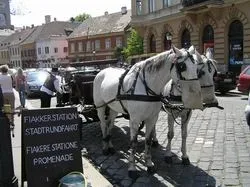
"A Hungarian is born and dies on a horse" - so says the proverb. In ancient times, in the cavalry of all royal courts of Europe, the elite units were Hungarian hussars. And in the boundless expanses of the Magyar puszta, no less famous were the "betyár" - noble robbers - and the "csikós" - mounted herdsmen. They say they were famous for the "talent of Magyar blood" - a virtuoso gift for horse stealing.
The horse show in Hungary is an unforgettable spectacle! For example, how can one person on horseback also drive a team of four? And a dashing csikós, standing on the rumps of the two rear horses, boldly drives another three ahead of him! The record - the "steppe dozen" - is in the Guinness Book of Records. The bravest lad in the village was determined at the annual competition. The winner was given free drinks all year round in the local csárda, fireworks were arranged for him, and no beauty could refuse him a dance.
Years have passed, but still the most native, most "Magyar" place in Hungary is the steppes of the Alföld. An endless plain, thickets of feather grass and thyme, herds of long-horned gray cattle, hook-nosed swarthy shepherds in high boots, slender-legged horses, the sharp crack of whips, the loud barking of shaggy sheepdogs...
Queens of the Csárdás
“Hungarian women are beautiful, temperamental, and calculating,” sighs Istvan. The candle flame mockingly winks at him through the gold of palinka. Well, tastes differ on beauty: some like long-legged, burning black-haired “Danube mermaids” with lush figures, while others stereotypically “prefer blondes.” But everyone is enthusiastically unanimous in assessing their passion. The Hollywood record holder for the number of officially registered marriages (whether eight or nine), the legendary Zsa Zsa Gabor, is a Magyar. And even today, 80% of all film pornography is shot precisely in Budapest. And precisely by the efforts of local “stars”...
Among historical beauties, we must note the unsurpassed Countess Erzsébet Báthory, whose concern for preserving beauty took somewhat exaggerated forms: this high-born lady ordered the killing of 600 girls in order to bathe in their blood and thereby remain always young and beautiful.
And here is another of her compatriots, the meek and God-fearing Queen Isabella, who for a long time agonized over cosmetic potions until she finally achieved what she wanted by inventing the famous “Queen’s rose water” – a distillate of rosemary. After regularly rubbing in this miraculous liquid, she became so much prettier and younger that the Archduke of Lithuania asked for her hand. And this despite the fact that by that time the beautiful Isabella had turned 72.
Goulash + paprikash - and to the ringing csárdás!
In Hungarian restaurant cuisine, there is everything: the “meaty” wildness of barbarians, the refinement of Roman colonizers, the sweetness of the Turkish harem, the sophistication of the French, and German heartiness. But in folk food there is little refinement and pretension. The celebrated goulash – a “shepherd’s soup” – was cooked simply by the csikós: they threw into a cast-iron pot everything that kind wives and mothers had stuffed into a satchel. And so that this “eclectic” brew could be consumed without harm to the stomach, it was simply generously seasoned with paprika – a hot-sweet pepper. What we consider goulash is called “pörkölt” by the Hungarians. And if you add a sour sauce to it, you get paprikash.
Hungarian cuisine is also renowned for its fish soup, and there are two “philosophies” of cooking fish – the Danube and the Tisza. On the Danube, fishermen boil pieces of fish with finely chopped onion, generously seasoned with red pepper. The broth is eaten with pasta, and the fish separately. For the Tisza-style fish soup, fish heads and small fry are boiled first, then pressed through a sieve. Pieces of more noble fish are added to the obtained base.
Soup in a bun – the answer of “uncouth” villagers to “enlightened” city dwellers: tasty, filling, and no dishes to wash. And in general, Hungarians love first courses – lebbencs, nyírség, slambuc (all from potatoes, noodles, vegetables, and spices) and, of course, fruit soup. Fried cheese for dessert? That’s not new; we’ve already tasted that in Lviv. But here under whipped cream with chocolate-cinnamon crumbs and drizzled with blueberry sauce... Or, for example, Somlói galuska – a sponge cake-sour cream-nut-caramel dessert. M-m-m, delicious!
...and a “piece of Hungary” to take with you
There are few souvenirs in Hungary. Among the universally recognized and indisputable ones are paprika (in all shades of hotness), Tokaji wines, and the famous goose liver. By the way, the scandal over it added ambitions to the already arrogant Hungarians: they say that François Mitterrand himself secretly bought this very foie gras at the Buda market. Those who wish to improve their health can be recommended the balsam “Unicum,” infused with forty medicinal herbs and produced for over two hundred years. For everything else, you will have to come back.
...It is getting dark. Well, it’s time for me to go! The colorful pebbles of the Hungarian mosaic slipped through my fingers so quickly. I have not bathed in Balaton, have not tasted Miskolc-style jellied meat, have not bought marzipan for the road. I haven’t even learned a single word of Hungarian... Oh, yes! Do you remember that scary word – udvozoljuk? Well, it simply means ‘welcome’!