
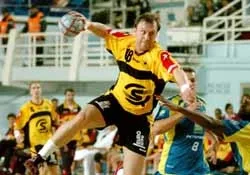
Now at 28, Veliky is the leader of the German national handball team and his club Kronau-Östringen, but his career began in the small town of Brovary near Kyiv. Fate itself determined Oleg's future. Handball became the only sport in his life, the future extra-class scorer never did anything else.
"When I was in the second grade," Oleg recounts, "a coach came to our lesson and invited everyone interested to the handball section. I remember there were more than 50 children at the first training session, but many dropped out almost immediately. Some lost interest, some got sick, some switched to another section. I liked handball from the first training session, although at first I saw it only as entertainment. Then it became interesting to participate in children's competitions – with each year I got more and more involved. That's probably why I stayed in this sport, even though all my classmates quit training – only four of us ended up in the sports boarding school, and then only I continued. And that's out of about fifty people!"
Then came performances at the adult level – for the capital's SKIF, after which the talented young man was invited to his team by the well-known Ukrainian specialist Leonid Ornstein. And it was in Brovary's "Svetotekhnika" that Veliky's star shone – at least at the Ukrainian level.
Despite his youth, this athlete was noticed by specialists, journalists write about him as one of the strongest handball players in our championship. Oleg Veliky proved himself from the best side both in his club and in the national team of the country. In the youth team of Ukraine, he also did not get lost. Moreover, he became its leader.
"My task in the 'youth team' was to lead the guys. The coaches told me that, and I myself understood that I could significantly help the team. After all, I had more experience: I had already played for the national team, and in the club I always started in the first seven."
The coaches are also pleased with Veliky. "You can immediately see that Oleg is a very talented, gifted athlete," says his mentor Leonid Ornstein. "It was not difficult to work with him, but I perfectly understood that the guy needed to grow, so I did not particularly resist when he decided to leave Brovary."
Of course, Oleg wanted to go to stronger Western European championships right away, but he made the right tactical move – he stayed in his homeland to gain experience, moving to the champions of Ukraine. Zaporozhye's ZTR met the newcomer without distrust, and Oleg became one of the team.
It is those years – the mid-nineties – that Oleg now recalls as the best in his Ukrainian career: "At that time I played for the national team and for the Zaporozhye club, and it was indeed a good time that coincided with the highest results of the national team. And I hope that in the future the 'blue-yellows' will be able to improve them.
Now, when we meet with the guys from the former squad, we often recall that period – indeed, for all of us it was very successful. At that time, both the handball federation and the state committee treated us with great understanding. Even episodes that may not be funny at all, we now recall with humor. We compare the achievements of that time with the current ones.
I really liked Zaporozhye – the conditions were the best in the country, and the audience there was completely special. I remember that only in Zaporozhye people reacted to me the same way as now in Germany – many recognized me, came up, said hello. People knew every player of ZTR and the national team, the city lived handball. I haven't been to Zaporozhye for a long time, so I don't know how things are there now, but I hope handball remains in favor. And what an atmosphere there was in the hall – it's just impossible to describe! We always had strong support from the fans."
Despite this, soon the most high-profile transfer in the history of Ukrainian handball took place – for a record sum, Oleg Veliky was bought from Zaporozhye by the German superclub TUSEM from Essen. And off it went...
"The Zaporozhye team was my third in the Ukrainian segment of my career, and I can compare. ZTR is a high level in everything: both in training and in preparation for competitions, and in everyday life. In general, everything is an order of magnitude higher than in other domestic clubs. But it cannot be compared to TUSEM, of course – they have a stronger financial base, conditions, and preparation. In these components, the German club already has an advantage."
The difference in the championships of Ukraine and Germany turned out to be even more significant: "The peculiarity is that in Ukraine there are not so many difficult matches, and there is a fairly large interval between them. Yes, there were indeed rounds when you had to play at full strength and win. But such a round happened once every two months, and the rest of the time there were not exactly easy, but lighter games.
In the German championship, you can play two matches a week for a month, and it is impossible to predict the outcome of such matches with 100% certainty. Moreover, where the game takes place – home or away – does not matter. The difficulty lies precisely in this life rhythm. You cannot breathe freely – the tension is so great. This surprised me, although I prepared for it, I still did not expect it to be so hard."
There were language problems, but Veliky successfully overcame them. "Now I can boast that I know German at a normal level, I can communicate, read newspapers and literature. Of course, I cannot yet be called a German, because I speak with an accent, but I can explain myself in any situation. And at first, of course, it was quite difficult."
Now life in Germany has improved – my wife Ekaterina and my little son Nikita helped me a lot with this. He is almost three years old and they come to all my games. Nikita shows considerable interest in handball. He plays with pleasure, keeps a huge number of balls at home and constantly asks: 'Dad, play with me.' And at all matches he sits and very carefully follows what is happening on the court, maybe he doesn't understand everything yet, but he is very interested.
I remember at first I really wanted to go home, but now I've gotten used to it, settled in. Now I have a dual feeling – I am drawn both to my homeland and to Germany. After all, I spend more time there. Life in Germany is more familiar, but whenever possible I definitely go to Ukraine.
The most difficult thing for Oleg during that period was the decision to take German citizenship. 'I dared to take this step, guided solely by sporting reasons. I still don't want to move abroad permanently. It’s just that with the German national team there are more chances to achieve something in handball. I had the opportunity to participate in the Olympic Games in Athens, but I was just a month short of being able to play for the German national team. In Ukraine, it wasn't even worth hoping for. Of course, not everyone understood this decision, but at the moment my friends and relatives support me. Over time, everything fell into place.'
In general, I think this way: while my career is in the development stage, you need to use the chance that appears. I won't make predictions for the future, life will show.'
And life showed the following. After the Games, the German national team was seriously renewed – veterans left, and promising young players came to replace them. And the leader of the team became… Oleg Velykyi.
After the European Championship in Tunisia, German and international media wrote about the significant potential of the Bundesteam. The leadership of the national team was also pleased with Oleg. The bosses decided not to chase results, but to systematically prepare for the Olympics in Beijing, where Oleg Velykyi also has excellent chances to compete. The main thing is that injuries don't get in the way.
Now the Brovary native is going through a period of recovery in his new club. 'Tusem disbanded a year ago,' the handball player said. 'After that I moved to the team "Kronau-Östringen." At first I had to play in the second Bundesliga. But last season we managed to get promoted.'
We have a young team, strong sponsors who set high goals for the team. In this team I feel great, without false modesty I will say that I have become one of its leaders. But in the winter I got injured, and I am still recovering. The injury turned out to be quite serious and, according to doctors, will take at least six months to heal. I hope that by the start of the next season I will be ready.'
Constantly offers come to Oleg – both from other German clubs and from Spanish ones, but Velykyi rejects them. 'I am absolutely satisfied with everything in this team, and there is no desire to change anything. In Spain there is also a very strong league, an interesting handball different from the German one. But it's a different country, a different mentality. I would have to start all over again. I just don't see the point in changing anything. For now, everything is fine with me.'