
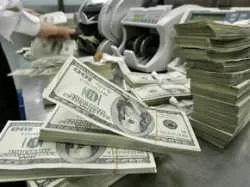
According to IMF estimates, about 64% of the world's gold and foreign exchange reserves are held in dollars by states.
Historian Glyn Davies, author of the book "A History of Money: From Ancient Times to the Present Day," notes that for most of human history, currencies have been international in nature and circulated simultaneously in many countries. The Roman denarius, for example, played such a role. This can be seen in the names of modern monetary units. For instance, the "descendants" of the denarius are the dinars of Serbia, Jordan, Algeria, and Kuwait. The "heirs" of the Ancient Greek drachma can be considered the dirhams of Morocco and the United Arab Emirates (as well as the modern Greek drachma, which disappeared due to the country's transition to the euro). The successors of the medieval Chinese wen became the Chinese yuan, Japanese yen, Korean won, etc.
Since the 19th century, a national currency has become an integral symbol of every independent state. Nevertheless, in recent decades there has been a reverse process - the number of currencies is decreasing. In 1996, the International Organization for Standardization counted 174 monetary units - at that time, according to the UN, there were 191 countries on the political map of the world. In 2008, there were 157 currencies, while the number of states increased to 194.
The main reason for this was the unification of European monetary units caused by the creation of the euro - the currency of the European Union. In 2002, 12 states switched to the euro. The euro buried such famous currencies as the franc (in France and Belgium), the mark (in Germany and Finland), the lira (in Italy), the guilder (in the Netherlands), etc. Currently, the euro is officially used by 16 of the 27 EU member states, plus Montenegro, Kosovo, Andorra, Monaco, San Marino, and Vatican City. In 2009, another European state - Slovakia - fully switched to the euro, causing the Slovak koruna to cease to exist.
More or less intensive currency unification is also taking place in other regions of the world. Since 1945, the "franc of the African colonies" has existed - originally this monetary unit was created by 12 former colonies of France. Since 1965, the Caribbean dollar has circulated in eight Caribbean states. In 1991, more than 50 African states agreed to create a common continental currency by 2028. Six Persian Gulf states (Saudi Arabia, Kuwait, Qatar, Bahrain, and the United Arab Emirates) also planned to introduce a single currency in 2010.
At the same time, the United States will most likely never abandon its dollar. The dollar is more than just a national currency of the United States. It is widely accepted that the American state itself, and moreover the global financial system, were created thanks to the dollar.
For instance, historian Steven Mihm, author of the book "A Nation of Counterfeiters: Capitalists, Con Men, and the Making of the United States," describes this story as follows. The inhabitants of the North American colonies of Great Britain desperately needed money, but money – gold and silver coins minted in Europe – was rare in colonial America. The silver and gold that entered the colonies did not stay there; it flowed to England. As a result, the local economy was based on barter, business suffered, and the authorities were unable to fulfill their financial obligations (for example, maintaining armed forces and effectively collecting taxes). Eventually, an original solution was found: in 1690, in the colony of Massachusetts (now a state), the authorities began to print paper notes that were stated to be equal in nominal value to "real" (i.e., gold and silver) money.
These were the first paper money of the modern world - earlier such practice had existed in China, but in America they did not know about it. It was implied that the authorities had a sufficient amount of precious metals to back the paper notes. In reality, there was no such currency fund, and moreover, neither Massachusetts nor the other colonies that soon followed its example, nor the private banks that issued dollars, ever had such assets. However, the new money proved to be in demand: they brought with them a new philosophy of finance, which implied that money could be issued today on the expectation that it would be backed in the future (through tax revenues, future harvests, etc.). Initially, American money was counterfeited, despite the fact that many notes bore inscriptions indicating that counterfeiters faced the gallows. However, American society, on the whole, tolerated counterfeits because the demand for money exceeded the supply.
This ideology prevailed in all other societies and states. Money, once "pegged" to gold and silver, is in most cases issued almost freely - authorities only ensure that it allows the economy to function successfully. In this regard, states periodically make massive injections of money into the economy or, conversely, reduce their number in various ways. The main thing remains that a particular currency is not refused acceptance - that is, it allows economic processes to be maintained.
The financial history of mankind also demonstrates that no single currency has ever been the only currency. Always and everywhere, various monetary units competed for popularity. The history of the British pound sterling, which was the king of currencies for most of the 19th and early 20th centuries, is indicative. However, it began to lose this significance around 1918, after the end of World War I.
Approximately in 1950, the US dollar took first place in the world by significance, and around 1977, the German mark surpassed the pound (it ceased to exist in 1998 after Germany switched to the euro). However, these dates are often disputed because the criteria for recognizing a particular currency as global are very vague. For example, a study by the University of Berkeley showed that the dollar overtook the pound in 1924-1925 - then the share of dollars exceeded the share of pounds in the gold and foreign exchange reserves of European and Asian countries.
Nevertheless, many analysts consider it a historical anomaly that humanity makes a choice in favor of only a handful of currencies, especially since these currencies are not backed by gold and silver. Economists also point out that no economy and no currency can be stable. Periods of rise are followed by periods of decline, and decline by rise.
According to estimates by the International Monetary Fund, countries now hold about 64% of their gold and foreign exchange reserves in dollars, about 27% in euros. The British pound sterling accounts for less than 5% of assets, the Japanese yen about 3%, the Swiss franc roughly 0.5%. Notably, in the last decade, the size of gold and foreign exchange reserves has grown significantly.
In recent years, many heads of state (e.g., Iran and China) have indicated that the US dollar is ceasing to be a world currency. Some economists make similar forecasts: for example, the Briton Jeff Frankels predicts that in the mid-2020s, the euro will replace the dollar as the world's main reserve currency. Factors working against the dollar include the decreasing share of the US in the world economy, budget problems, declining purchasing power of the dollar, etc.
However, other arguments speak in favor of the dollar. According to the Wall Street Journal, the dollar accounts for the lion's share of world trade (that is, parties prefer to conduct international trade transactions in dollars). According to a study by the Council on Foreign Policy, the dollar is accepted in almost every country in the world (it is familiar to people, and therefore transactions with it do not cause rejection). The euro, yen, pound, and potentially the Chinese yuan will need a long time to achieve such popularity. All political and economic crises of the last five decades have been marked by a rush for the dollar - the population of affected countries immediately began to buy American currency, considering it a reliable way to preserve funds.
The dollar's closest competitor, the euro, is managed rather inflexibly, due to the amorphous nature of the European Union's power structures. In addition, other currencies have been strengthening in recent years - the yen, Indian rupee, Australian dollar, yuan, which businessmen from these countries are switching to for settlements. That is, the weakening of the dollar is happening in parallel with the weakening of the euro.
Jason Goodwin, author of the book "Bucks," asserts that the American state will try to prevent the overthrow of the dollar. The presence of the dollar in the gold and foreign exchange reserves of other countries allows the US to borrow its own money, pay for the trade deficit, and ensure low interest rates on bank rates. In turn, American companies find it more comfortable to do business outside the country.
Based on materials from Washington ProFile.