
AUSTRIA
International exhibition Art Bodensee, July 26-29, Dornbirn. About 50 art galleries will present contemporary art at the 7th International Art Bodensee exhibition, which will take place at the Dornbirn Exhibition Center. Organizers claim it will be the only summer fair of contemporary European art, where works by 300 artists from Germany, Switzerland, Austria and Liechtenstein will be offered for sale. Traditionally, art of the 1960s holds a special place at the Dornbirn exhibition. //www.artbodensee.info //www.dornbirnermesse.at
"Exotic and Curious Natural Objects from the Kunstkammer Collections of the 16th-17th Centuries," until September 3, Vienna. The Kunsthistorisches Museum in Vienna is opening an exhibition prepared jointly with the Natural History Museum. It brings together scattered objects from the famous Habsburg collection stored in various museums in Austria. It is known that Archduke Ferdinand II of Tyrol and Emperor Rudolf II were passionate collectors of curious and anomalous items. Objects from this collection form the basis of the exhibition. Ingenious objects made from mollusks, minerals, parts of rare animals, bezoars (stomach stones of ruminants) in gold settings (which were believed to have healing properties), "snake tongues" meant to protect against venom, and other healing-magical objects are displayed alongside illustrations from scientific works of the 16th-17th centuries. These are primarily anatomical drawings and depictions of "freaks of nature" – hairy people, deformities, giants, dwarfs. //www.khm.at
BELGIUM
"Flemish Primitives and Exoticism," until October 7, Bruges. The Groeninge Museum, renowned for its collection of early Netherlandish painting, is hosting the exhibition "Flemish Primitives and Exoticism," dedicated to the depiction of the "foreign" and exotic in the paintings of Flemish masters of the 15th-16th centuries. How did they depict people of other races, their dwellings, clothing, everyday objects, exotic animals? Visitors to the exhibition will be able to find answers to these questions. The exhibition of Flemish primitives is part of the Flemish Art Collection project, uniting three Belgian museums: the Royal Museum of Fine Arts in Antwerp, the Ghent Museum of Fine Arts, and the Groeninge Museum in Bruges. Thematic exhibitions are currently being held there, which we have previously written about. A single ticket to visit all museums costs €12. //www.brugge.be //www.flemishartcollection.be
GREAT BRITAIN
Summer Exhibition and other exhibitions, until August 20, London. The Summer Exhibition at the Royal Academy of Arts is one of the largest temporary exhibitions of contemporary creativity in the world. About 9,000 paintings, drawings, photographs, prints, sculptures, and architectural models will be shown at this year's Summer Exhibition. These are works not only of different genres and directions but also of very different quality. At the end, artists will receive awards, and their creations will be offered for sale. The theme of this year's exhibition is "Light."
Parallel to the Summer Exhibition, if you have the energy, you can also visit three other exhibitions at the Royal Academy of Arts in London: "Anatomical Drawings by Benjamin Robert Haydon" (until October 21), "Portraits of Artists from the Royal Academy Collection" (until November 25), and "Impressionists on the Sea" (until September 30). //www.royalacademy.org.uk
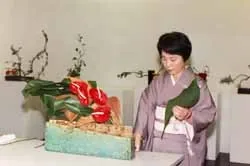
"Ikebana: Living Flowers of Japan," until August 19; "Beauty in Japanese," July 19 - October 21, London. Ikebana is the ancient art of flower arrangement, its origins linked to the spread of Buddhism in Japan. From the 6th century, it transformed from a ritual practice into a domestic one. In modern Japan, there are many different schools of bouquet composition, but the main rules of ikebana, based on Zen Buddhism, are common to all. These are simplicity of composition, revealing the uniqueness of each flower, development over time, dynamism, symbolism, asymmetry, and apparent incompleteness. The exhibition is also interesting because 7 compositions will be renewed every 7 days for 7 weeks. Of course, this is a good reason to come to the museum every week, especially since from July 19, an exhibition of works by contemporary Japanese craftsmen will open in the same venue. There, visitors will be able to see "beauty in Japanese" created from ceramics, glaze, bamboo, wood, metals, and glass. //www.thebritishmuseum.ac.uk
HOME + GIFT Exhibition and Fair of Gifts and Home Goods, July 15-18, Harrogate. This fair in fashionable Harrogate has been held since 1961, with about 1,000 exhibitors presenting new design solutions and realized ideas in everyday items. These include accessories for bathrooms, bedrooms and kitchens, clocks and jewelry, gift collections of elite cosmetics, porcelain and glass, ceramics, greeting cards and souvenirs, gifts for children, and similar household items that designers strive to turn into something perfect. //www.homeandgift.co.uk/
GERMANY
Sand Sculpture Festival, until September 2, Lübeck. 9 tons of sand for creating sculptures have already been brought to Travemünde beach, where it has been compacted and is "ready for use." 75 sculptors from different countries will create their masterpieces over two weeks. The theme of this year's festival is "Time Travel." Among the announced projects are Julius Caesar with Cleopatra, a ball at Versailles with Louis XIV, European fashion from the Middle Ages to the 20th century, knights from the time of King Arthur, Napoleon Bonaparte, and even robot models, also "through time" – from 1927 to the 1984 "Terminator." In short, there will be plenty to see. Incidentally, you are not limited to just viewing: Monday through Friday, visitors are offered a paid two-hour workshop to try to create their own sand sculpture. Ticket costs €7. //www.sandworld.de
«Dreams and Dreaming», until October 3; «Long Night of Museums», July 14, Dresden. At the Dresden Museum of Hygiene, which has a unique collection of exhibits from different eras related to human structure and adaptation in nature and society, an exhibition dedicated to the study of sleep and dreams has opened. As the organizers state, this exhibition is "an invitation to comprehend the mystery of the night", an obvious opportunity to penetrate the secrets of human sleep. Visitors will be helped by drawings, sculptures, video installations, photographs and films.
Reminder: On July 14, during the traditional «Long Night of Museums», you can enter the Museum of Hygiene and 40 other museums and art galleries in Dresden with a single ticket. It is easier to get from museum to museum on special buses that run from 6 pm to 1 am. //www.dhmd.de //www.dresden.de
DENMARK
«Boundaries of Architecture I: Cecil Balmond», until October 21, Copenhagen. The Louisiana Museum of Modern Art is located near Copenhagen in the town of Humlebaek. It is situated in a huge old park on the shores of the Øresund Strait. It is there that an exhibition dedicated to alternative architectural projects of the future has recently opened. Here you can see architectural projects, diagrams, photographs, drawings and models of the famous engineer and architect Cecil Balmond. It is supposed that this is the first exhibition in a whole series of similar exhibitions at Louisiana. Balmond's fundamentally new projects, very far from traditional architecture, are gaining increasing popularity, and his book on architecture, Informal, was named the best book of the year and received an award from the Banister Fletcher Prize. //www.louisiana.dk //www.louisiana.dk
SPAIN
«Van Gogh's Last Landscapes», until September 16, Madrid. An exhibition dedicated to the last period of Vincent van Gogh's work has opened at the Thyssen-Bornemisza Museum in Madrid. The exhibition has clear chronological limits: May 20 – July 29, 1890. It was during this period, until his death (July 29), that Van Gogh lived in Auvers-sur-Oise, where, experiencing "sadness and extreme loneliness", he created his last landscapes. These are exactly what can be seen at this exhibition, which consists of four sections: "Traditions of Landscape", "Houses in the Landscape", "Fields", and "The Last Series". The paintings were provided by museums in Belgium, Switzerland, the Netherlands, and Spain. Among the works are such masterpieces as "Houses at Auvers" and "Wheat Field with Cornflowers". //www.museothyssen.org //www.museothyssen.org
«Picasso's Series of Small Sculptural Figures in the Context of His Work», until September 16, Malaga. The year 1907 was a turning point in Pablo Picasso's work – almost all art historians agree on this. At the beginning of the year, he finishes «Les Demoiselles d'Avignon» and everyone understands that this is a different, new Picasso, who has turned to the primordial, "not yet overcoming chaos", primitive foundations of existence, where good is not separated from evil, and ugliness from beauty. It was in 1907 that Picasso became seriously interested in primitive African art and created a series of small sculptural figures. Now it is presented at a "research" exhibition at the Picasso Museum in Malaga. The artist himself, however, later denied that African art became one of the sources of his cubism, but art historians claim that this is exactly how it was. The curators of the exhibition in Malaga have tried to prove this. //www2.museopicassomalaga.org
ITALY
«Artempo: When Time Becomes Art», until October 7, Venice. In Venice, simultaneously with the 52nd Biennale of Contemporary Art, the Artempo exhibition is running at Palazzo Fortuny. It is interesting because it completely refutes the traditional concept of understanding time – from the units and methods of measuring time itself to the "test of time" of truth and genius of works of art and human activity in general. Visitors are asked to imagine time and art as relative and subjective things. The viewer is immersed in the world of relativity through a number of techniques: alternating modern bright halls with dark ancient heavily draped rooms, the deliberate achronological arrangement of objects (for example, an ancient Chinese Buddha looks at the canvases of contemporary conceptualists, ancient cloudy mirrors reflect a distorted metal installation by Anish Kapoor). The boundary separating art from non-art is also declared relative: the exhibition offers to free oneself from stereotypes on this issue as well. For those who still hold a traditional understanding of art, we add that the Artempo exhibition features works by 80 artists, including Alberto Giacometti, Pablo Picasso, Andy Warhol, and Francis Bacon. //www.museiciviciveneziani.it
«The Art of the Garden from Babylon to Rome», until October 28, Florence. Nature, art and science, taken together, constitute the ancient "art of the garden", define its poetics and philosophy. It is the philosophy of the garden that the organizers of the Florentine exhibition, which opened in the Boboli Gardens, have tried to explore.
The exhibition consists of five parts: "Plants of Ancient Egypt", "Mesopotamia: Origins of Garden Art", "The World of Greece: Gardens of Gods and Philosophers", "The World of Rome: From the Center to the Outskirts", and ends with an exact reconstruction of two Pompeian gardens, which visitors can stroll through.
For the organization of the exhibition, ancient frescoes, archaeological data, drawings, diagrams, plans of gardens and hydraulic devices, antique vases, as well as modern models of restored ancient fountains (the most curious of which is a model of the hydraulic system of the Hanging Gardens of Babylon) were used. In addition, the organizers employed modern animation and video installations to more fully recreate the picture of ancient gardens. The exhibits were provided by many European museums and private collectors. //brunelleschi.imss.fi.it
IRELAND
Exhibition of works by Lucian Freud, until September 3, Dublin. The Irish Museum of Modern Art is hosting an exhibition of one of the most famous contemporary configurative artists, Lucian Freud, grandson of the famous founder of psychoanalysis. Grandfather's lessons did not benefit the artist, as the grandson did not let any curious journalists into the space of his personal life, thereby creating the necessary mysterious aura. The exhibition in Dublin brings together 50 paintings by the artist, including those specially prepared by the author for it. These include portraits and his famous nude paintings created over a 60-year creative period. In September, the exhibition will move to Copenhagen, then to The Hague. //www.modernart.ie
THE NETHERLANDS
"Van Gogh's Drawings: A New Understanding", until October 7, Amsterdam. Research exhibitions at the Van Gogh Museum in Amsterdam are a frequent occurrence. In mid-July, a new exhibition will open there dedicated to the study of experimental techniques and stylistic features of Van Gogh's drawings. At such exhibitions, not only the objects themselves are displayed – the research materials themselves are no less interesting: photomagnifications of fragments, X-rays, art historical commentaries.
Until October 7, the museum also hosts another research exhibition "Hidden Colors", dedicated to the study of the overlay and mixing of red, yellow, and blue paint in Van Gogh's early paintings. We remind you that the same museum also hosts the exhibition "Max Beckmann in Amsterdam" until August 19 (which we already wrote about in April). //www3.vangoghmuseum.nl
FRANCE
Exhibition "Hands", until September 30, Paris. The exhibition "Hands" at the Musée d'Orsay in Paris presents works by the most famous portrait photographers of the early 20th century. In early photographic portraits, the position of the hands determined the character of the subject no less than the face. Hands as a self-sufficient and independent plastic fragment expressing personality traits is the main thematic line of this exhibition. Visitors will be able to see the hands of Vaclav Nijinsky, Isadora Duncan, Bernard Shaw, Edgar Degas in photographs by such masters as Nadar, André Disdéri, Alfred Stieglitz. //www.musee-orsay.fr
"Fantastic Creatures in the Paintings of Marc Chagall", until October 29, Nice. The Marc Chagall Museum in Nice was opened in 1973. Its permanent exhibition is mainly devoted to the biblical theme in the artist's work. Since the end of June, a temporary exhibition of a somewhat different direction has been held here. "Fantastic creatures, chimeras and hybrids", as stated in the catchy, enticing poster, are depicted in Chagall's paintings in complex metaphorical and symbolic contexts. The focus of this exhibition is the artist's famous "bestiary", created by him back in Vitebsk and expanded in France. The paintings are provided by many French museums and private collectors. //www.rmn.fr //www.musee-chagall.fr
CZECH REPUBLIC
"Exhibition of One Masterpiece", until January 31, Prague. In the medieval Sternberg Castle, an exhibition of one painting by Rembrandt opened – the portrait "Bearded Man in a Beret" from the National Gallery in London. An exhibition of a single painting is always an interesting event, allowing one to thoughtfully examine every detail. Only at such events do we become capable of truly contemplating – instead of gulping down and trying to remember "artistic information". This Rembrandt painting dates from the second half of the 1650s (presumably 1657) – one of the most difficult, tragic periods in Rembrandt's life: bankruptcy, sale of his collection and house. But it is precisely in these years that the artist's paintings become freer, more original and daring, striking with a kind of "magical" depth, universal human meaning, harmony of form and content. Visitors will be curious to compare this late work by Rembrandt with another, early one – the portrait "Scholar at a Table" (1634), which is displayed in the adjacent hall of the museum. //www.ngprague.cz