
In fact, the northern part of Great Britain has given the world thousands of scientists, poets, and researchers. Moreover, little Scotland with a population of just over 5 million people ranks third in the world in the number of scientific publications (only the USA and Japan are ahead of it). And first - in scientific discoveries in the fields of zoology, botany, molecular biology, astrophysics, and genetics. However, there is nothing surprising about this - Scotland has always been an enlightened country. It is no wonder that four of the first six universities in Great Britain appeared exactly here.
In total, Scotland has 13 universities and nine colleges offering higher education. The basic course (undergraduate) at Scottish universities lasts four years. Upon completion, students receive a bachelor's degree. The first two years are usually devoted to studying a range of subjects. During this time, students decide on a more narrow specialization, to which the final two years of study are devoted.
Characteristic features of Scottish higher education are flexibility and diversity of choice: many subjects can be studied without previous school qualifications; students are allowed to change their disciplines frequently, especially during the first two years of study; in some cases it is possible to transfer directly to the second or even third year. The only exceptions are specialties such as engineering, dentistry, medicine, veterinary medicine, and architecture, which are strictly limited by the set of academic subjects required for obtaining a diploma.
Postgraduate education is available to anyone who has already completed a university degree, and it is not at all necessary to have a British one.
Most Scottish universities are located in the four most significant cities of Scotland. Glasgow is the largest and, as is commonly believed, the liveliest city in Scotland. The capital of Scotland, Edinburgh, is known as the 'city of festivals'. In the north stand the 'city of granite', ancient Aberdeen, which over the last 30 years has become the oil capital of Europe, and Dundee, with its beautiful view of the wide estuary of the River Tay. Universities are also located near small towns that are nevertheless proud of their glorious history, such as St Andrews.
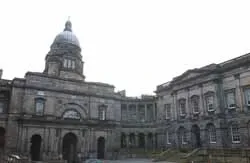
We will begin our review with the University of Edinburgh, but not because it is located in the capital or is the oldest educational institution in Scotland. Last year, this university made a significant breakthrough, rising from 13th place to 5th in the national ranking, overtaking the famous St Andrews and receiving the status of the best Scottish university of 2006.
The leader of Scottish higher education is located in one of the most beautiful and green cities in Europe. Most of Edinburgh's historic buildings are listed by UNESCO as world heritage sites. The capital leads an active social, cultural, and sporting life. Every year Edinburgh hosts nine international festivals. The city has many museums, theaters, and concert halls.
The University of Edinburgh was founded in 1583. Originally known as King James College, then Town's College, in the 18th century it became a leading higher education institution not only in the eyes of the offspring of British aristocratic families, but also of most European students.
The high level of teaching, the variety of forms of study, and serious research work have earned the university international recognition. Here studied Charles Darwin, Walter Scott, Robert Louis Stevenson, Arthur Conan Doyle, Robin Cook (Foreign Secretary of Great Britain), Gordon Brown (Deputy Prime Minister of Tony Blair's government).
Students are offered a choice of more than 300 specialties, which can be studied at the faculties of law, medicine, veterinary medicine, humanities, natural sciences and engineering, social sciences, music, and theology. The university has more than 4 thousand foreign students from 130 countries. In total, more than 20 thousand students and postgraduates receive education here. The university maintains close ties with a number of North American universities: Stanford University, University of Pennsylvania, Georgetown University.
The university library is considered one of the richest in Great Britain. Its collections hold more than 3 million volumes. The sports center has a gym, swimming pool, tennis courts, and a golf course. A place in a dormitory is guaranteed to all first-year students.
The second place in the latest ranking of Scottish universities, compiled by the Sunday Times, is occupied by the oldest university in Scotland and the third oldest in the United Kingdom - St Andrews. It was founded in 1413 by papal decree. In 1423, King James I took the university under his special patronage, exempting it from paying any taxes.
The ancient small town of St Andrews, in the very center of which the university of the same name is located, went down in history as the world center of golf: the Old Course in St Andrews is known throughout the world as the first official field for this game.
More than a third of the population of this town, which numbers 16 thousand people, is in one way or another connected with the university: they are either students or teachers. Apparently, that is why new students very quickly begin to feel at home in St Andrews.
Despite its small size, the university offers a fairly wide range of academic programs. Preference is given to the humanities, for example, here is the largest department of medieval history in Great Britain. However, no less attention is paid to the study of various areas of physics: the laboratories are equipped with modern laser installations. It also houses the largest optical telescope in Great Britain, and the marine laboratory of the University of St Andrews is a recognized leader in the study of whales, dolphins, and seals.
Social life at the university is active - there are more than 100 student clubs and 75 sports clubs. Naturally, the first among them is the golf club.
Following the university of the quiet St Andrews comes the university of Scotland's largest city - Glasgow. Despite the fact that Glasgow is considered an industrial metropolis, it is a brilliant example of Victorian urban architecture. The predominant one- and two-story buildings give it a cozy, homely look. There are no ugly modern buildings or a business district like the City as it exists in European cities of this scale. And this only adds to Glasgow's charm. The city is rightly called a center of arts: it hosts numerous festivals, as in Edinburgh. The University of Glasgow, founded in 1451, enjoys well-deserved authority not only as an educational institution but also as a center for scientific research. It is a member of the international consortiums Universitas 21 and Russell Group, which unite leading universities in the field of scientific research.
At various times, the University of Glasgow was graduated by one of the founders of thermodynamics, Lord Kelvin, economist Adam Smith, television inventor John Logie Baird, Nobel laureate James Black, and the Prime Minister of Great Britain of the early 20th century, Sir Henry Campbell-Bannerman.
19,000 students and postgraduates, 2,000 of whom are foreigners, are trained at the faculties of humanities, biomedicine and life sciences, natural sciences, social sciences, veterinary medicine, information technology, mathematics and statistics, theology, as well as pedagogical, medical, engineering, law, and finance.
Occupying the fourth line of the ranking, Aberdeen University is among the five oldest universities in Scotland: it was founded by Archbishop William Elphinstone back in 1495. It is also one of the best universities, with over 13,000 students.
The University of Aberdeen is known for its high level of teaching and research in medicine, humanities, and natural sciences, as well as its outstanding achievements in the study of the world's oceans - fortunately, it is located on the northeastern coast of Scotland. According to official statistics, 92% of the university staff are engaged in research work. University scientists have become Nobel Prize laureates four times (including for the production of insulin). The administration of Aberdeen University has created excellent conditions for study and leisure for students. There are laboratories equipped with modern equipment and an excellent library - one of the largest in Scotland.
The main areas of academic activity are the humanities, biology (including many areas of ecology, agriculture, and forestry), economic and social sciences (including management), engineering, law, mathematics, physics, and medicine. However, the pride of the university is its oldest faculty - the law faculty.
The University of Aberdeen is known as a major sports center. There are sections for martial arts, athletics, badminton, basketball, boxing, canoeing, cricket, curling, football, gliding, golf, hockey, tennis, triathlon, and orienteering is studied, along with rugby, sailing, ski jumping, snowboarding, and swimming. In addition to sports sections, there are many interest clubs, including a wine connoisseurs club.
By the way, at the University of Aberdeen foreigners enjoy certain advantages: free English language courses are organized for them to prepare for their studies. If a student needs longer language study or additional preparation in other subjects to successfully pass entrance exams, they can apply to Aberdeen College, which is linked to the university by a special agreement. After taking a preparatory course there, the student is entitled to enter immediately the second year of the university's degree program.
Closing the top five is the youngest of the presented Scottish universities - the University of Dundee. Founded in 1881, the University of Dundee was part of the University of St Andrews as an institute until 1967. Despite the emergence of a new midwifery department and the merger with the College of Art (which became the basis of a new faculty), the University of Dundee remains relatively small. On five faculties (philology and social sciences, law and accounting, natural sciences and mechanical engineering, art and design, as well as medical) a little more than 10,000 students and postgraduates study. Except for the medical faculty, which is located in a park area, the other university buildings are located near the city center.
The University of Dundee conducts active scientific work. The Department of Biochemistry is recognized as a leading European center in this field. The University of Dundee's program for studying the legal and economic aspects of the oil and gas industry is considered the best in Europe and one of the best in the world. The Department of Pharmacology is among the top three strongest pharmacology departments in the UK.
The university has gathered under its roof a large number of scientists studying the causes of cancer and searching for methods of treatment. The Wellcome Trust building was built specifically for the residence and work of about 250 specialists studying the causes of cancer, malaria, lethargic encephalitis, diabetes, and hereditary skin diseases. For its success in cancer research, the University of Dundee received Her Majesty's award.
Thanks to the fact that the university adapts its educational and scientific programs to the needs of specific areas of medicine and economics, its graduates are in high demand among employers. The university leads in graduate employment among British universities, especially in such specialties as law and information technology.
Foreigners come to Dundee also because the cost of living here is one of the lowest in Scotland (for example, even first-year students can afford to rent an apartment). In addition, the university offers English language courses lasting from four to 30 weeks, which precede the start of classes in the main program, and during the course of study free language support is provided. Also, international students can expect to receive a scholarship.