
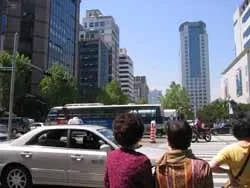
Administratively, Korean cities are divided into municipal districts (called 'ku' or 'gu' depending on the preceding sound) and neighborhoods ('ton' or 'don'). However, as the 'Seoul Herald' reports, this administrative division does not facilitate finding a desired address. In particular, streets in Korean cities mostly have no names. Houses are numbered by districts, many of which are quite extensive. Since numbers are assigned to buildings generally in order of construction, a dwelling with a certain number can be located in any part of the district. Therefore, it is fundamentally impossible to find the right house knowing only its address under such a system. There is little hope of asking local residents: the districts are large, each containing hundreds or even thousands of buildings, and no one even knows the number of the neighboring house.
In practice, when searching for a desired address, help usually comes from a system of external landmarks - some well-known buildings, subway stations, or large shopping centers. Hosts often come out to meet first-time guests at a bus stop or subway station. Therefore, all institutions in their advertisements never consider it necessary to indicate the official address, which is practically useless, instead describing the route to customers based on well-known landmarks in the area, and often provide these explanations with detailed maps.
Now, the address system in Korean cities will be built on the same principle as in most other countries of the world. All roads in the city will be divided into three classes: 'taero' (large avenues), 'ro' (smaller avenues and large streets), and 'gil' (small streets and alleys), and houses will be numbered consecutively: even numbers on the right side of the road, odd numbers on the left. The address will include the name of the city, municipal district (if any), street name, and house number. Residential complexes consisting of multiple buildings will have one number, and the numbering of buildings within them will remain unchanged. The innovation will undoubtedly help tourists in finding museums, attractions, and shopping centers.