
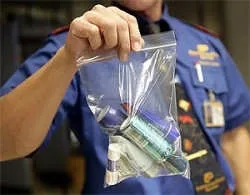
The restriction on carrying liquids has frayed many nerves of air passengers
The news that in just six months passengers will be able to fly from some British airports with any amount of liquid in their hand luggage pleased many. Over two and a half years, the restriction on carrying liquids became a major source of stress for passengers.
Soon travelers will be spared the need to call a flight attendant for a glass of water during night flights, to remember which tube of hand cream can be taken on the road, and to pack baby food in bags. Thanks should go to technicians who, using modern electronic components and radio parts, improved the scanners at British airports. Although each new device will cost 100,000 pounds sterling ($137,500), the expense is worth the comfort: now potentially dangerous liquids will be detected by the scanner.
True, the authorities are in no hurry to announce plans publicly. If a passenger believes the rules have already changed but the new scanners have not yet been installed at the airport, conflict is inevitable. Security staff already encountered this when trying to explain the innovations to outraged travelers in 2006.
In August 2006, large-scale terrorist attacks were prevented on board British aircraft. According to information released by intelligence services, terrorists intended to blow up at least two dozen planes during flight using "liquid bombs." Unprecedented security measures were introduced: passengers were forbidden from taking any hand luggage except for wallets, documents, glasses, keys, handkerchiefs, and feminine hygiene items. To bring liquid medicine, a prescription had to be shown, and baby food had to be tasted. Players, laptops, and mobile phones were banned.
A few days later, the threat level was reduced, and the restrictions were slightly eased. Electronic devices had to be packed in plastic bags, the size of allowed hand luggage bags was greatly reduced, and liquids remained banned. Since, according to intelligence, the terrorists' targets were planes bound for New York, Washington, Los Angeles, Chicago, and Boston, the Americans also introduced serious security measures. However, they sometimes went beyond reason: in August 2006 at New York's JFK airport, passengers could be seen fighting with security for the right to take a tube of toothpaste on a 10-hour transatlantic flight.
By November, the panic subsided, and more or less reasonable rules were developed. Passengers were allowed to bring cosmetics, food, and other necessary liquids in containers no larger than 100 ml. Thus, no one was left without contact lens solution or mouthwash, but using them on board was nearly impossible—sealed bags were not allowed to be opened on the plane.
Many other inconveniences arose, primarily related to purchases in duty-free shops, where travelers often buy alcoholic beverages and perfumes. To prevent airports from losing enormous revenues, special measures were introduced: purchases were packed in special bags, and cashiers recorded the flight number to issue the purchased bottles at the boarding gate. But due to the lack of uniform rules, many passengers simply chose not to bother, which had a negative impact on shop profits.
Additionally, extra staff had to be hired to check hand luggage. At British airports, passengers were given standard-sized plastic bags for liquid containers. This caused outrage among environmentalists, as many stores had recently abandoned plastic packaging in favor of more eco-friendly paper. No scandal ensued. Environmentalists have always called airplanes the most harmful mode of transport for the atmosphere, so the additional complaints were a drop in the ocean.
In Russian airports, similar restrictions were only introduced in May 2007, but by that time Russians traveling to Europe and the US had already experienced all the delights of the fight against terrorism.
The question of whether "liquid attacks" are feasible remained a favorite topic for journalists for a long time. The British incident was called either a terrorist act aimed at intimidation and panic (a version that suited the defendants very well) or, conversely, a means of government propaganda. Eventually, experts agreed that theoretically, "liquid attacks" are possible, but carrying them out requires more than sending an uneducated suicide bomber on a flight; a professional with detailed training in handling explosives is needed.
However, after some time, experts questioned the effectiveness of the proposed security measures. Numerous experiments were conducted, which revealed that if five or six like-minded individuals check in for a flight, they could bring small bottles of chemicals and, following instructions precisely, make a "liquid bomb" right on board the plane. Moreover, the danger lies not only in an explosion that could damage the aircraft's skin but also in a fire that can be started with a much smaller amount of substance. With several fires in different parts of the cabin, only professional actions by the crew can prevent a tragedy.
As Lenta.ru notes, the prospect of British airports dropping restrictions on carrying liquids could be the first glimmer of common sense. Perhaps after this, the European Union will also decide to rely on new-generation equipment and thorough checks of passenger information, after which it will be as difficult to bring ingredients for a 'liquid explosive' onto an airplane as a machine gun and a hand grenade.