
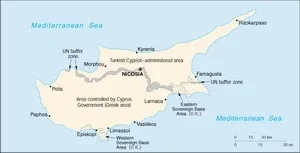
Annan's plan envisaged the formation of a common federal state within which two independent administrations would operate. At the same time, the Greeks were returned part of the territory seized during the entry of Turkish troops to the island in 1974. 86 thousand refugees were given the opportunity to return to their homes. In total, the document ran to nine thousand pages, so the population listened to the opinion of their leaders.
The President of the Republic of Cyprus, Tassos Papadopoulos, called on his fellow citizens to vote against, since repatriation concerned only part of the refugees and stretched over many years, as did the payment of compensation to those who would not be able to return. In addition, Turkish units stationed in the north would not be withdrawn immediately, leaving Ankara with a powerful lever of pressure. Mr. Papadopoulos also emphasized the negative economic consequences of unification. Given the large payments for lost property and the need to bring the north up to the level of the more developed south, unification would have cost 6 billion euros. The EU and the US promised about 2.5 billion euros, the rest would have come at the expense of taxpayers, mainly the more affluent Greek Cypriots.
The president was supported by the church and the largest left-wing party, AKEL. The right spoke out in favor of Annan's plan.
According to the official representative of the US State Department, Richard Boucher, "the failure of the referendum in the Greek community is a defeat for the international community that undermines the hopes of the island's residents who voted for a settlement of the problem." The EU Enlargement Commissioner, Günter Verheugen, called for economic support for Turkish Cypriots, who "should not suffer" because of the behavior of their Greek neighbors. The latter, in turn, not without reason fear that the international sympathy they previously enjoyed will shift to the northerners. Tassos Papadopoulos hastened to state that his fellow citizens voted not against peace, but against the specific UN plan.
The intransigent Cypriots came under strong pressure from the UN, the US and Europe before the vote. The EU transparently hinted that it would like to see a united Cyprus in its ranks. "I hope that the Cypriot people will vote for the UN plan," said British Prime Minister Tony Blair. "We must not miss such a historic moment," warned US Secretary of State Colin Powell. Russia called for the self-determination of Cypriots without external interference. "This is our permanent position," noted Foreign Minister Sergei Lavrov, receiving his Cypriot counterpart Georgios Iacovou in Moscow. The veto imposed by Russia in the UN Security Council on the resolution on Cyprus served the same purpose.
The president of the self-proclaimed Turkish Republic of Northern Cyprus (TRNC), Rauf Denktash, like his colleague in the south, publicly called for saying "no" to unification and even threatened to resign if otherwise. "God bless Russia!" Mr. Denktash declared. "It saved us from disaster. It demonstrated that such immoral months-long pressure is unacceptable." "My main goal has been achieved: Annan's plan is rejected! We saved our republic!" the leader of the Turkish community exulted. With Turkey's support, he called on the world to recognize the TRNC and provide it with financial assistance. Turkish Foreign Minister Abdullah Gül also called for lifting the TRNC from international isolation and lifting the embargo. Meanwhile, a representative of the Greek government, Theodoros Rousopoulos, stated that Athens respects the opinion of the people of Cyprus and is ready to continue working with Nicosia on a solution to the Cyprus problem.
Katerina Labetskaya,
Igor Tarutin.