
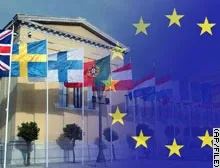
Usually disagreeing even on the simplest issues, the leaders of the 25 member states of the European club showed enviable unanimity. They stated that in the future, countries wishing to join the warm European company must fully comply with the so-called Copenhagen criteria and scrupulously fulfill all conditions of Brussels. Theoretically, this leaves the door to Europe if not wide, then at least half-open. In practice, it means that any candidate can be given so many conditions that its accession to the EU will take place at about the same time as the Last Judgment.
Observers believe that this decision was the result of the prevalence in Europe of the so-called 'isolationist party', led by German Chancellor Angela Merkel. There is just over a week left until Germany officially assumes the duties of the President of the European Council, and the Germans have prepared very thoroughly for this event. From January 1, Angela Merkel is to become not only a kind of 'President of Europe', but also the chair of the G8, so her workload will increase significantly over these six months. It is no wonder that in the last couple of months, top leaders of international organizations have been frequenting Berlin – it is enough to recall the fact that the new UN Secretary-General Ban Ki-moon made his first visit precisely to the German capital.
Over the next six months, Germany becomes almost a central player on the international stage, and its leader – perhaps the most influential woman in the world. It is not surprising that European colleagues hastened to support Ms. Merkel on the main European issue for her at the moment. The latest actions of the European Commission, which suspended negotiations with the Turkish government, also show that in Brussels she will find many allies who believe that 'the ark is full'.
As for the issue of immigrants, the amazing European casuistic style of speech, which EU diplomats have mastered perfectly, manifested itself fully. On the one hand, the leaders of European countries adopted a resolution that points to the 'need to encourage legal migration' (and, of course, this implies fighting illegal migration, the scale of which, by some estimates, exceeds legal numbers by an order of magnitude). On the other hand, the resolution does not say a word about the fact that most 'immigration' countries in Europe have adopted many new laws over the past year that sharply limit the possibility of legal immigration.
One of the results of the new policy was a sharp increase in the number of illegal immigrants. Some European states can no longer cope with this flow on their own. For example, Spain officially asked the EU for technical and material assistance in intercepting hundreds of boats with illegal refugees from Africa, which flow endlessly every night to its shores from Morocco and Algeria. Approximately the same situation is developing in Italy, but the Italian authorities, according to them, are coping for now.
If we look at the results of the Brussels summit, we can assume that soon the European Union will have uniform rules for accepting immigrants. However, until then, each country will have to somehow get out of the situation on its own.
European Union expands to 27
On January 1, 2007, Bulgaria and Romania will join the 25 countries of the European Union. The upcoming enlargement will be the fifth in the history of the EU, but not the last. Next in line are the Western Balkans (Croatia, Macedonia, Montenegro, Albania, Serbia, Bosnia and Herzegovina). The doors of the EU will be open to them, but they will be able to step over the threshold no earlier than 2010 and it will not be easy.
The sixth enlargement will be preceded by strict monitoring of the applicants' legislation and their compliance with EU criteria. European Commission President José Manuel Barroso also emphasized that 'first we must put our own house in order', including dealing with the European Constitution, rejected in 2005 by France and the Netherlands. On eight out of 35 points, negotiations on Turkey's accession to the EU are 'stalled'. Turkey's 'European perspective' will be preserved, but the process itself will stretch for 15-20 years.
When considering all future membership requests, the European Union will also proceed from its own capacity 'to absorb' newcomers, even if they fully meet the community's criteria. This was decided by the EU summit in Brussels on December 15.
Boris ALTNER.
IA Rosbalt