
As the weekly 'Itogi' notes, in our country the bicycle is still considered a whim. They say, a respectable person is suited by a good car, not something dubious on two wheels, on which one also has to strain, pedaling. Meanwhile, in many countries the approach is completely different. Thus, the Paris authorities have for the past several years been pursuing a policy aimed at reducing car traffic. Along with expanding the public transport network, such as buses running on aquazole (diesel fuel mixed with water, much less harmful to the environment) or trams, considerable attention is also paid to the bicycle. For example, the cost of renting a bicycle in the capital of France is today only a euro per day. Therefore, the number of cyclists is also growing. So, according to the Paris mayor's office, from October 2002 to October 2003 alone, their number in the city grew by 36%, with 87% of cyclists riding every day. That, however, is not surprising, given the presence of 300 km of bike paths within the city limits.
Other countries also do not forget cyclists. So, in Holland, where more than 30% of all trips are made by bicycle, the two-wheeled friend has become something of a national symbol. According to stories, during the Second World War, German patrols requisitioned bicycles from the local population, drowning them in the canals. More than sixty years have passed, but the Dutch have not forgotten the expropriation and during football matches between Germany and the Netherlands they chant: 'Return our bicycles!'
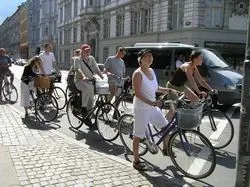
In Copenhagen, one of the world's most bicycle-friendly cities, residents can rent bikes for trips within the city. It costs about three dollars, with most of that amount returned when the bicycle is returned. Our correspondent witnessed a scene that is ordinary for Danes and shocking for us: for an official meeting with a delegation from the Moscow government, the deputy mayor of Copenhagen (a lady) rolled up on a bicycle in jeans and a short top.
And in Japan, the government is implementing a special program involving the construction of guarded bicycle parking near metro or railway stations. The savings are obvious: equipping a parking space for a car costs $12,000-18,000, for a bicycle - $50-500.
Even in such a car country as the USA, the bicycle is winning its place on the roads. In fact, the 'Critical Mass' movement, which advocates for the interests of cyclists, originated precisely in San Francisco in September 1992. It turned out unexpectedly that there are a huge number of people dissatisfied with the dominance of internal combustion engines and unwilling to put up with it. In the same States, some companies, under pressure from the 'greens', began to install showers in offices so that after pedaling, one could wash off sweat and dust.
By the way, many police stations have their own bicycle units, and not only in the USA, but also in Australia, Germany, Iceland, and Canada. The calculation is simple: a police car costs more than $20,000, and its maintenance - $3,000-4,000 per year. For a bicycle you will have to pay no more than a thousand, and for repairs - $100.