
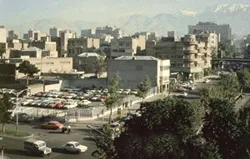
It turned out to be cold in Tehran and there was snow on the ground, so we decided to fly south right away and went to the local airlines in the neighboring terminal. In Iran, planes are a quite affordable mode of transport. Between all major cities there are several flights a day.
I was already wearing a headscarf, which, like all women on the plane, I had put on before the gangway at Tehran airport. In Iran, all foreign women are obliged to look the same as Iranian women, that is, to walk with their heads covered. And not only their heads. Trousers are also not welcome in Iran. On top you need to wear if not a coat or a raincoat, then at least a special robe or a skirt at least knee-length. It soon turned out that this was not the last condition for the existence of the female sex in this amazing country. The local airport has two separate entrances: for men and for women. In order not to pander to discrimination and chauvinism, I followed my friend into the men's entrance. The Iranians on duty at the metal detector did not like this behavior, but it was too late: the doors did not open automatically from the inside. I gestured to the guards not to worry about trifles. But they fussed, quickly found a key, opened the lock and escorted me outside, sternly pointing to the next door. Behind it was the same frame, only nearby, immersed in books with Arabic script, sat ladies in black hijabs and the same black floor-length cloaks.
The ticket offices are also male and female. But they are located next to each other, and because of the large crowd and commotion, buying tickets separately was impossible.
IsfahanThe nearest flight was to Isfahan, which suited us very well. Isfahan and Shiraz are the most popular cities in Iran among the rare foreigners. There is everything tourists need: palaces, gardens, a bunch of antiquities, luxurious Shiite mosques and plenty of inexpensive hotels.
In Isfahan, the locals' favorite place is a wide (for these arid places) river in the middle of the city. When the sun shines, and in Iran it almost never happens otherwise, Isfahanis sit on the bank all day long, have picnics and play cards. The most famous of the ancient bridges across the river is the Si-o-se-pol bridge of thirty-three arches. Inside it, right in the old masonry, there are small carpeted rooms with windows looking out onto the water. There they smoke excellent apple hookah and drink tea with lump sugar.
A fifteen-minute walk from Si-o-se-pol is Imam Square, which guidebooks say is twice the size of Red Square. By Imam they mean the father of the Islamic Revolution, Ayatollah Khomeini. Before the Islamic Revolution it was called Shah Square. All over Iran, next to the huge portraits of Khomeini, are equally large images of his follower Ayatollah Khamenei. Not only do the old men bear almost the same names, they are depicted in the same black turbans and look very similar. They differ in that Khamenei wears glasses and Khomeini does not, Khamenei is alive to this day, while Khomeini has already died. A smaller portrait that sometimes hangs next to the ayatollahs usually belongs to the current president, Mohammad Khatami.
On Imam Square there are fountains and cypresses of bright yellow color. Overlooking the square are the Imam Mosque and Sheikh Lotfollah Mosque, Ali Qapu Palace, and the rows of the ancient bazaar.
The main advantage of the local souvenir and carpet sellers, who in Arab countries usually give you no peace, is that they are rarely encountered. Moreover, like all Iranians, they are educated and impeccably polite. On Imam Square a man came up to us and immediately said that he was a nomad.
“And where are you from?” he asked. “From Moscow.” “Oh, Russia! Dostoevsky, Russian literature!” he exclaimed with such enthusiasm that I wanted to remind him of Griboyedov, who was torn apart by the Persians. But we were also polite and said reservedly: “Oh, Iran, oh, Saadi.” “Saadi is in my heart,” the nomad reassured us and, gesticulating wildly, continued: “Russia, Rinat Dasaev, Leo Yashin…”
We had nothing to say in response. After listing a dozen footballers, our interlocutor made another unexpected transition: “By the way, wouldn’t you like to look at the best carpets in Isfahan?” We didn’t want to and promised to come later. He didn’t take offense and gave us a couple of his business cards. Unfortunately, the word “nomad” was not on them. There was only mention of carpets.
Rarely does a Persian speak English like that nomad. Most of the locals, if they have ever left their country, have done so only once – on the hajj to Mecca, and most have never been anywhere, so foreign languages, by and large, are of no use to them. Besides carpet merchants, women driving Iranian-assembled Peugeot 206s, hotel porters, and non-Muslims can say a few words of English in Iran. There are very few of the latter, and they live in separate quarters that stand out among the rest of the streets for their cleanliness. In Isfahan this is the Armenian district of Julfa. Behind thick stone fences there are many Christian churches. They are architecturally similar to mosques and are rarely open.
ShirazPlanes and buses travel from Isfahan to Shiraz. We chose the latter. The seven-hour journey lay through a mountain pass. Up in the mountains there was sleet. In Shiraz the oranges were ripening. Besides innumerable and very beautiful gardens and parks, this city is known for the mausoleums of the Persian poets Saadi and Hafez, the ancient Persian city of Persepolis located nearby, and the ruins of even more ancient Pasargadae. In them the entire school course on the history of the Ancient World lies before your eyes.
Persepolis was built by Darius the Great and was completed under the other Dariuses, Xerxes and Artaxerxes, until Alexander the Great tore it apart. Fortunately, not completely. Behind the colonnades, gates and reliefs in Persepolis one can discern the outlines of palaces and temples. Much less remains of Pasargadae. There the main things are the tomb of the conqueror Cyrus the Great and several Old Persian inscriptions from the same period.
Few local residents can clearly explain that to get to Persepolis (Iranians call this place Takht-e-Jamshid) from Shiraz you need to take a bus to the town of Marvdasht, and go the last few kilometers by taxi. From there you also have to catch a car for about ten dollars to Pasargadae, and then in the same car through Naqsh-e Rostam (tombs of Persian kings carved in the mountain, including Darius) and Naqsh-e Rajab (just ancient bas-reliefs on the rocks) return back to Marvdasht.
Self-Flagellators
When we were in Shiraz, something incomprehensible was happening there. With the onset of darkness, small demonstrations began to move through the streets. People sang unmelodious songs and beat large Yamaha drums, slightly reminiscent of Krishnaites. By nightfall, the strange celebrations had gained momentum. Demonstrations began to gather near mosques. Trucks appeared with banners written in a much more intricate Arabic script than is usually found. Traffic was blocked in front of mosques, speakers were dragged there and microphones connected to them. Measured drumming and dreary songs could be heard from everywhere. Every shop had a TV on. From there they also sang and beat drums. In the hands of people in the center of processions appeared objects resembling brooms tied from iron chains. They waved these things and, in time with the drumbeat, lowered them onto their backs, though rather carefully.
Only men took part in these conventional self-flagellations. Women dressed in black stood on the sidewalks and watched them carefully. We managed to find out what it was only at the hotel. We asked the porter what was going on, and to make it clear, we showed how the drum was beaten. He understood immediately.
"You know, there was such an Imam Hussein. He was killed. This is ‘bdysh-bdysh’," — here he also showed how to beat the drum — "it will be five nights before the day of the killing and five after."
The Shiites paid tribute to the memory of Imam Hussein very diligently. Soon we were told what the iron whips meant. The unfortunate imam was beaten to death with the same ones a thousand years ago. When the Iranians participating in mourning events were not flogging themselves with a whip, they beat their chests with their fists in the same rhythm. This meant that the imam is always in their hearts.
Local channels showed Shiites flagellating themselves in mosques from morning to evening. The news had live broadcasts. Some beat themselves until they bled, some cried. On the streets, by the way, they did not beat themselves to blood and did not cry. If there was a TV in a cafe or at a train station, there were always several people who watched these procedures of honoring Imam Hussein with interest.
Bandar Abbas
From Shiraz we went to Bandar Abbas, the largest Iranian port city on the Persian Gulf. The flight turned out to be a night one, and upon arrival it unfortunately turned out that all hotels of acceptable quality and price were occupied. It was well past midnight when we started hailing a taxi near another hotel where there were no vacancies, when suddenly a car stopped on the other side of the road, and from its window they shouted to us:
"Don't worry, I know English and I'll help you now."
There were two people in the car. The one who spoke English was named Toraj. Upon learning that we were from Russia, he said that it would be better if we were from Kyiv. The guy had studied for several months in Kyiv at an American business school and witnessed the beginning of the Orange Revolution, which he really liked. Probably, in the city of Bandar Abbas, he was the only person from whom one could hear the word “Yushchenko”.
Behind the wheel was the driver of his father, a shipowner. The next day, Toraj showed us two of his father's ships that had cast their nets a few kilometers from the shore. He himself ran a separate business: selling televisions in Iran brought from the Arab Emirates. But even for Toraj, finding a hotel in Bandar Abbas that night proved difficult. He had to use his dad's connections. My friend Roma was introduced to the porter as the captain of a fishing vessel, who under no circumstances could be left without a roof over his head.
Bandar Abbas lives its own separate port life and has little in common with the rest of Iran. A lot of Indians wander around the city; in the port, Afghans live in camps, who get something from customs. Many locals, especially on the islands, are not Shiites but Sunnis, as evidenced by the modest gray-stone mosques. Because quite a few Arabs live here, the local population speaks a wild mixture of Farsi and Arabic, which ordinary Persians have difficulty understanding.
The next day, Toraj took us to Qeshm Island, from which the three of us returned on a real wooden steamer packed with all this motley crowd. Two men sat down in front of us, both with equally short haircuts.
"Look, they are from Hezbollah," Toraj said immediately, without lowering his voice and being sure that no one else would understand him. As it turned out, he recognized this by the fact that our fellow travelers' beards were, in some special way, either shaved or trimmed.
"What, outright terrorists?" I was surprised. This was not entirely diplomatic. Only Israelis consider Hezbollah terrorist, and in Iran they are supposedly supposed to be fiercely hated. But Toraj seemed to be of the same opinion.
"The terrorists are in Lebanese Hezbollah. Ours is calm," he said.
Here, apparently interested in the conversation, the men with identical beards turned to us and started a conversation through Toraj. Hezbollah was interested in three things: how Orthodox differ from Catholics, to what percentage we believe in Paradise, and whether Alexander Mostovoy would play in the European Football Championship.
"You didn't accidentally tell them that you don't go to the mosque?" I asked Toraj when the Shiites turned away again.
The fact is that in schools, children who do not go to the mosque are beaten with sticks, because that is what the Quran says. Girls have it even worse, because the Quran also says something about mandatory headscarves, which in Persian are called “rusari,” and about robes (“mantu”). If a girl comes to school without a headscarf, her parents will be fined, and until they arrive, the girl may be taken to the police. In general, many in Iran understand that the Shia and Hezbollah in power are the Middle Ages, but few want any kind of coup to happen. Toraj, for example, would be sorry to lose his televisions.
Train. Olivier Salad
Leaving Bandar Abbas, we found ourselves in a completely idiotic situation: having just arrived from the island of Hormuz, known for its well-preserved Portuguese castle from the Age of Discovery, we suddenly learned that the bus we planned to take that evening to the city of Yazd did not exist at all, and we were already very late for the only train. At the station, where we ran in maybe five minutes before departure, a new surprise awaited us – there were no tickets for that only train.
But then some things began to happen that were wonderful for the usual Iranian unhurriedness. Someone very quickly found a ticket distributor, who decisively said that getting on this train was already impossible. We firmly stated that we really needed it, without any real hope. Then he took us to the main woman at the station. The same thing happened with her. Meanwhile, between her saying that we couldn’t get to Yazd no matter what and her deciding to take us to the train chief, half a minute passed. But the most “terrible” thing was ahead. The train chief stood in the middle of a crowd of other ticketless passengers, who were all vying to tell him the same thing we were about to say. What was truly impossible was getting to him. But then one of our companions squeezed closer to him and shouted a phrase from which we only made out the word “khoriji” – in Persian it means “foreigners.”
“Khoriji onto the train,” the train chief commanded without looking at us, and pointed to the vestibule. We got on. The train started moving. A thought flashed that the train was about as chaotic as the mess that got us there. But no, it was a normal train of a dozen cars, with clean vestibules and separate compartments. Or rather, an almost normal train. An hour and a half after departure, it suddenly stopped at some wayside halt. There was no city or village around – only a one-story brick building that turned out to be a mosque.
The entire long-distance train, with its schedule and several hundred passengers, stopped near this mosque for the evening prayer. People streamed out of the cars into the brick house. The Iranian railway had never seen such stunned ticketless passengers as we were at that moment. We didn’t sit in the vestibule for long – we were immediately invited into the nearest compartment. As guests. Six people were already there: in Iranian trains, instead of third shelves for luggage, there are regular sleeping places. A man named Muchtapo and his wife knew English quite well. They translated the conversation for everyone else. In general, everything was not as it should have been on the Bandar Abbas–Yazd train. It was like the Moscow–Sevastopol train. Everyone took turns going to the conductor for tea with glass holders. We showed the Iranians photos on a digital camera. The Iranians looked at all three hundred of them. Then they spent a long time telling each other jokes. They couldn’t translate them for us, but they laughed a lot themselves. Then our fellow travelers began to unwrap bundles of food. Muchtapo’s wife treated us to salad. The taste seemed familiar.
“We call this o-li-vie,” she said slowly. We said that we do too. The Persian Olivier had the same ingredients as the Russian one, including one item whose English name Muchtapo’s wife could not remember and said in Persian. It was kol-ba-sa.
Hassan and his wife Mulikhe, who were sitting by the window, decided to go to sleep and said they would give us one of their bunks, and they would both fit on the other. But then the train chief came. He didn’t let us sleep on one bunk and took us to his compartment. In the morning he took from us exactly the amount that the tickets would have cost. The other ticketless passengers slept in the dining car.
Yazd. Chak-chak Sanctuary
Yazd, where our train arrived in the morning, is known for its adobe Old City and “wind towers” – part of a complex air-cooling system that has survived since ancient times. It also involves so-called “qanats” – something like burrows in the stony ground through which the Persians channeled water accumulating in the mountains down to the city. In the Soviet film “Tehran-43,” a fascist agent played by Armen Dzhigarkhanyan used qanats to prepare an assassination attempt on Stalin, Roosevelt, and Churchill during the Tehran Conference. In Yazd, the Water Museum is dedicated to all these plumbing and air-conditioning tricks.
This city is also interesting because about two thousand of its approximately three hundred thousand residents are Zoroastrians. Not far from Yazd in the mountains is one of their main shrines, called Chak-Chak. When we got ready to go there, a girl from our hotel’s front desk named Mitra asked to come with us. She was a Zoroastrian, and her religion required her to go to Chak-Chak as often as possible.
If viewed from the foot of the mountain, the Zoroastrian sanctuary looks like some southern Soviet sanatorium. When you climb the stairs, it turns out that among the small brick buildings of modern appearance, where Zoroastrians from all over Iran gather for Nowruz, there is a cave. Behind the copper gates burns the sacred fire, which, they say, has been maintained for more than two thousand years. When we climbed up there, an unreliable-looking old man in a torn sweater and crumpled trousers was watching over the flame. From the outside, it didn't look like he could be entrusted with such a shrine. Our fire-worshipper went to the bookcase in the corner of the cave and took from there the Zoroastrian sacred book, the Avesta. Taking her for a tourist, the old man tried to take it away, but quickly understood everything and again stood by the fire, stirring the ashes. Mithra sat for about ten minutes on a bench before the flame, whispering fire-worshipping prayers.
In Yazd, she took us to a Zoroastrian temple built not long ago by a wealthy Iranian fire-worshipper. A fire that had been burning for only fifteen hundred years was brought there. Generally, the temple is almost always closed to outside visitors. Mithra led us around. If you approach the stone fence from the other side, there is a small gate for local Zoroastrians, who can walk through it to pray whenever they wish.
Then the fire-worshipper invited us to visit. At home were her fire-worshipper husband, his fire-worshipper parents, and a five-year-old daughter, who for now, because of her age, was not considered a fire-worshipper. At first, the life of the intelligent family of fire-worshippers seemed quite ordinary. They lived in the Zoroastrian quarter, went to Zoroastrian schools as children, knew the Pahlavi language, in which their sacred books are written, watched satellite television, and together worried that they, representatives of the most ancient religion, had only one seat in parliament in the homeland of this religion.
But then Kamran came. In this family, he was the one in charge of religious matters. Kamran immediately invited us to his place. His house resembled the Pushkin Museum in Moscow, only in miniature. There was a hall, stone floors, a small mezzanine, and little columns. In the most prominent place hung the main Zoroastrian symbol, half a wall - something like a bird with three rows of feathers. These rows signified the Zoroastrian commandments: not to do evil, not to think evil, and not to speak evil.
Then Kamran lifted his sweater and showed us the special underwear that fire-worshippers are supposed to wear - a linen shirt tied at the waist with a cord. It is supposed to be tied with four special knots, each of which also means something important for Zoroastrians. The second one at the back, for example, symbolized peace.
The Shiites in Yazd turned out to be just as hospitable. We got to them completely by accident, just walking through the old city. Amid the chaotic buildings, a huge tent was spread out in the inner courtyard, where a large Shiite family who had gathered for the holiday from different parts of Iran was going to celebrate the anniversary of Imam Hussein's death that same evening. We were seated together with everyone on the carpet, and tea, apples, and oranges were brought. Only one girl - a student at Isfahan University - knew a few words of English. She immediately asked:
— Do you love Imam Hussein? We politely replied that in our homeland, unfortunately, little is known about him. The girl apparently did not believe this surprising thing and decided that we simply did not understand her.
— Do you think it is right that during the month of Imam Hussein's death we walk around all in black?
That already seemed completely wrong. By that time, I had more than once asked myself why from morning to evening I had to carry a headscarf and a black robe. The only consolation was to think that Iran is simply planet Pluk from the famous movie "Kin-Dza-Dza". Pluk is a Chatlan planet, and we, the Patsaks, must wear tsaks. So that we wouldn't be transclucated. The Shiites suggested we come in the evening, when the commemoration of Imam Hussein in their tent would be in full swing. We did not dare.
Tehran. Day of Closed Doors
It would have still been possible to awaken in us kind feelings toward Imam Hussein, had we not come to Tehran. We had been warned in advance that it is a normal capital and we would find no exoticism like the ancient narrow streets of "Tehran-43". But on that morning when we arrived in this city, it was not a normal capital. The day was beginning when Shiites remembered Imam Hussein with particular fervor. Everywhere people were walking and flogging themselves with whips. On the central avenues there were puddles of blood - there had just been a sacrifice. Two sheep were about to be slaughtered by the Shiites right in the diplomatic quarter opposite the Italian embassy. All museums, all shops, all cafes and indeed everything was closed on the occasion of the celebrations.
When we wanted to eat, we found nothing better than to catch a taxi and explain our problem to the driver. Finding somewhere to eat turned out to be a difficult task for him too. After making several circles around the center, he suddenly stopped near some cafe. It was also not working, but through the glass wall it was visible that someone was inside. Our driver got out of the car and, pointing at us, began to explain something. Then he came back and helplessly spread his hands. But when we were already about to drive on, a waiter ran out of the cafe, climbed into the trunk of his car and took out a stack of plastic boxes with some kind of fast food. He caught up with us and silently shoved all of it right through the open window. He did not take money. Inside was chicken pilaf.
Then it was the driver's turn. He generously and mostly with gestures explained that he would now take us for a free ride around the city. We made it clear that it didn't have to be free, but the driver waved his hands. First he drove somewhere to the outskirts of Tehran to show a street where many restaurants are open on ordinary days. He called them wonderful. The street was very dirty. In the middle of the road, on its back, with a bloody wound on its throat, lay a freshly slaughtered cow. Then the driver let us take turns driving his car - an old locally produced Khordo. Then he drove to a mosque, where everyone who loves Imam Hussein was treated to tea, tangerines, and, for some reason, cucumbers.
Of a normal capital, there was one thing in Tehran that day – the metro, although on that day, songs about Imam Hussein could also be heard from loudspeakers at all stations. The metro was built about twenty years ago, but Tehran residents still feel like discoverers. If you ask an ordinary Tehran resident where the metro is, he will silently point down, right at the asphalt. At that moment, his face will reflect a feeling of restrained pride for his country, which is familiar firsthand with this wonder of the world. Since ordinary Tehran residents, as a rule, speak only Farsi, it is extremely difficult to get them, using only English, to then show the way to the station.
Everyone who boarded the plane flying from Tehran to Moscow seemed a little pleased to meet each other, although, of course, they were complete strangers. Having climbed up the gangway, all the women, without exception, including Iranians, did the same thing – took off their headscarves. It was doubly pleasant to stuff the Iranian robe into a backpack.
- Casual dress! – someone from the nuclear specialists loudly commanded.
Maria TSVETKOVA, Gazeta.Ru