
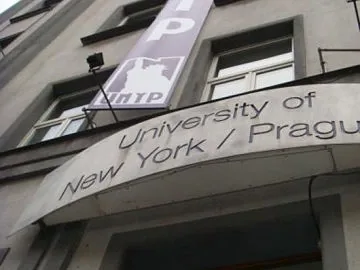
At New York University in Prague, students can study under European or American programs
One of the most reliable ways is to obtain a diploma with a master's or bachelor's degree by studying in English. For this reason, more and more universities, both private and public, are offering programs in English.
New York University in Prague is one of the few educational institutions that teach exclusively in English. Its rector, Andreas Antonopoulos, told Radio Prague more about this:
“We have fewer than a thousand students; the exact number depends on how we count those participating in international programs. Compared to Czech state universities, our institution is relatively small, but as far as I know, we are the largest educational institution in the country that teaches in English.
As for where our students come from, it is a true multicultural paradise. We have young people from 65 countries, and no major regions stand out except, of course, the Czech Republic. However, the number of local students is lost against the rest of the diversity, making up about 30 percent of the total.”
Explaining why New York University in Prague, which celebrated its twentieth anniversary this year, was established here, the rector adds: “Prague is a convenient, safe, and undoubtedly one of the best places to study. Specifically, it is worth noting the standard of living, the international character of the city, ample job opportunities after graduation, and safety, which is important for both students and their parents.”
Currently, majors related to business are very popular among students, but some, like Vladislav Kulikov, choose other fields.
“I am a psychology student, studying here for the fourth year, but I haven't decided yet whether to continue my master's studies here. Among private universities in Prague, New York University is one of the best options. According to many, the teaching here is at a higher level. Most of our teachers are Czechs, but there are also Americans among them. Some teachers from America come only in the summer to conduct a few seminars.”
A whole stream of medical students study in English at Charles University. Deputy Dean Professor David Sedmera told Radio Prague more about this program:
“Citizens of other countries who speak Czech can, of course, study in the Czech program. But the opposite also happens. For example, currently in the English department we have three Czech students who graduated from school abroad or lived there for some time with their parents, and therefore could not study in Czech due to their limited vocabulary.”
The reasons why students choose to study medicine in the Czech Republic vary. In some cases, it is due to the small number of educational institutions and the difficulty of entrance exams, and in others, thanks to a well-developed network of scholarship programs.
“In the English stream, we have students from 62 countries,” says David Sedmera. “Among the countries that represent about 50% of our students, Israel is first, followed by the United Kingdom, then Germany, and in fourth place is India.”
In total, 720 students came to the Czech Republic this year to study in this program. The First Faculty of Medicine of Charles University has a worldwide reputation, the deputy dean reminds:
“The diploma in English fully corresponds to the Czech education system, but if these specialists want to practice here, they will need to provide a certificate of Czech language proficiency at level C1. When students ask me where they can work after graduation, I answer: anywhere in the EU, but you will have to learn the language of the country where you decide to work.”
Studying at home in English is much more convenient, many Czech students note, but not all of them choose such programs. The main obstacle is that such education, with rare exceptions, is paid, while education in the native language is completely free. Therefore, many choose an alternative solution: writing their thesis in English or studying in a Czech program with a large number of subjects taught in English.
Student Kati Megrelishvili, who was among such students and recently received a master's degree in economics, shared her experience:
“I studied at Charles University, Faculty of Social Sciences (FSV) at the Institute of Economic Studies. Actually, it was a Czech program, but almost all subjects were taught in English, and ninety percent of the students were Czechs. I really liked our lecturers, but studying was very difficult.”
Given that the instruction was in English, were there enough exchange programs? “Yes, we had programs, but there was very high competition, and you had to win to go somewhere.”
The University of Economics also offers a wide range of programs in English, but there too, it is possible to choose the language for the final thesis, regardless of the language of instruction. Tamar Balgiashvili, who recently successfully defended her master's thesis in English, explains her choice:
“I chose to write my thesis in English because I think it will help me in my doctoral studies and in my future career. I approached the faculty with this proposal myself. The thing is, a year or two ago the rules became stricter. If a student is studying in a Czech program and wants to write a thesis in English, they must publish an article in a peer-reviewed foreign journal that meets the necessary criteria, or their thesis supervisor must be a foreigner working in the Czech Republic.
Writing a thesis under a supervisor living abroad involves additional procedures. Thus, not every student will take this path. I can say that the policy of our faculty does not support writing such works.”