
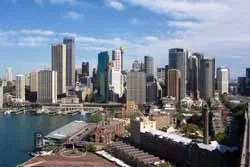
Today Australian educational institutions are becoming some of the most sought-after in the world. As Expert notes, more than 180,000 students from the USA, Canada, China, Southeast Asian countries, France, and Scandinavian countries study here. According to the Ibisworld Industry Report, international students now make up a quarter of the total number of students at Australian universities, and this indicator is increasing by 8-10% per year.
Demand for Australian education is constantly growing; in particular, according to the Australian Immigration Service, the flow of students from Eastern European countries has increased over the past two years. This is largely due to the low cost of tuition and living compared to other English-speaking countries. The average tuition fee is $7-8 thousand per year (in the UK, for example, a student would have to pay one and a half to two times more). However, the range of prices for tuition and living is quite wide. For example, the cost of living in a small town somewhere on the northeastern coast is almost half that in Sydney. By the way, the Australian education services market as a whole is characterized by a fairly low degree of concentration: the country's largest universities are the University of Melbourne, the University of Sydney, the University of New South Wales, and Monash University; moreover, if we take into account the number of students, the share of each of them in the education services market will not exceed 6-7%.
Another positive factor in the development of education in Australia is the country's 'exoticism,' combined with living conditions familiar to many. After all, Australia is, in essence, European traditions and living standards transplanted to a distant continent, developed on fertile land inhabited by unusual animals and plants, in a comfortable climate.
The low price of educational programs in this country does not come at the expense of quality. Australia has a strict system for monitoring the quality of education at universities and schools, carried out by the Ministry of Education. Every year, educational institutions across the country undergo certification. Those that do not meet the requirements are stripped of state accreditation - the so-called Cricos Code, which gives the right to accept international students.
Strategic approach
Such an approach is understandable: education has become one of Australia's most important sources of income. Year after year, it ranks third or fourth on the list of industries that are the country's main sources of income (for example, in the 2004-2005 fiscal year, the industry brought in over $15 billion). The number of universities also testifies to its prosperity: 47 public and two private universities. The country has many colleges of further education (the so-called TAFE), which play an important role in the Australian education system. The colleges offer short programs in technical and business education, which make it possible to start working in one's specialty after just one or two years of study.
In addition, TAFE colleges provide our compatriots with admission to Australian universities: they compensate for the lack of a twelfth year of schooling, which often becomes the main obstacle for our schoolchildren when entering universities in other countries. Another way to overcome differences in education systems is to enroll in a university preparatory course (Foundation) or spend a year studying English at a language school. However, the Australian authorities are favorable to students: it is one of the few countries where a student visa gives the right to work, and a student can work up to 20 hours per week (it is unlikely to be able to devote more time to work, since the intensity of study is very high).
But the intensity of the curriculum at Australian educational institutions means that the duration of study in Australia is shorter than in other countries. For example, the average bachelor's program is designed for only three years, and a master's program for one to one and a half years. Accordingly, the cost of staying in the country is reduced, and, as Anna Voznesenskaya, director of the educational agency IQ Consultancy, told Expert in an interview, this factor is very important for students intending to receive education in the field of business or an MBA degree. It is often this that makes young businessmen prefer Australian business schools even over US Ivy League universities.
'The geographical position and nature of Australia have had a significant influence on its education system: its remoteness from other continents forced the development of engineering specialties, aviation and shipbuilding. Australians explain their successes in specialties such as ecology and marine biology by the proximity of the Great Barrier Reef. The rapid development of information and computer technologies in this country can probably be explained no differently than by the desire to compensate for the continent's once-existing isolation from the rest of the world,' says Anna Voznesenskaya.
And also recreation
However, you can come to Australia not only for educational purposes. This distant continent is extremely interesting from a tourism point of view, especially for lovers of exotic travel. The country's tourism industry, having experienced some decline in 2001-2002 (as a result of the general downturn in the global market after the events of September 11 and the terrorist attacks in Bali), has begun to develop again, especially in 2004-2005. Last year, the industry's turnover amounted to almost $2.5 billion, which, although not by much (by 1%), is still higher than the year before. Tourists mainly come from New Zealand, Great Britain and Japan, but the number of our travelers is also growing year by year.
According to representatives of the Australian Tourism Commission, they are attracted by developed infrastructure, exotic flora and fauna, untouched pockets of wildlife and hospitable cosmopolitan residents. Among the most popular tourist programs are diving (including on the Great Barrier Reef, where diving equipment and experienced instructors already await clients), excursions to wild areas of the country, visits to the jungle, safaris. Among Australia's main attractions are Kakadu National Park, Kangaroo Island, the Red Desert (which contains, in particular, reddish-brown monoliths and other rock formations), the 12 Apostles rocks, the Great Barrier Reef (a natural wonder the size of Great Britain and Ireland combined, comprising more than 1,000 islands), and the island of Tasmania, whose nature combines tropical forests and alpine heathlands.
Of course, the largest cities - Sydney and Melbourne - are also interesting. On the one hand, there are bright cultural and architectural attractions; on the other, the active social and nightlife of Australian metropolises amazes even residents of New York. Finally, the country's wine regions are popular - most wineries can be visited to see how Australian wines that have won worldwide fame are created.
Contrary to geography
The head of the international relations development department of the country's Ministry of Education, Oliver Simmonson, also explains the rapid development of education in Australia by the desire to enter the global space: "Australia strives to get closer to the rest of the world through education. Over the past ten years, the government has set our Ministry the goal of internationalizing Australian education, and today the results of this educational policy are already visible. Australian educational institutions cooperate with many countries. In the education department in Canberra, about a hundred people are engaged in international educational programs, and department staff work in many other countries."