
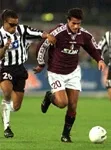
Perhaps that is why the news of Latvian businessman Alexander Basharin's interest in Italian Torino did not become a front-page story. Well, Torino is Torino, a Latvian is a Latvian — we have seen worse, they say.
The first reports of Basharin's interest in Torino appeared in the media in the spring of last year. The investor himself commented on the situation as follows: "This process is at the negotiation stage. It is not yet complete. Therefore, I cannot provide any information on this matter. My partners, people from Italy, Latvia and Russia, are doing exactly the same." In short, Basharin did not deny the news, but he was in no hurry to confirm it. This was probably not least because around the same time, negotiations between serious Russian investors and the well-known Italian clubs Roma and Parma, which had practically been on the verge of completion, fell through. Negotiations also stalled regarding the Turin club. True, it is predicted that they will be able to be completed this spring.
Torino, one of Italy's oldest football clubs, was founded in 1906. The Turin side have been champions of Italy seven times and have won the national Cup five times, but recently Torino have seen a decline. The team plays in Italy's second division, and their last success (in the Italian Cup) dates back to 1993. According to information from potential buyers, Torino's annual turnover is about €35 million. The sum for which the current owners would agree to sell the club to Basharin and his partners is approximately €50 million. The Latvian businessman himself believes that about €35 million will have to be invested in the reconstruction of the stadium. He probably knows what he is talking about, since for several years he has headed the recently created football club Jurmala, which quickly broke into the elite of Latvian football. Experts claim that Jurmala's budget was the largest in the first league and even exceeded the capabilities of a number of teams from the elite division.
Alexander Basharin is a 53-year-old deputy of the Jurmala City Council, where he heads the development committee. He has done boxing, at one time worked in Kyiv, has long been involved in real estate, belongs to the circle of the richest residents of Jurmala and is among the most affluent citizens of Latvia. At the end of last year, he was accused of "living beyond his means." The Corruption Prevention and Combating Bureau, while checking his income declaration, found that Basharin's expenses exceed his income, which, you will agree, is unnatural. However, the bureau refrained from further comments, as it awaits the final results of the State Revenue Service's inspection.
Basharin's name also surfaced last autumn in connection with the high-profile murder in Riga of Ukrainian businessman Alexei Zharov. It turned out that the latter was a co-owner of OOO Jurmalas perle and a business partner of the Jurmala City Council deputy (each owned almost 33% of the company's shares). And in the updated list of the richest people in Latvia, Basharin's name was not found. The compilers of this rating based their conclusions on the fact that the businessman's legal income is not so great.
Some publications even managed to joke about the possible purchase of Torino by Basharin. They say that even Jurmala is difficult to maintain with the funds he has, let alone a team from Italy. But more sensible authors do not forget to emphasize that the purchase of Torino is not the work of Basharin alone. He has partners - perhaps even much richer ones - who do not want to be in the spotlight. In this case, Basharin acts as a manager. Or maybe the Latvian entrepreneur is looking for an opportunity to legalize his shadow income... The situation is confusing, but it seems that matters are coming to a head. At least, that is how both Basharin himself and representatives of Torino spoke about the spring of 2005.
"We have covered a considerable part of the distance," the businessman comments on the situation. "But it is premature to say that we are about to shake hands on it. Also, there is no guarantee that some competitor will not suddenly appear with an offer whose price range will outbid ours. Moreover, I am not personally going to acquire the Italian club, but together with entrepreneurs from Russia, Italy and Latvia. You could say that in this team I am in charge as a project manager.
We are interested in this deal and have certain plans for it. We are counting on Torino's return from Serie B to the company of their more successful Turin neighbors from Juventus. A club that has won the Scudetto seven times and enjoys enviable fan support is far better suited to competing with Milan, Inter, and Juventus itself than to floundering in Serie B. Moreover, in 2006 Torino will turn 100 years old, and such a respected anniversary should, of course, be celebrated while being among the contenders for the Scudetto.
Why would I, a real estate specialist, need a football club? Everyone will have to take my word for it that I do not consider football a business. It is a hobby. And a very pleasant one."
From information from the Italian side, it is known that the financial injection should be very timely for the club. Recently, Torino has been experiencing serious economic difficulties. And as a consequence, there are problems on the field, which have led to the team being in the middle of the table in Italy's second-strongest division. Basharin's representative Carlo Piazzola (a FIFA agent known for his work with the football clubs Roma and Udinese) tried to calm the excitement that arose among fans and journalists. He stated that his patron does not yet intend to repeat the Chelsea scenario and stage a personnel revolution at Torino.
"The sum named by Basharin will be directed to the financial recovery and improvement of the club's structure. Torino's debts will be paid off, and the implementation of the program to build a new stadium will begin," Piazzola stated at the beginning of this year.
The journalists also asked what the Latvian businessman knows about Torino. Basharin said the following: “When we flew to Italy with Jurmala for a training camp, I started looking for partners to exchange experience, players and ideas. I was advised to contact Torino. It is a well-known club with a solid past. It has about a million fans. They say that half of the Italian parliament supports this team.”
Of course, I have heard about the tragedy of 1949, when the brilliant Torino team crashed in a plane crash while landing in their native city. I have happened to visit the basilica built on the site of the tragedy. It seemed to me that buying Torino could activate contacts between Turin and Jurmala. Not only in sports. For me, as chairman of the Jurmala development committee in the city council, this is important.
I am not embarrassed that Torino is going through hard times now. The previous owners made several serious mistakes, and the worst of them was offensive statements against the fans. In Italy that is not forgiven. All this could not but affect the atmosphere in the team. In general, in such a situation, a change of leadership usually occurs. After the “process started”, the fans’ interest in the team immediately revived. That, in turn, became a stimulus for the players and coaches. Changes in financing should also pay off. All this is done to raise Torino’s popularity - a club with such a rich history cannot die in the lower divisions.”
Aleksandr Basharin complained that a lot of time was wasted due to the poor work of an interpreter. There was also no progress in negotiations due to the sluggishness of the current Torino owner Francesco Cimminelli. He supposedly took too long to decide on the amount and the list of property put up for sale. The Latvian businessman does not rule out that Torino could be headed by one of the domestic coaches, as well as the appearance in the team of players from Latvia or Russia.
And to the question of how Italy reacted upon learning that a foreigner was going to buy Torino, he answered: “Positively. Fans are hanging banners at the stadium with the words: “Basharin! Come quickly! We are waiting for you!” In Turin there was even a 15,000-strong demonstration in support of the sale of the club. Legal difficulties? There were none. Italian Prime Minister Silvio Berlusconi spoke in favor. As for other clubs, I like the Torino option much more than Roma. Roma has debts of €500 million! With Torino you can even make money. But first you need at least to bring the balance to zero.”
ROMANOV SETTLES IN HEARTS
“Zagranitsa” has already informed readers about the purchase by another Baltic businessman, this time Lithuanian, Vladimir Romanov, of one of Scotland’s oldest football clubs - Hearts from Edinburgh (only Rangers from Glasgow is older). True, a lot of time has passed since the article about the upcoming purchase was written. Accordingly, the situation has changed.
Having become a shareholder of Hearts, the Lithuanian businessman did not stop there and continued the “hunt” for the club’s shares. He owned almost 10%, and sought to reach the level of 30%, after which, according to the existing rules of the stock exchange, he would have the right to buy out all the remaining shares. After the share issue was carried out, in February Romanov bought another 19.6% of shares and became the largest shareholder of Hearts. But he lacks very little to the figure “30” - 0.095%. Nevertheless, it is the Lithuanian businessman who now controls the activities of the club, which occupies a place in the upper part of the standings of the Scottish championship. Let us recall that Romanov is also the owner of the Lithuanian club Kaunas (the national champion) and the Belarusian MTZ-RIPO.
One of the main goals Romanov proclaimed was to increase the number of Hearts fans to at least the number that Celtic or Rangers - the leading Scottish clubs - have. To do this, the owner of the controlling stake wants to invest the necessary funds in Hearts’ infrastructure, in particular in expanding the stadium.
Last autumn, the businessman promised that if he gained control of Hearts, he would invite the famous Soviet coach Anatoly Byshovets, who won the 1988 Olympic tournament with the USSR national team, to the post of the club’s sporting director. In the meantime, Hearts has taken two Kaunas midfielders on loan until the end of the season - Mikoliunas (a Lithuania national team player) and Kizhis. Another Lithuanian, Skerla, previously played for the Edinburgh club, and in winter another Lithuanian national team midfielder moved to Hearts from Moscow’s Lokomotiv - Chesnauskis (Deividas, the elder brother of Dynamo Kyiv player Edgaras, also a Lithuania national team footballer). It is curious that the Scottish media spread information that Anatoly Byshovets selected about two dozen footballers from Eastern Europe for Hearts.
Anatoly Fedorovich himself, a native of Kyiv, a product of Dynamo and one of the best forwards in the history of Ukrainian football, emphasizes that until the decision of the Hearts shareholders to appoint him to the post of the club’s sporting director, he works at the International Football Development Fund.
“This organization was created at the bank of Vladimir Romanov and is headed by him. Under the wing of this organization are Lithuanian Kaunas, Minsk MTZ-RIPO and Hearts. I hold the post of general director and carry out work on organization and control of the result. Kaunas and MTZ-RIPO have different tasks: the Lithuanian team is fighting for the championship, and the Minsk team needs to stay in the top league. The only common problem is poor infrastructure. Hearts does not have this: it has a wonderful academy at the university with artificial fields and indoor arenas. I would like Hearts to intervene in the fight for first place and disrupt the hierarchy of Celtic and Rangers.”