
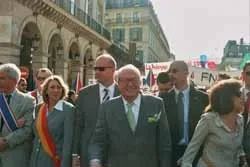
The last time nationalist parties were represented in the European Parliament was from 1989 to 1994. Their faction was called the 'European Right' and at that time united only two political organizations – the National Front of France and the German Republican Party. The parliamentary group was led by a then not very well-known right-wing politician Jean-Marie Le Pen.
After that, for many years the representation of the right in the European Parliament was so small that they could not create a faction, since the minimum threshold for this is 20 deputies. However, on January 1, 2007, Bulgaria and Romania officially joined the European Union, whose nationalist parties had long been negotiating with their European like-minded counterparts to create a parliamentary bloc. Moreover, the right-wing radicals, who are traditionally represented in the European Parliament as so-called non-attached deputies (for example, from the Italian 'Tricolour Flame' and Social Movement), also managed to reach an agreement with the others and act as a united front.
As expected, the head of the National Front of France, Jean-Marie Le Pen, led this 'movement' of the right in parliament. He became particularly popular and known worldwide after the 2002 presidential election, when he overtook the Socialist Party candidate Lionel Jospin and advanced to the second round with Jacques Chirac. However, Le Pen's leadership in the activities of the European Parliament faction will be more representative, as he ceded the post of chairman of the parliamentary group to his party colleague and the second man in the National Front, Bruno Gollnisch. The latter, by the way, was accused of Holocaust denial, which is a crime in France, and is currently awaiting a court verdict. The 'French part' of the right-wing faction in the European Parliament became the most numerous – it consists of seven deputies. Jean-Marie Le Pen entered it as an ordinary member of parliament. Apparently, he decided to concentrate his efforts on the upcoming presidential elections in France in April, where he will compete with Chirac's successor Nicolas Sarkozy and socialist Ségolène Royal.
The second largest in the parliamentary faction of the far-right were the Romanian radicals. The bloc included five members of the Greater Romania Party. True, its leader, Corneliu Vadim Tudor, known for his anti-Semitic, anti-Roma, and anti-Hungarian statements, did not join the union. Three members were delegated to the faction by the Belgian party Vlaams Belang (Flemish Interest). This organization demands independence for Flanders – the richer, Dutch-speaking region of Belgium. It was re-founded in 2004 after a court declared its predecessor, the Vlaams Blok (Flemish Block), a racist organization and banned its activities. Italian nationalists sent to the European Parliament the granddaughter of Italy's fascist dictator Benito Mussolini, Alessandra, who is part of the Italian coalition of far-right parties – Social Alternative, and a member of the Tricolour Flame organization, Luca Romagnoli. The faction will also include one member from the Austrian Freedom Party; the British right will be represented by former UK Independence Party member Ashley Mote (perhaps the most moderate of the deputies in the new union, as he immediately distanced himself from the activities of his faction colleagues conducted outside the walls of the European Parliament).
The youngest member of the right-wing union was 23-year-old Bulgarian Dimitar Stoyanov, who is also called the ideologist of the group 'Identity, Tradition, Sovereignty'. He is a member of the nationalist party Attack and advocates for a 'mono-ethnic Bulgaria', not hiding his negative attitude towards the Roma and Turkish minorities. He has repeatedly stated that Roma are prone to crime and sell their children. He is also accused of anti-Semitism, but he disagrees with this, claiming that 'there are many influential rich Jews who pay the media to control public opinion'.
Having become a full-fledged faction in the European Parliament, the far-right can claim not only financial support from the European Union, which alone in 2007 will amount to more than 800 thousand pounds, but also more influential posts in the executive bodies of the EU (for example, they can chair two committees and expect the position of vice-speaker). In addition, the nationalists will have a voice in discussing the agenda of plenary sessions of the European Parliament and will be able to submit their own proposals.
The main goal of the right-wing faction is to restrict immigration to the European Union countries – they intend to play on the sentiments of ordinary Europeans who fear losing their jobs due to the influx of labor migrants. Also, members of the faction will oppose the adoption of the European Union constitution and, in general, its enlargement. In particular, the far-right intend to actively hinder Turkey's accession to the EU. Some observers ironically note that, demanding that new countries not be allowed into the European Union, the radicals apparently forget that they were able to create a faction in the European Parliament only thanks to the EU enlargement.
The head of the right in the European Parliament, Bruno Gollnisch, earlier tried to defend the honor of the new union, stating that it includes not 'some hooligans' but businessmen, doctors, journalists, professors and artists. According to him, the right-wing radical bloc differs from other European parties in that it defends 'Christian family values and traditions of European civilization'. The faction's slogan became the call: 'Patriots of the world, unite!'. Gollnisch emphasized that they will fight against a 'single, bureaucratic European superstate'. 'If defending one's identity is called racism, then that is something new in politics. We see it completely differently,' stressed the leader of the right-wing radicals in the European Parliament.
It is worth noting that the most discussed topic in the European Union right now is the ability of the EU, so to speak, to "digest" newcomers. Moreover, this complex and controversial issue is being discussed precisely by the traditional European countries - Great Britain, France, and others. The French authorities are particularly sensitive to further EU enlargement. Paris even proposed in 2007 to conduct a "comprehensive study on how the massive 2004 enlargement affected the basic goals of the EU." At the same time, a forecast will be given of the financial, economic, political, and "administrative consequences of the accession of each of the seven current candidates - Croatia, Macedonia, Albania, Montenegro, Bosnia and Herzegovina, Serbia, and Turkey (by the way, Georgia and Ukraine were not mentioned by France even as unofficial candidates)." Furthermore, France proposes that after Croatia's accession in 2010, the admission of each subsequent candidate should be approved by referendums in EU countries.
The European public is also cool towards further EU enlargement. Therefore, the statements of ultra-radicals will likely resonate with some citizens of a united Europe (currently, the right claims to represent the interests of 23.7 million voters). Moreover, the emergence of their faction in the European Parliament could be used to "test" the toughest and most unpopular proposals regarding immigration and EU enlargement among European legislators. Large countries, with the help of radicals, will be able, if necessary, to deflect the blow from themselves by observing the reaction of citizens and other members of the EU legislative bodies to certain proposals of the EU political elites.
Ruslan KADRMATOV.
Lenta.ru