
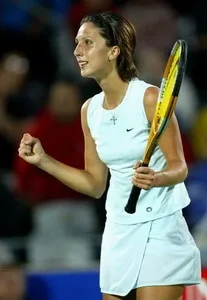
Unlike, say, our eastern neighbors - the Russians - one cannot expect great achievements from Ukrainian female tennis players. I am not even talking about the men, since they are nowhere near the Australian Open. And yet there was a time when we had reason to be proud: when Andrei Medvedev was among the top ten tennis players in the world, won at elite tournaments, when our men's team fought in the Davis Cup not against various African teams, but against decent teams from the European continent. By the way, the level of women's tennis in the country was about the same then as it is today. Only now, against the backdrop of men's troubles, we have gradually come to terms with the fact that even the very fact of several of our young ladies participating in a prestigious tournament is a reason for joy. Sad.
It becomes especially dreary when you learn that in Russia tennis is several steps ahead in its development. Suffice it to say that Ukraine's first racket, Tatyana Perebiynis, is listed 81st in the world rankings. While the best Russian, Anastasia Myskina, is in the top ten and holds a high seventh place. And between Myskina and Perebiynis in the world rankings there are nine more representatives of Russian tennis - Elena Dementieva (eighth racket in the world), Nadia Petrova (12th), Vera Zvonareva (13th), Elena Bovina (23rd), Lina Krasnoroutskaya (25th), Maria Sharapova (32nd), Svetlana Kuznetsova (33rd), Elena Likhovtseva (38th) and Dinara Safina (48th). By the way, the well-known tennis top model Anna Kournikova, who has not been on the court recently, has dropped to 311th place.
Russia in women's tennis is generally a role model. Especially for the republics of the former USSR. The number of Russian representatives in the top hundred of the world ranking is given above, and it is greater than the number of more or less decent female tennis players available in Uzbekistan, Estonia, Kazakhstan, Latvia, Lithuania and Georgia. And the total number of Russian women in the WTA ranking list is greater than in all the other republics of the "united and indivisible" combined. Including Ukraine and Belarus.
The progress of Russian tennis (and women's tennis in particular) is directly linked to several factors. The first is the country's large human resources potential. The second is great financial potential. The third is the interest of many high-ranking sports (and not only) officials in high results, which translates into care for tennis players. Suffice it to recall what large-scale tournaments are held in Russia - the Kremlin Cup, the Sankt-Peterburg Open - to understand that tennis there is a serious pursuit for serious people. For us, where everything rests on the efforts of a small initiative group of fans, expecting the final tournament of the women's team world championship (like the one held in 2003 in Moscow) in Kyiv or another Ukrainian city is still many decades away.
Nevertheless, tennis in Ukraine lives. Although it is not in the most prominent places. Maintaining a court in perfect order and at a high level is not the cheapest pleasure. And a proper tennis complex should have at least a dozen courts in order to be able to both earn money by attracting wealthy tennis enthusiasts to pay for their own hobby, and to raise future stars.
And if we are talking about an international tournament, and even a high-level one, then these courts also need stands and the proper infrastructure. Meeting such requirements is quite difficult, and in Ukraine there are as yet no visible prerequisites for hosting serious tournaments in which serious tennis players would participate.
Well, God be with them - the tournaments. One can live without them and raise tennis players (although at home tournaments there are more opportunities to earn ranking points). But even here things are not all smooth for us yet. Although some progress has been observed in recent years. Take women's tennis, for example, where our affairs, as already mentioned, are more or less.
There have always been plenty of talented female tennis players in Ukraine. It was just the lack of qualified coaches and financial opportunities that limited their progress. Things were especially bad in the mid-90s. But even then, the most savvy and enterprising parents began to take their talented children abroad - to live and train in excellent conditions.
This is the path that the parents of the famous Russian Anna Kournikova once took, sending her to be raised at the famous Nick Bollettieri academy in the USA. Marat and Dinara Safina grew up in Spain, where they received their tennis education. Today many praise the rising star of Russian women's tennis Maria Sharapova, who also studied with Bollettieri. There are plenty of examples of decent foreign upbringing. Including among Ukrainian tennis players, male and female.
True, the situation has begun to even out recently. Yes, elite foreign tennis training centers continue their work, producing high-quality output. But they are already facing competitors in the CIS. In Tbilisi, for example, the once celebrated tennis player Leila Meskhi has opened a tennis academy. Regional centers are being created in Russia. And in Ukraine, things are no longer so hopeless locally as before. That is why our little stars are staying at home.
But will they be able to reach heights while training in Ukraine? Our female tennis players certainly have potential. And considerable potential. Take Perebiynis, for example, who in 2000 became a finalist at the junior championships of England and the USA, and in the same year won Wimbledon in doubles. But in adult tennis, she has not yet achieved serious success. At least, she has not won a single WTA tournament in singles. Victories came only in the less prestigious ITF version.
Now our tennis experts have very high hopes for 16-year-old Odessa native Victoria Kuznetsova, who trains under the guidance of her father. Current age restrictions do not yet allow her to participate in a large number of tournaments, but reaching the final of the 2003 Australian Open junior championships speaks for itself.
The younger representative of the Bondarenko family, Ekaterina, has considerable potential. 18-year-old Katya, whose training is overseen by her mother, although she did not reach the finals of junior tournaments, made her mark in the semifinals of the US Open and the quarterfinals of the 2003 French Open - also among juniors.
If earlier only Elena Tatarkova represented Ukraine in Grand Slam tournaments, then in 2001 and 2002 Perebiynis began to keep her company. At the 2003 Open Championships of England and France, Vakulenko took the place of veteran Tatarkova, and in the USA the number of Ukrainian women in the singles draw increased to three (Beigelzimer joined). It is pleasant that in 2004 we also manage to hold our positions. The only thing left is to win. By the way, Vakulenko at a recent WTA tournament in Canberra almost reached the first final of such a serious competition in her life. She limited herself to the semifinals. But this also testifies to progress.
In short, there is someone to count on. The main thing is to correctly manage the existing potential. And then, before we know it, we will catch up with Russia. After all, Russian women have already managed to make the tennis world tremble with a massive breakthrough to the highest places in the rankings and purely Russian women's finals and semifinals in very prestigious tournaments. And are we any worse? After all, a few years ago their situation was also not the most cheerful...