
For the first time, such a major football tournament will be held in one of the CIS countries. However, this fact does not particularly please the Russian Football Union. Russia, which had already participated in the bidding for the host of the 2008 European Championship and lost it heavily, was planning to make another attempt in a few years and submit its bid for Euro 2016. Now that the 2012 European football championship has been awarded to Eastern European countries, Russia's chances of hosting such a major football tournament in the foreseeable future are close to zero.
But never before had the UEFA Executive Committee been so limited in its choice. Each of the candidates raised great doubts. No one, for example, doubted Italy's ability to host the European Championship as soon as tomorrow. The title of world champions, won last year in Germany, seemed to increase the Italians' chances. The fact that the newly elected president of the European Football Union, Michel Platini, has Italian roots also spoke in their favor; at least, one member of the UEFA Executive Committee, Vyacheslav Koloskov, admitted to a correspondent of 'Vremya Novostei' that he had no doubt where Mr. Platini's sympathies lay. But the corruption scandal that erupted a year ago on the Apennines, involving almost all the country's leading football clubs as well as many senior officials, erased the advantages of the Italian bid. The recent killing of a policeman by football fans in Sicily further devalued it.
In the Croatian-Hungarian bid, the weak link turned out to be Hungary. Political instability in the country significantly worsened the chances of these candidates. A small but widely publicized protest by Hungarian fans completely nullified them: during the visit of the UEFA commission to Budapest, about three hundred fans took to the streets under the slogans: 'Hungarian stadiums are rotten, like all of football' and stated that their country was not ready for Euro 2012.
Poland and Ukraine also have plenty of problems. Polish football is also mired in scandals related to match-fixing. And another political confrontation in Ukraine slightly evened out the chances of all contenders, although all sides of the Ukrainian political crisis confirmed their interest in the European Championship by providing the necessary guarantees. So on the eve of the vote, even Vyacheslav Koloskov, who along with the other 11 members of the UEFA Executive Committee had to cast his vote for one of the candidates, found it difficult to pick a favorite.
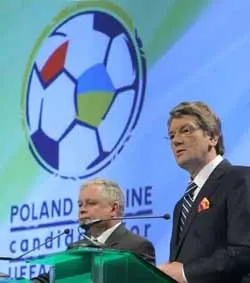
In the end, Ukraine and Poland were saved by the arrival in Cardiff of the presidents of these countries - Viktor Yushchenko and Lech Kaczyński. 'Together with my friend and colleague, the President of Poland, Lech Kaczyński, we speak on behalf of more than 80 million Europeans. We have firmly pursued this goal, and I am convinced we will achieve it,' Yushchenko said while addressing the members of the UEFA Executive Committee. Several of those 80 million made up a good company for Yushchenko in Wales - along with the president in Cardiff, Chelsea striker Andriy Shevchenko, multiple world record holder in pole vaulting and now head of the National Olympic Committee of Ukraine Sergey Bubka, head coach of the Ukrainian national team and Golden Ball winner Oleg Blokhin, and boxer Vitali Klitschko campaigned for Ukraine. In addition, FIFA President Sepp Blatter tacitly supported the bid.
As a result, out of the 12 members of the UEFA Executive Committee who took part in the vote, seven voted for Ukraine and Poland (including the Russian representative Vyacheslav Koloskov). All of them were thanked by Hryhoriy Surkis - the president of the Football Federation of Ukraine and UEFA vice-president, who ensured political support for this project in Ukraine and lobbied for it in European football circles. 'It is difficult for me to describe the feelings I am experiencing,' said the usually imperturbable Hryhoriy Surkis, visibly moved. 'Believe me, this three-year marathon has left many scars on the hearts of those who care about the fate of our countries. We will justify that historic, fantastic choice announced by UEFA President Michel Platini... 15 years ago, independent Ukraine was born. It was a chance to realize itself as an independent country. Now we have a new chance, a new challenge of fate, new feelings and emotions. I thank all those who gave their votes to Ukraine and Poland. Believe me, we will justify your trust.'
Along with trust and the honorary right to become co-organizer of the tournament, Ukraine received serious obligations for its financing. About half a million dollars had already been spent on advertising Euro 2012 during the election campaign. Another $17 million was spent on the construction of the House of Football in Kyiv, which impressed even UEFA officials. But this amount is insignificant compared to the costs of the entire tournament.
The European Championship will cost Ukraine approximately $4 billion. Of this, the state budget will allocate only 1.2 billion hryvnias (approximately $240 million), and local budgets will find another $40 million. Budget funds will go to the reconstruction of the national sports complex 'Olympiyskiy' as well as to improve transport infrastructure. The remaining 20 billion hryvnias are planned to be raised from non-state sources, for which 400 government guarantees are given in the bid book.
Such large expenditures are due to the fact that the country currently has no arenas capable of hosting matches of this level: within five years, either new ones must be built or old ones must be seriously reconstructed. According to the bid, the Euro 2012 matches will be hosted by four Ukrainian cities – Kyiv, where after reconstruction the Olympiyskiy Stadium will be able to accommodate 75,000 spectators; Donetsk, where a new stadium for 50,000 will open in 2008; Dnipropetrovsk with a new stadium for 35,000, which is planned to be completed in September 2007; and Lviv, where the 40,000-seat arena needs serious reconstruction. In addition, there are plans to build another new stadium in Kyiv on the site of the hippodrome, and the reserve cities Odesa and Kharkiv have long declared their readiness to build a stadium each, just in case.
By the way, there are no ready-made stadiums in Poland either. The national 70,000-seat stadium in Warsaw is only to appear in 2009, the Olympic arena in Wrocław will still be reconstructed, as will the stadium in Chorzów. The Baltic Arena stadium in Gdańsk is planned to be completed by 2010.
But in Ukraine they believe they will not lose out. The fans alone are expected to bring $3.2 billion to the European Championship. And the Ukrainian side estimates the expected profit from hosting the European Championship at $7.4 billion. Plus at least five ultra-modern football arenas, upgraded transport infrastructure, a revived hotel business. And a sense of self-importance on the political map of Europe.