
Turin has twice in its history worthily fulfilled the role of a capital
The metropolis, located in the Piedmont region at the foot of the Alps, has already twice in its history worthily fulfilled the role of a capital. The first time was in 1861, when Turin became the first capital of unified Italy, and the second time was at the end of the 19th century, when the first Fiat automobile plant appeared there and the city came to be called the capital of automobile manufacturing, the European Detroit, if you will. As for tourists, there were plenty of them at the current European Figure Skating Championships, which were held in Turin. Among them it is hard to find even one person who was dissatisfied with the reception.
Excellent hotels, a trim, dignified city, luxurious shops. And it is not surprising, because it was here in Turin, and not at all in Paris, that such world-famous high fashion brands as Armani, Valentino, Cerruti and Ungaro emerged on the basis of the GFT textile group. And there is no need to even mention the world-famous coffee brand Lavazza, and the drinks Cinzano and Martini loved on five continents. The list of Turin's successes is varied and long.
As for tourists, they could only drool in front of shops closed on Sunday. Sunday is a family day for Turin residents. A day of morning mass, then a delicious lunch, walks along the streets and preparation for the work week. True, the last Sunday of January adds other colors to the usual palette of a quiet day off. It is carnival day. Almost everything is like in Rio de Janeiro, only significantly smaller in scale, and the feathered dancers show the public not a naked body, but only elaborate costumes imitating both a southern tan and voluptuous figures. It is cold to be naked: it is minus three degrees outside.
Thus it has always been. But modern rhythms dictate other rules. And shops will certainly be open on Sunday. And there will be tens of times more souvenir shops than now. And much more will happen for the first time in 2006, when Turin for the third time will become the capital of the 20th Winter Olympic Games.
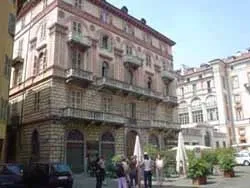
Turin looks like an expensively, tastefully dressed person who holds their back perfectly. The city's residents themselves look exactly that way. At first glance, they are more reserved than their compatriots from the warm regions of Italy. Evidently, the geographical proximity to France has its effect. Also, the cold winters do not particularly encourage temperamental behavior. The capital of the Celtic tribe of Taurini (from the Latin taurus - "bull") was turned by the ancient Romans in the 1st century AD into a military camp with an ideally clear settlement pattern, strictly parallel and perpendicular streets. No crooked alleys. Twenty centuries have passed since then. The bull has forever settled on the coat of arms of Turin, and the topographical structure of the city has remained as it was in ancient times. An ideal location for those who like to walk, finding themselves in an unfamiliar place for the first time. A solid, clean, convenient city that has everything it takes to be considered one of the most well-maintained in Europe has decided to challenge time and itself. The task is not simple - to be not just "one of", but to become an urban leader of the 21st century.
Turin, having won the right to host the 2006 Winter Olympics, becomes the first major European center to host such an important sporting event. The choice was not made by chance.
First, the natural and climatic conditions of this area of Northern Italy were duly appreciated. Second, from the very beginning the plan for building new and reconstructing old sports facilities very carefully integrated them into the layout of the city and its suburbs. Around Turin there is enough free space for the most ambitious architectural projects. And the modernization and expansion of existing sports facilities does not infringe on the rights of neighboring buildings.
Third, Olympic construction for Turin is a continuation and supplement to the planned modernization of the city and its infrastructure. Thus, holding the 2005 European Figure Skating Championships became another test for the restored and completed ice Palace of Sports "Palavela", which is located within the city limits. A little earlier, the ice stadium no less successfully hosted the European Short Track Speed Skating Championships.
At first glance, there is nothing unusual about the design of this stadium, which seats 10,000 people. But once you are in the stands, you quickly realize that from every seat, even if it is under the dome, you can see perfectly. The steep amphitheater of spectator rows, a huge screen in the center above the rink with live broadcasting and all the information about the athletes and their coaches, achievements and scores, pristine acoustics, convenient places for journalists and the latest equipment - all this puts Palavela on a par with the most sophisticated ice stadiums in the world.
As for the athletes and their coaches, they too duly appreciated both the quality of the ice and the conditions for training and competition. But testing the new ice arena would be incomplete without considering the spectator factor. The people of Turin proved themselves to be emotional, knowledgeable and fair fans, who greeted absolutely all participants of the championship with ovations, regardless of country. Moreover, the packed stands and tickets sold out even before the start of the competition showed better than any polls that the majority of the city's residents said "yes" to the 2006 Olympics.
By February 10, 2006, the opening of the 20th Olympic Games, everything must be ready. No, even earlier. Already in early November of this year, international meetings of hockey players, luge athletes, and speed skaters will take place at the new Olympic venues - something like a dress rehearsal before the premiere.
2,500 athletes will come to the Olympics, and the same number of accompanying personnel, not to mention one and a half million fans who are already preparing to head to Turin, ten thousand journalists and technicians, hundreds of specially invited guests, judges and many, many others.
The current construction landscape around Turin clearly divides people into pessimists and optimists. A person with rational thinking, apparently, is not given to believe that from this concrete chaos a new wonderful city could emerge very soon. Most likely, this is exactly how our planet once came into being. Who believed in what then? Here is a poured foundation and metal rods threateningly protruding from it. And nearby is a huge panel depicting the futuristic main hockey stadium “Palasport Olimpico,” finished in metal in the style of crazy sets from films about star odysseys. Will they really build this colossus in a year - the brainchild of Japanese architect Arata Isozaki? A representative of the construction company calmly replies that, of course, they will make it in time, and that this hockey spaceship will hold about 12 thousand spectators. And then it can be easily transformed into anything you want, and that it will bear the name of the recently deceased famous head of the Fiat automobile empire, Giovanni Agnelli.
There is no fuss at the construction site. There are also few workers. The traditional bowl of the municipal football stadium, built back in the 1930s, looks just as lonely nearby. Probably, back then the arena was considered the same architectural miracle as its current neighbor is today. The main configuration of this facility will be preserved. At the same time, it is planned to modernize it, expand it, and build it upward, to worthily open the 2006 Olympics, and then solemnly close it in front of 35 thousand spectators and 2 billion TV viewers around the world. Oh, it would be good to come here in a year and check how Turin will pull all this off.
The impression from other facilities is the same. Builders call this stage of work the “zero cycle.” From the observation deck of the Lingotto commercial center (the building of the former Fiat plant), a panorama of the construction of the speed skating rink with the simple name “Oval” opens up. This “Oval” is being created by London and Milan specialists, taking into account all the latest achievements of science, and unusual technology is being used. Eight thousand spectators, 400 meters of ice track, easily foldable structures that can divide the rink space into small sectors for a wide variety of events - from book and other salons to major sports competitions. The Winter Olympics competitions will be held not only in Turin, but also in small nearby towns. It is impossible to imagine, let alone write about dozens of new and renovated sports facilities, about the Olympic Village with a total area of 80 thousand square meters, which will later become the city's housing stock, about new roads, a railway station and an airport. Everything must correspond to the high level of the event.
But even today, when Turin is cluttered with scaffolding, it remains one of the most elegant cities in Europe. Moreover, the famous Turin artist and lighting design specialist Richi Ferrero came up with the idea of turning the construction site of an underground parking lot into a stage for his new musical-light composition. The shields covering the statue in the middle of Piazza San Carlo turn every evening into a four-sided screen for the author's new fantasies. And the pit around the whimsical tower serves as scenery. Only in this way, through art, can one probably reconcile supporters of the new and the old.
Turin's central streets are surrounded by arches, as happens in the inner courtyards of palaces. A city-palace, but not frozen, but stubbornly striving to live by the laws of the 21st century. High technologies, the search for new opportunities for industrial development must coexist with environmental programs and with the preservation of historical and cultural monuments. Judging by the calm confidence of the Turin residents, they have no doubt about success. No one is going to destroy the old city, replacing it with fake new construction. It stands firmly and proudly, its whole appearance saying that it once was also considered an ultra-modern construction project. And thanks to this, another leap into the future was made, in which Turin residents live today and without which tomorrow is impossible.