
Cataclysms do happen at resorts, and one must be aware of it: forewarned is forearmed. However, as "Itogi" notes, some of these news items are not just news but information weapons in a war waged by resorts.
A tarnished image from the tsunami
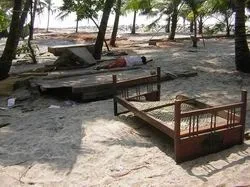
Sometimes, in order to take away tourists from a competing resort, nothing needs to be done at all - just skillfully take advantage of a misfortune that has already occurred. A vivid example is the tsunami that hit Southeast Asia at the end of 2004. The affected countries were listed: Indonesia, Malaysia, Thailand, Burma, Sri Lanka, Bangladesh, India, and the Maldives. Many clients no longer consider these countries as a place for recreation, although some resort areas were not affected at all. Thai authorities note that tourism revenues have halved. "I feel sorry for Thailand, as if someone deliberately includes this country in the list of misfortunes. Before the tsunami, they said there was SARS there, although there was no outbreak there. It is possible that someone benefits from this state being associated with negativity in the mind of a potential tourist," says travel agency representative Marina Gushchina.
Information about cataclysms instantly scares off tourists. "Last year, information about a cold snap in Spain strangely spread: allegedly, snow fell on the beaches. Such an anomaly was indeed observed, but in 1952. And we were surprised that this unsubstantiated news was actively discussed. As a result, sales for Spain noticeably declined," says Tatyana Mityushkina, director of the department for Russia and the CIS at the holding company Iberoservice. It is clear that not always behind such news is malicious intent. However, participants in the tourism business note that a coincidence noticeably differs from an organized campaign - in frequency of mention, in the form of presentation.
An equally deadly argument for a tourist is a national conflict. The event itself may not touch the soul: well, let them conflict. But it can be made so that it will affect everyone who comes to the country. A classic example in the history of tourist wars is the situation around the arrest of Kurdish leader Ocalan in Turkey in the late 1990s. "A wave of rumors began that there would be unrest among the Kurds," says Irina Levitskaya, general director of a travel company. "But nothing of the sort happened: most Turkish hotels belong to the Kurds, and they are not at all interested in unrest. However, the result was achieved. Prices for Turkey collapsed, many participants in the tourism market went bankrupt. Most German tourists, of whom there are very many, refused to travel. Greece and the resorts of the Black Sea coast were suspected of spreading those rumors. Although, of course, the "author" of a campaign in such cases is very difficult to establish."
Tourist countries themselves will never admit that they are waging a war against a major competitor, and they themselves will never accuse anyone of an "attack" - it is too delicate a matter. Open conflicts are extremely rare. An example is the spat between Kazakhstan and Kyrgyzstan that occurred in 2003. Moreover, at the level of high state officials. The then Prime Minister of Kyrgyzstan, Nikolai Tanayev, accused the Kazakh media of "attacks" that somehow began with the start of the tourist season. For example, Kazakh journalists persistently confused the names of the village of Aksy in southern Kyrgyzstan, where there was a confrontation between the authorities and the population, with Aksu - a resort on Lake Issyk-Kul. As a result, according to tour operators, tens of hundreds of Russian tourists returned purchased vouchers to Issyk-Kul. However, this case rather confirms the rule: tourist conflicts do not often reach a high state level.
Is there a war?
Many experts are skeptical even of the term "tourist wars", explaining the inflation of minor negative events to the scale of a catastrophe by the simple chase of the media for "sensations". At the Turkish embassy, the country most popular among our tourists, they said they had not encountered black PR against themselves. At other embassies of tourist-attractive countries, they reported that if such wars are being waged, they do not interfere with them. "We pay serious attention to tourism at the governmental level," explained Said Nofal, tourism adviser at the Egyptian Embassy in Russia. "Of course, there is competition - for example, more Russians go to Turkey. And here is why: a large mass of tourists go on vacation in the summer, and they think that at this time it is too hot for us. But those who have visited Egypt once will return: we can rest both in summer and winter. And if some negative information does arise, it does not affect the flow of tourists."
Deputy head of the National Tourism Representation of Tunisia, Mejid Kahlawi, says that competitors, of course, come in different kinds, but he has not encountered dirty fighting. Besides, the strongest passions flare up in the competition of beach resorts, and Tunisia differs from other countries in its excursion program. Kahlawi is absolutely convinced that waging dirty wars in tourism is like throwing stones among glass houses: they will hit your house too. But the representative of Tunisia does not deny such a type of competitive struggle as dumping.
Press Secretary of the Russian Union of Tourism Industry Irina Tyurina is also among those who believe that tourist wars are a far-fetched phenomenon: "Not a single case of black PR has been proven. Personally, a couple of years ago I tried to figure out where the rumor came from that mudflows were expected in Sochi. They suspected that either Turkey or Crimea could be interested in this. It turned out that something of the sort was said by Sochi geologists in one of the TV reports. They are not paid a salary, and they decided to emphasize their importance. And then it grew with information and terrible footage."
According to experts, the tourism market today has reached such a level of development that dirty methods of fighting for clients are ineffective. Only strong companies interested in honest business remain among the players: those who denigrate competitors do not win, but those who have better offers.
However, the truth, as usual, is probably in the middle. “I don’t see systematic struggle, but at the level of individual cases, orders are visible,” said Marina Slesareva, First Deputy Minister of Resorts and Tourism of the Autonomous Republic of Crimea. “For example, the recent tragedy on a wild beach near Sevastopol, when a Russian tourist died, is a fact. But when information is spun that there is almost a cholera epidemic in Crimea, although nothing was found there that could become a hotspot, that already smells bad.”
How negativity is countered
Countries that live by tourism allocate serious funds from their budgets to improve the image of their resorts. For example, in 2001, when after the escalation of the Arab-Israeli conflict a sharp outflow of tourists from the country began, an anti-crisis campaign was organized in Israel, aimed at Russia, Germany and other countries. “This is a large planned program that included actor tours, advertising, hotlines where you could get information, and so on,” says Oleg Ilyin, director of external international relations at Imageland. “We carried out explanatory work. Yes, the situation in Jerusalem is tense. But at popular Israeli resorts - the Dead Sea, in Eilat - there was not a single terrorist attack. The airport is located in a calm place, between Jerusalem and Tel Aviv. The campaign lasted about two years, until positive dynamics were achieved: more people began to enter the country than to leave.”
The scale of advertising sums, of course, depends on the capabilities of the country. Turkey spends more and more every year: according to some data, in 2004 it invested about $25 million in promoting its resorts only in Russian media, and this year it allocated $80 million for the same advertising campaign. Cyprus is much more modest - $1.6 million, Tunisia even less - $700-800 thousand. According to Marina Slesareva, Crimea has 1.5 million hryvnia (about $300 thousand) allocated for these purposes, and these funds are mainly aimed at attracting Russians. Krasnodar Territory allocated 60 million rubles - about $2 million.
However, advertising spending is not all the expenses necessary for popularizing and promoting resorts. Money is invested in infrastructure development and so on. But the game is certainly worth the candle. Cyprus alone, which receives 2.5 million tourists, earns total revenue from this industry of $2.2 billion. There is something to fight for.