
Photo epa
GERMANY
Germany and beer are almost synonymous. But even in such a country there are real beer oases. For example, Bamberg, where one of the most unusual types of beer is brewed - Rauchbier, or the small town of Kulmbach, the birthplace of the unique Eisbock beer. But the main "oasis" is Bavaria.
What is good for a German
The expression "beer flows like a river" is quite real in Bavaria. Such a variety of tastes and aromas of this hoppy drink can hardly be found anywhere else. Of Germany's 1,500 breweries, 730 are located here. The older the brewery, the higher its prestige. The sure path to success is using ancient recipes from grandfathers, great-grandfathers, even better, great-great-grandfathers. Some types of beer can only be tasted on site. They are brewed in small towns in small quantities and for their own consumption. But sooner or later, the routes of all beer tours in Bavaria converge in Munich, which the Bavarians, not given to false modesty, have declared the "beer capital of the world." The city, however, has many other merits: after all, it was the residence of Bavarian kings, the headquarters of BMW, and the nearby Alps.
Munich is life-loving. Possessing the largest beer hall in the world, the "Mathäser", with a capacity of five and a half thousand people, it easily copes with the heavy burden of capital duties. One of the best drinking establishments, the "Schellenstrube", is located in the Schwabing district. It has existed since the end of the 19th century and is famous for the rare beer Aventinus, one of the oldest in Germany, which monks began brewing back in the 14th century. If the weather permits, Germans prefer beer gardens - simply put, outdoor pubs. A very colorful beer garden for several hundred people adjoins the huge food market at Viktualienmarkt, a three-minute walk from the New Town Hall at Marienplatz. Long tables under the lush crowns of centuries-old linden trees, prompt waiters, white islands of beer pavilions, and, of course, a stage for a brass band.
The beer complex "Löwenbräu" on Nymphenburger Strasse is good in any weather. Here there is a cozy restaurant, a German-style well-kept garden with tables for a couple of hundred people, and most importantly, right next door is the famous Munich brewery Lowenbrau.
Of course, you can drink beer anywhere. But you must save your strength for a visit to the "Hofbräuhaus" - the Royal Brewery in the very center of the Old Town. It is, moreover, the most visited tourist attraction in Munich. Beer has been brewed here since 1589. For especially honored guests, there is a hall on the third floor. On the second floor there is a respectable restaurant, and on the first floor is the pride of the Hofbräuhaus - a huge room that can accommodate a thousand people, known to Germans more as the "Stall". The atmosphere is very simple - low vaulted ceilings, long oak tables and benches. On a low podium in the middle of the hall, an orchestra of five hefty fellows. At the end, there is a traditional Bavarian "concert". Tipsy visitors jump onto the tables and, swaying to the beat of a rousing march, end the evening with choral singing.
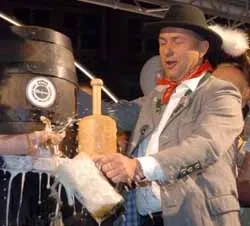
The dream of every beer lover is to attend the Munich Oktoberfest. Its history began with the grand celebrations that took place in 1810 for the wedding of the future King Ludwig I of Bavaria and Princess Therese. The beer party was a great success, and it was decided to repeat it. Since then, every year, on the penultimate Sunday of September, exactly at 12 o'clock, the mayor of Munich knocks out the bung from a beer barrel and, addressing the crowd with the words: "The barrel is open!", solemnly announces the start of the most joyful beer festival on earth. The number of blows it takes to knock out the bung is a subject of betting. Guests come from all over the world - seven million people in two weeks. In the capital of Bavaria, business life practically stops, and all of Munich turns into one big beer garden lined with long tables. The main arena of the festival is the Theresienwiese (Therese's Meadow) in the very center of the city. Special "beer horses" pull carts with beer barrels to it from the central Marienplatz. On the huge green field, a dozen and a half tents are erected, the largest of which can accommodate 10,000 people. Inside are wooden tables and benches. Brass bands play in succession. Busty German waitresses weave between the tables, with circus-like dexterity carrying 8-10 liter mugs of Marzenbier - beer brewed especially for this festival. From time to time, everyone stands up together to shout the traditional "Prosit!". The climax comes when those gathered, putting their hands on each other's shoulders, begin to sway rhythmically, singing: "as long as the Isar carries its wonderful waters, fun and coziness will not disappear in our Munich." In the evening, dancing begins in the tents. Everyone who can, dances as best they can, trying to keep in rhythm with the national Bavarian melodies.
The festive day ends exactly at 22:45. The fun subsides, the music stops, and the crowd disperses. The peace and quiet in the huge tents amaze no less than the reckless fun a few moments before. And the next day everything starts all over again.
During the festival, 7 million liters of beer are drunk, 750 thousand roasted chickens, 500 thousand portions of sausages, 100 thousand pork knuckles, and up to a hundred spit-roasted bulls are eaten. And every time after the festival, its organizers miss 150-160 thousand beer mugs. No, this is not theft, of course. Just a little souvenir to remember the unforgettable festival.
BELGIUM
Let no one be put off by the modest size of Belgium. The number of Belgian beer varieties is hard even to count. Belgians even had to fight so that their descendants could enjoy the wonderful taste of the foamy drink.
Everyone should have such a stove
Beer for Belgians is truly a gift from God. They learned to brew this hoppy drink from the monk Arnold, who after his death was declared the patron saint of brewers. Seven centuries ago, Belgium won the foundation of its beer prosperity with arms in hand. In 1288, the Duke of Brabant, John Primus, in a war against neighbors—the Lotharingians—defended the fields of his native Brabant, where excellent hops grew, from raids and devastation, and created excellent conditions for the development of brewing for his subjects. The merits of the brave John Primus are immortalized in the popular Belgian beer Primus and even received international recognition—the name of the beer "Gambrinus" produced in the Netherlands and the Czech Republic is nothing more than a distorted version of the duke's name.
Sculptures of John Primus and Saint Arnold greet every visitor to the Beer Museum on the main square of the Belgian capital, Grand Place. The museum is small but very interesting. It is maintained by the Guild of Belgian Brewers, located in the same building, which looks more like a palace. After learning all the intricacies of Belgian brewing in the museum, you can move from theory to practice. Start at least with the beer restaurant Chez Moeder Lambic on St. Gilles Square. The highlight of this establishment is the various types of "lambic" beer, for the preparation of which only natural yeasts are used, obtained, literally, from the air of the Lambic Valley near Brussels. The most popular brands are Lambic Kriek, made with cherries, and raspberry Lambic Framboise. The restaurant's menu includes hundreds more varieties of lambic: strawberry, blackcurrant, plum, peach, and even banana. Gueuze beer, which can also be tried in this restaurant, is a blend of lambics of different ages, sometimes called "Belgian champagne" for the similarity of characteristics.
The lion's share of beer production in Belgium belongs to two super-companies, "Alken Maes" and "Interbrew." However, the country's beer worth relies on hundreds of small breweries, whose owners have preserved, invented, and sometimes revived traditional artisanal brewing technologies, turning this process into a true art. The mass production of beer by Belgians was prompted by the discovery of some medieval healer, who noticed that during a plague epidemic, most survivors regularly drank beer. Since then, every city and even every village has had a brewery, sometimes several. No one knows the exact number of varieties of Belgian beer.
Some varieties disappear, but others immediately appear. According to long-standing tradition, brewers continue to create new brands for holidays and significant dates, weddings, and even for the laying of a house. From early spring to late autumn, beer establishments occupy the picturesque squares and streets of the Belgian capital. Forget about large mugs. Here beer is served in glasses of 0.25 or 0.33 liters. The most original Brussels beer pubs are Mont Subite on 7 Montagne aux Herbes Street and Becasse near the Stock Exchange on 11 Taborastraat Street. Also open for visits is the old Gueuze brewery on 56 Gheude Street—the last brewery in Brussels where beer is made by hand.
The most reckless beer fun in Belgium is timed to the birthday of the symbol of Brussels—the bronze peeing boy named Manneken Pis. The celebration takes place on the second Sunday of September on the main square of the Belgian capital. The day before, a huge canvas awning is erected along the entire length of the medieval Grand Place, under which large beer barrels are installed. Every Belgian brewer considers it a point of honor to treat everyone to the results of his labor.
In the Middle Ages, the instigators of brewing in the territory of modern Belgium, and indeed all of Europe, were monks. Strong beer was brewed for the monastic nobility, and weaker beer for the others. And although brewing has long turned from a monastic affair into a quite secular occupation, monastic types of beer are especially popular. The most remote point of a beer tour in Belgium is the town of Chimay in the south of the country. The beer that made it famous, Cheese, is brewed by the monks of the local abbey of Notre-Dame de Scourmont, bottled, and finally matures in them only after two to three years. It is never pasteurized and can be stored for several years. In the medieval interiors of the abbey's tasting room, you will be offered the same drinks that were drunk in Europe 300-400 years ago: fruity "Chimay Premier," dry "Chimay Cinch," peppery "Chimay Grand." Different varieties differ in the color of the labels. Typical abbey ale is simply "Chimay," served in bottles with blue labels. Opening the bottle and pouring the beer into glasses is a real sacred rite. The main thing is not to stir up the sediment at the bottom of the bottle, rich in vitamin E. Knowledgeable people drink it at the very end—like a dessert.
Those who do not want to travel far across the country can immediately go to Liège, to the beer restaurant Le Vaudree. Just don't overestimate your capabilities—this establishment offers more than a thousand varieties of Belgian beer.
• By the way, about labels. Today they are not only stuck on beer bottles. Labels with branded labels and product information are attached to clothing, shoes, backpacks and bags. Therefore, you also need to pay special attention to the quality of the label. A manufacturer who values his name orders high-quality label production, thus protecting his brand from counterfeits.
CZECH REPUBLIC
Beer for the Czech Republic is the same as oil for the United Arab Emirates. But unlike oil, the source of Czech well-being is inexhaustible. The best beer in the world, according to many, is brewed precisely in this small European state.
Bill was here
To be in Prague and not try Czech beer is like being in Paris and not noticing the Eiffel Tower. Perhaps the reason is the city itself, perhaps the features of the national cuisine, but the fact is clear - you want to drink beer in Prague. And that's that! The typical reaction is the same as Odysseus's to the sweet call of the sirens - right here, right now, and not a step further. Beer is the main mystery of the Czech Republic and its main source of income. The official start of brewing is considered to be 1087, when beer was not just brewed and drunk, but they were so delighted afterwards that they could not resist recording this fact in the chronicles. The same chronicles speak of a real "beer boom" that occurred in the Czech Republic in the 13th-14th centuries. To solve the problem of competition and not deprive each other of labor income, the Czechs invented the "mile rule," according to which two brewers could not settle within a mile of each other. Historians believe that this led to the formation of many Czech cities. There were no problems with quality either. If the local beer community decided that the barrels contained a yellowish liquid of unclear taste instead of the beloved barley drink, then the defective beer was poured not into mugs but onto the town square, and the unfortunate brewer was fined and punished with rods. Especially "distinguished" ones were put in a special collar and chained in the middle of the square for all to see. The educational effect of these measures was so effective that even now, after hundreds of years, the quality of this drink in the Czech Republic is beyond praise.
Among the many varieties of Czech beer, there is only one that does not exist - bad. Tourists who come to Prague for the first time can entrust themselves to local guides and go on a tour of the most famous pubs. Or you can, without wasting time, get down to business yourself.
On Letenská Street, 12 in Malá Strana, boldly descend into the ancient vaulted cellar "U Svateho Tomase" (At St. Thomas), where many generations of fans of light and dark beer "Braník," brewed at the monastery brewery since 1352, have already drunk more than one ocean of their favorite drink. The beer is truly excellent and there are always free tables during the day.
The only drinking establishment in Prague that is difficult to get into at any time of day or night is the outwardly unremarkable pub "U Zlateho Tygra" (At the Golden Tiger) on Husova Street, 17. It gained extraordinary popularity in 1994, when two presidents accidentally dropped in - Czech Václav Havel and American Bill Clinton. The next address is the pub "U Kalicha" (At the Chalice), where the ever-cheerful soldier Švejk loved to talk about life. The walls of the establishment are covered with autographs of celebrities, and jazz plays in the evenings. They serve "Pilsner Urquell" and strong six-degree "Březňák." Thanks to its literary fame, the pub is considered a cult spot among tourists. True, the Czechs themselves rarely go there, probably because of the high prices.
A modest house on Kremencova Street, 11, received the right to brew beer in 1499. Yes, indeed, the house! Because the brewing license was issued not to the brewer, but to his house with its walls, roof, gate, and all partitions. This explains the good preservation of ancient Czech buildings - the owners had to take care of their condition so as not to lose the right to make beer. Today, the local home brewery "U Fleku" (At Fleku) is the most famous beer bar in Prague, a favorite place for "beer tourists" from Germany. Everything is as it was 500 years ago. And the same beer, with its unique taste and aroma.
There is no point in listing all the varieties of Czech beer and comparing their taste qualities. Let us only say that at Czech state receptions, high guests are served two types of beer: "Pilsner Urquell" and "Budweiser Budvar." In the beautiful town on the Vltava, České Budějovice, which the Germans living here called Budweiser, beer has been brewed since time immemorial. Even before the advent of brands, any local beer was simply called "Budweiser." In 1853, the Budweiser Burgerbrau brewery first brewed the strong beer "Budweiser Budvar" with a sweetish taste and unique aroma. It needs no advertising; today it is known throughout the world. "Pilsner Urquell," also known as "Pilsner Urquell," is considered the best type of light beer in the world. Perhaps this is aided by the intercession of St. Wenceslaus, the patron saint of Czech brewers. Perhaps by the famous Bohemian hop Žatec. The Pilsen brewers themselves explain the excellent taste of the resulting beer by the natural quality of the local spring water. Hence the name - "Urquell," which means "source." The collection of awards of the most titled beer in the world could be envied by any former Soviet general secretary of ours. Hundreds of breweries around the world try to replicate its seemingly simple production technology. A futile effort. All their products, in whose names the words Pilsner, Pilsener, Pils are clearly read, may be good in themselves, but they are clearly inferior to the Czech original. You will find the freshest beer in Pilsen at the bar opened at the old brewery on Urquell Street. Just don't overdo it - the excellent taste of this foamy drink sometimes makes you forget its strength.