
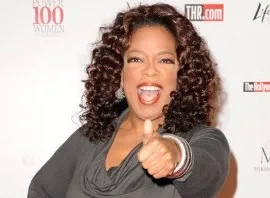
The famous TV host doesn't need a surname – for Americans she is Oprah or simply O.
And suddenly – such a surprise! The superstar announced that on September 9, 2011, the last episode of her show would air. "I love it so much," said the superstar, "that I know it's time to say goodbye to it." Fans, however, are not discouraged. After all, their favorite and spiritual mentor is creating her own cable television channel – OWN (Oprah Winfrey Network), so there is hope for continued meetings with her in a new format.
She Looks – and Rewards with Rubles...
Her show is broadcast in 140 countries. In the US, it is watched by 30 million people weekly. In 1998, Oprah's daily rating was sky-high – 14 million viewers. By now, following general trends, that figure has dropped to 7.3 million, but it's still much higher than any of her competitors.
Her impact on political processes was most evident during last year's presidential campaign. Oprah, who said she had "voted as many times for Democrats as for Republicans in her life," for the first time in her television career came out in support of a specific candidate – Barack Obama. And some serious experts tend to consider this moment decisive in the Democratic primary stage. Scientists Craig Cartwright and Timothy Moore from the University of Maryland made complex calculations showing that Oprah's support gave the current president one million additional votes! That was the difference that allowed Barack Obama to beat another contender, Hillary Clinton, in a number of key states.
Former Illinois governor (Oprah's show is produced and recorded in Chicago) Rod Blagojevich considered appointing her as senator to replace Obama. The official, later fired for attempting to auction off that seat, said: "Her voice is louder than all one hundred senators combined." Oprah reacted with surprise and complete lack of interest in a legislative career.
Now an example from economics. Once, while discussing mad cow disease, the show host exclaimed: "Perhaps I'll refrain from eating another hamburger." A wave went through the entire country. Some Texas beef producers estimated their losses at $12 million and even dragged the emotional lady to court. But they achieved nothing. The jury acquitted the idol.
In the humanitarian sphere, the TV star's influence is truly boundless. "Oprah Winfrey undoubtedly has more influence on culture than any other single president, politician, or religious leader, except perhaps the Pope," believes Vanity Fair magazine. When in 2002 she decided to close one of her show's segments – the famous "Book Club" – the publishing industry recorded a $150 million drop in revenue within a few months. Both publishers and viewers begged her to return to this segment. Conversely, virtually any book mentioned on her show instantly became a bestseller. This includes such serious works as "The Sound and the Fury" by William Faulkner or "One Hundred Years of Solitude" by Gabriel García Márquez.
In 2001, spouses Richard Pevear and Larissa Volokhonsky published their new translation of "Anna Karenina" and were very proud that over three years sales amounted to about 60,000 books. One can imagine their amazement when in 2004, after Oprah's presentation of Leo Tolstoy's classic work, publishers hastily printed an additional 800,000 copies.
In short, few in America can compare with her in influence and authority. Until recently, polls showed that about 74% of Americans viewed Oprah favorably. True, last year, apparently due to her open support of the Democratic president, she lost some of her admirers. Nevertheless, according to the conservative and pro-Republican Fox News channel, that figure never dropped below 55% and is now rising again. "She is the most outstanding woman in the country," believes New York journalist Maureen Dowd. "People trust her more than the president."
If Only You Knew...
These assessments and achievements are all the more astonishing if you know the horrific circumstances in which the little girl from the backwoods of Mississippi began her life, where she was born 55 years ago. While gathering information about her childhood, I kept recalling Akhmatova's lines: "If only you knew from what rubbish poetry grows, knowing no shame..."
Oprah's mother, Vernita Lee, who worked as a maid, conceived her as a minor. Her father, Vernon Winfrey, was equally young, having enlisted in the army before his daughter's birth. The fruit of teenage love was named Orpah – after one of the minor characters in the biblical Book of Ruth. But few relatives and neighbors could overcome the awkwardness of pronouncing 'r' before 'p'. The reverse was easier, and she became Oprah.
The family's poverty was indescribable. The child's clothes were made from old sacks, and she crafted dolls for play from dried corncobs. The girl delighted her grandmother, with whom her mother left her, by learning to read before the age of three. In the local church, the little one was called the Preacher because of her ability to recite long passages from the Bible by heart. At the same time, the grandmother did not hesitate to whip the granddaughter with a rod if she misbehaved or didn't do her chores.
Grandmother's scoldings, however, turned out to be mere trifles compared to what awaited Oprah after moving to her mother in Milwaukee. Vernita was at work from dawn till dusk, and the girl was left to her own devices and completely defenseless. From the age of 9, she repeatedly became a victim of sexual abuse by her cousin, uncle, and a family acquaintance. Unsurprisingly, at school she was a tomboy and later dropped out altogether. She ran away from home several times. At 14, she became pregnant. The child died a few days later.
Her mother, in despair at handling her daughter, sent her to her father, who by then had left military service, in Nashville. He treated her harshly and strictly but encouraged education and learning in every way. So gradually Oprah's natural abilities resurfaced, and she graduated from school with excellent grades. A victory in a recitation contest earned her a scholarship to Tennessee State University. Years later, Oprah Winfrey would tell colleague David Letterman: "I believe that education is freedom. I believe that education saved my life."
At 17, Oprah won another contest — "Miss Black Tennessee." At the local radio station studio, where she was being interviewed for the occasion, the winner was jokingly asked to read some news on air. The reading so pleased the editors that they immediately offered her a job at the radio station, where she became both the youngest employee and the first black woman to anchor a news broadcast. Then she worked in Baltimore in the same capacity.
In 1983, she moved to Chicago to host a low-rated morning program on AM Chicago radio. Within months, a miracle occurred. Oprah's program not only took first place in the city. It surpassed Phil Donahue, the founder of the new-format talk show on radio and later television. Soon her program was named "The Oprah Winfrey Show" and began broadcasting nationwide on September 8, 1986. A star was born!
Miss Billionaire
What followed was both simpler and more difficult. Simpler because in a sense life got better, though there were still plenty of worries and women's dramas. More difficult because she had to find something else for her broadcasts besides her mesmerizing voice and emotional empathy with interlocutors. Moreover, television arrived, and its specific requirements, particularly regarding visuals, also had to be properly adapted to.
And Oprah made one small discovery after another, leading to great results. For example, on her shows she shifted the focus from experts and analysts to ordinary people and conversations about their personal problems, during which she herself tearfully confessed to her own life's hardships and sins: how she ate a dozen and a half buns in one sitting, dipping them in maple syrup, how she dabbled in cocaine, and how she was a victim of rape.
On her show, something occurred that the Wall Street Journal called "Oprahfication." Her guests in the studio would publicly reveal things about themselves to the entire country that they sometimes didn't even trust to their closest friends. One famous singer, sobbing, recalled how her own father raped her in childhood. Tom Cruise jumped over chairs and a sofa to fall on his knees and declare his love for his new flame Katie Holmes. Public exposure of secrets and confession, thanks to her show, became a wild but distinctly American form of catharsis that one had to go through to move on in life. Sometimes toward new sins.
In the US, there are many explanations for the Oprah phenomenon. I will quote one, from Time magazine, when ten years ago it first ranked her first in significance in the arts and entertainment industry. "Winfrey saw the power of television in the mix of public and private; linking strangers and transmitting information through public channels, TV is at the same time overwhelmingly perceived by us in the private setting of our homes. Like a family member, it sits with us at the dinner table or talks to us on lonely evenings. Having grasped this paradox, Oprah subtly awakens viewers' desires to improve their lives and the whole world. She pushes people to care for others because she cares about them herself. That is her genius, and that will be her legacy."
Oprah's genius also lay in the fact that she mastered the style invented for male talk shows by host Phil Donahue — when he moves with a microphone among his guests — and then emphasized feminine content and a feminine approach. Instead of the role of referee or biased interviewer, she herself openly engaged in conversations with people. This was a very feminine way of conducting conversations, and Oprah showed the power of her incursion into this market.
In her growth alongside the show, Oprah Winfrey demonstrated great versatility of talents. She acted in films, including Steven Spielberg's "The Color Purple." She wrote several books, one of which earned her an even larger advance than former President Bill Clinton got for his autobiography "My Life," which set a record in that regard. She is also a capable entrepreneur, though she admits that accounting statements remain a mystery sealed with seven seals to her. On television, Oprah is a producer and co-founder of the cable channel for women Oxygen and of three shows — Dr. Phil with child psychologist Phil McGraw, Dr. Oz with cardiac surgeon Mehmet Oz, and the cooking show Rachael Ray. She publishes two profitable magazines — O, The Oprah Magazine and O at Home.
Together with her salary ($385 million in 2008) for working on the show, these sources made her the only female billionaire among African Americans (and also among males) in America. In 2009, Forbes ranked the TV star 141st among the richest people in the US, with a fortune of $2.3 billion. She is not ashamed of her financial achievements and does not try to appear modest. "I appreciate the life I earned through hard work," Oprah repeats. "My path to the top was difficult. I always felt how hard it is to earn a decent living. And now I enjoy life."
During the show's working season, she lives in her Chicago apartment. The rest of the time she prefers to spend at the estate "Promised Land," spread over nearly 20 hectares in Montecito, near Santa Barbara, California. She also has property in Miami, Hawaii, the island of Antigua, and a ski chalet in Telluride, Colorado.
Oprah and her longtime partner since 1986, Stedman Graham, have no children of their own. The drama of her first pregnancy proved insurmountable. However, she organized and finances a school for girls in South Africa, calling all 150 students her daughters. The family constantly has several dogs – cocker spaniels and huskies. Among Oprah's closest friends are Gayle King, poet Maya Angelou, personal fitness trainer Bob Greene. This circle also includes Arnold Schwarzenegger's wife Maria Shriver, actors Denzel Washington, Sidney Poitier, Julia Roberts, John Travolta, Halle Berry.
The show must go on
Of course, not everything in this amazing woman's life was smooth; even in her most successful years there were suffering and torment. The struggle with excess weight almost cost her a nervous breakdown. Unrequited love nearly drove her to suicide. A psychological trauma was the public disclosure by one of her relatives of the fact of Oprah's early pregnancy and the subsequent rapid death of the child.
There were serious blunders on the show. For example, in 2005 she sincerely promoted a work by one James Frey, "A Million Little Pieces," in her book club as an example of how a person addicted to drugs overcomes a harmful addiction. A year later, this author on her own show, under pressure from her angry questions, was forced to confess to lies and incoherent fabrications. A recent segment called "The Secret" (read as "the secret of life") also drew much criticism. Its idea is this: if people think positively, then such an attitude will lead to success in life and change it for the better. Experts somehow considered this idea pseudoscientific and even harmful to the psyche, since it vulgarizes the process of making important decisions and responsibility for them.
Oprah is not afraid of criticism and accusations. "Where there is no struggle, there is no strength," she repeats. Her advice to herself and to all who wish to listen: "Think like a queen. A queen is not afraid of failure. Failure is just a stepping stone to greatness." Therefore, her fans confidently and hopefully await a new project to create her own cable network. They believe in her motto: "Whatever your goal, you can achieve it if you have the desire to work hard." The show must go on!
Nikolai ZIMIN. 