
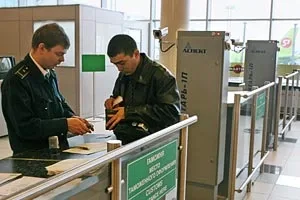
Those crossing the Russian border will have to account for every cash penny
The current law "On Currency Regulation and Currency Control" requires individuals importing into Russia cash currency or rubles, as well as traveler's checks and securities in excess of $10,000, to submit a written declaration to customs officers. Now the Federal Customs Service (FCS) proposes to require all entrants not only to declare the funds brought into Russia, but also to explain their purpose and sources of receipt.
The FCS also wants to receive information about the owners of the transported funds or the persons for whom these funds are intended.
Oral explanations will not be sufficient. As supporting documents, customs will accept only documents on sale of property, inheritance, donation, withdrawal of cash from bank accounts. Corresponding fields will be added to the customs declaration. By the way, on the website broktransconsult.com.ua you can familiarize yourself with the services provided by a customs broker.
In the explanatory note to the draft law, the FCS states that the adoption of these amendments will bring Russian currency legislation into line with international requirements and identify cases of importing cash into Russia for the purpose of financing terrorism and legalizing criminally obtained income. The amendments, the FCS claims, comply with the special FATF (Financial Action Task Force on Money Laundering) recommendation "Cash Couriers." This recommendation was developed to deprive terrorists and criminals of the opportunity to finance their activities by transporting bearer cash across state borders.
The FCS submitted a package of relevant amendments to currency legislation for consideration by interested agencies at the end of July.
Recently, this is far from the first infringement on travelers' rights. In June, the FCS decided to strike at "shuttle traders" and proposed to triple reduce the value of goods that can be transported duty-free across the border: from 65,000 to 20,000 rubles. And the transported goods can be assessed by customs expertise. The Ministry of Finance in early June proposed increasing fines for illegal currency transactions, in particular for exceeding the amount of exported cash. It is proposed to impose a fine of 75% to 100% of the transaction amount. The current Code of Administrative Offenses provides for a fine of 1-1.5 thousand rubles for citizens, 5-10 thousand rubles for officials, and 50-100 thousand rubles for organizations.
Experts are skeptical about the FCS proposal. In their opinion, with such innovations, it only creates the appearance of fighting truly serious crimes. "Does customs really want to counter the sophisticated methods used by criminal groups with such a stupid primitive method?!" wonders retired Major General of the Customs Service, Head of Customs Law and Foreign Trade Regulation Practice at Pepeliaev, Goltsblat & Partners, Galina Balandina. It is foolish to hope that organized crime will declare its income at customs. "This way, couriers are not caught, but honest citizens will face unnecessary problems," Balandina believes.
"Serious people do not carry large sums of money in their pockets or suitcases; it's not the 90s anymore, especially since modern technology allows 'seeing' money hidden both on a person and in luggage," agrees Alexei Binetsky, partner at the law firm BRG in Berlin. There is no problem transporting money by putting it on a bank card.
In civilized countries, it is not customary to scare a potential investor with inadequate strictness. "They won't ask you where the money comes from at the border, say, in Germany, but they may ask what you intend to spend it on, and they will be quite satisfied with almost any answer," the expert says. "Since you are bringing money in, you will spend it inside the country, which is good for the economy. And catching you for intending to buy drugs or weapons will be the job of another service."