
From off-season to the City of Angels
Travels reveal not so much our curiosity about what we are going to see, as our fatigue with what we are leaving behind.
Alphonse Karr
Los Angeles has nothing to do with it. The City of Angels (Krung Thep) is the real, ancient name of Bangkok.
Independence begins with small things - gathering information, booking flight tickets, reserving a hotel. All this applies to a simple beach vacation as well. And then what?
Europe and third-world countries are full of backpackers. This notion has gone beyond the scope of “a backpack on your shoulders and a tent under the starry sky”: the prospect of letting someone transport, feed, and lay your body on the beach seems more and more boring - more and more people want to travel and do it on their own.
The countries of Southeast Asia, and Thailand in particular, are a paradise for backpackers. Trouble-free movement, ease of obtaining visas, information booklets, maps, and guidebooks on every corner, a huge number of well-appointed hotels of all price categories, the hospitality of locals - it feels like the entire infrastructure here is “tuned” for independent tourists. An indisputable argument in favor of the Southeast is its cheapness.
Domestic tour operators on this route prefer to sell package beach services. It is unprofitable for travel agencies to meticulously calculate your future movements, minimizing their cost, and to book cheap hotels (which, in the case of Thailand, especially on the islands, does not at all mean a lack of comfort or low quality of service). A step left, a step right - and in our view that is already exclusive, for which you have to pay dearly...
Another common stereotype is the seasonal approach to planning a vacation. The peak season in Thailand is December-February, especially the New Year holidays. The low season - May-June and September-November - is due to climatic features. It is during this time that the so-called “hot season” and “rainy season” occur. In quotes, because this division is very conditional. You are unlikely to feel the difference of five degrees that defines the concept of “hot season”. Tropical rains indeed seem to illustrate the biblical “the windows of heaven were opened”. However, the time of the flood depends on the geography of the region: June-August in the foothills, August on Phuket, November on Samui. The real problem is high humidity. Walking out of the air-conditioned building of Bangkok airport into the street in May is like hitting a wall. And yet the Thai heat is much easier to bear than ours, and on the islands the sea breeze even allows you to forget about it. In general, climatic features, of course, should be taken into account. But do not forget: the low season has its advantages - no crowding on charter flights and cheap accommodation; in low season Thai hoteliers reduce prices by up to 50%.
May holidays are the traditional opening of the season at European resorts and in Turkey, which is dearly loved by our compatriots. High demand forces tour operators to inflate prices. So why not turn your gaze to the East?
The journey begins at home
Travel should be serious work, otherwise, unless you spend whole days drinking, it becomes one of the bitterest and at the same time stupidest pursuits.
Gustave Flaubert
Let's talk about the practical side of the matter. What is included in a standard tourist package? Air tickets, insurance, entry visa, hotel reservations, transfer.
You can save significantly... by contacting travel agencies. This is exactly the case when you should not refuse the services of agencies. They sell the same air tickets and often much cheaper. The explanation is simple - agencies buy blocks of seats on flights at special prices. You can also take out insurance at agencies.
If your trip lasts no longer than two weeks, you don't need to worry about a visa. Entry visas are issued upon arrival at any international airport in Thailand - look for the Visa on arrival signs. You will need a photo (you can take it right on the spot - the Thais have taken care of everything) and a passport with a validity of at least six months. The visa fee is 1,000 baht (about $25) - paid in baht. A tourist visa for up to 60 days can be obtained without problems or queues at the Thai embassy.
Now you need to decide on your route and hotels. The best way to get information is the Internet, short guides on tour operator websites, and travel reviews from tourists themselves. The undisputed leader among Internet resources on the topic is the website of the Tourism Authority of Thailand - www.sawadee.com. There you will truly find everything - information about history, attractions, maps, airplane and train schedules. It also has an extensive database of Thai hotels with booking options. By the way, a hotel's response to your request (not necessarily a booking confirmation by email, but simply “come, we will be glad”) may come in handy when applying for a visa, so it is worth having one. In general, you don't have to pay for hotels in advance. Choose several options that meet your requirements, and take a list with exact names and addresses with you. This will give you freedom of choice on the spot. If you do decide to book hotels in advance, also order a transfer from the airport - this service is provided by all hotels.
The city with the longest name
The Thais call their capital the City of Angels. This is only the beginning of the longest city name in the world (according to the Guinness Book of Records) given to Bangkok at birth - Khrung Thep Maha Nakhon Amorn Rattanakosindra Mahindrayutthaya Mahadilokpop Noparat-tana Radchhani Burirom Udom Rachnivet Mahastan Amorn Pimarn Avatarn Satit Sakatuttiya Vishnukarm Prasit.
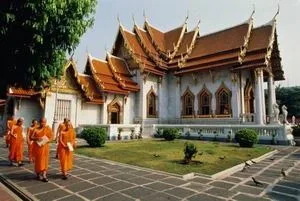
Bangkok is a motley mosaic. A city of squalid shacks and skyscrapers. Intricate canals and lacework of highway interchanges. The bustle of streets and the meditative contemplation of temples. The approach of "look right, look left" will not allow you to escape the power of these stereotypes. But once you leave the tourist bus and step off the guest carpet path, the city itself will fill these banal definitions with unique meaning. Bangkok's heart is in its temples, capable of literally blinding you with the luxury of gold, bright colors, and mirror mosaics. Even on the territory of the largest cultural complex - the Royal Palace - all temples are functioning. Thais come here with whole families, light candles, burn incense, and leave fresh flowers at the foot of Buddha statues. Sitting, as is customary, directly on the temple floor, they look from afar like Copenhagen mermaids - heels must not be pointed toward Buddha.
Bangkok's main artery - the River of Kings, Chao Phraya - literally pierces the city's body with a hundred canals. It is no accident that it is called the Asian Venice. Even Thai boats with upturned bows, steered while standing, are very similar to Venetian gondolas. In the center, on both sides of the river, are majestic temples and the city's most expensive hotels. But turn into the labyrinths of canals, and you will encounter poverty.
Bangkok's roads and traffic are a topic for a separate conversation. I will only say that if the object of your interest is on the opposite side of a busy highway, that does not mean you will get there in five minutes. Bangkok is exactly the place where you should take a taxi even to the bakery. Fortunately, this bourgeois indulgence will cost very little.
By daylight, you can look at the capital of Thailand from bottom to top, merging with the crowd in the business district and marveling at the modern structures of skyscrapers. And after sunset, you can see it from a bird's-eye view, standing alone on the observation deck of the Baiyoke Sky hotel - one of the tallest hotels in the world. The taste of Bangkok is Thai cuisine, exotic, thrilling, and... extremely spicy. For the sake of experiment, you can try to dispel this stereotype too: do not forget to order more rice and utter the magic words - not spicy.
Bangkok is like a patchwork quilt - no smooth transitions. Special attention deserves the Banglamphu district, located in the historical part of the city. It is here that the Mecca of backpackers from all over the world is located - Khao San Road. Khao San is something transitional between Europe and Asia. It is a motley, many-faced crowd living between yesterday and tomorrow. It is life seething from morning until late night. Perhaps the only place in Bangkok where farangs (as all white foreigners are called in Thailand) are more numerous than locals. And there are also many cheap hotels here - from very budget guesthouses to quite decent three- and four-star ones. Travel agencies on every corner, so Khao San can be the starting point for your further journey.
Country of saffron monks and priestesses of love
There is no husband who would not dream of becoming a bachelor for at least an hour.
From the film "The Diamond Arm"
It would be strange not to mention that in the minds of most people Thailand is associated primarily with sex tourism. And in reality, it fully justifies its reputation - numerous "massage" parlors, go-go bars, transvestite shows, and so on. The capital of the Thai sex industry can be considered the resort of Pattaya, so beloved by Russian tourists.
Statesmen are very concerned about such a reputation of the country and intend to improve its image: "We promote beaches, sun, history and culture, not night entertainment." Currently, a proposal is being discussed to close all bars in the country at midnight. However, even such measures are unlikely to change the situation. Recently, the Thai government began a public discussion on legalizing prostitution. Mandatory registration of the priestesses of love is estimated at $4.3 billion.
According to unofficial data, there are 200,000 prostitutes in Thailand and... about 250,000 monks. Thais are generally very religious. More than 90% of the population professes Buddhism, and this has a strong influence on everyday life. By tradition, every male Buddhist, usually after military service, becomes a monk for some time. Such temporary monasticism is something without which a young man cannot be considered a sufficiently mature and worthy citizen.
North.
Trails of smugglers
Let's meet in the evening, we'll smoke opium.
Agatha Christie
Northern Thailand could be called a state within a state - everything here is different: climate, nature, and people. The North is considered the most picturesque part of the country - river valleys give way to mountainous terrain covered with tropical forest - jungles. Thai civilization originated here. The second largest city in Thailand - the northern capital Chiang Mai - is almost three times older than the City of Angels. It is Chiang Mai that is the gateway not only to the northern regions of Thailand, but also to neighboring countries - Myanmar (Burma) and Laos.
All of this you will find in any guidebook. And you should not deviate from tourist routes in northern Thailand. Here, a step left or a step right may well lead you onto the trail of smugglers. Once, between the three neighboring states forming the so-called Golden Triangle, caravans of silk, tea, and tobacco traders traveled. Today it is one of the world centers of drug trafficking. The Thai Institute for the Study of Hill Tribes still calls opium one of the main sources of income for the local population.
By the way, about tribes. This is the name given to the numerous ethnic minorities inhabiting the northern provinces of Thailand. Each tribe has its own language and unique culture, which had not experienced significant influence of civilization until the last century. No group is assigned a specific territory, and the customs of some tribes even forbid them to own land. Perhaps the most famous tribe is the Padong, or long-necked Karen, whose women stretch their necks with kilogram rings. In general, apart from languages, the visible difference between tribes is precisely women's costumes and traditional norms of behavior. And men... Sadly, but fact: about half of the male population of the northern ethnic groups of Thailand are drug addicts.
Samui. Coconut Paradise
In our lifetime we visit paradise more than once, but we always remember only the expulsion from paradise.
Milorad Pavić
It is banal, but any tropical island can be called paradise. There are many of these miracle islands in Thailand - from the largest and most pretentious Phuket to the tiniest pieces of land of the Ang Thong marine national park. But if not for the hippies who discovered Ko Samui in the 1970s in search of inexpensive vacations, who knows where I would have met my paradise on earth.
You understand this at first glance at the little plane of "Bangkok Airways", shuttling between the capital and the island, all painted with palm trees, fish and butterflies, with the smell of ginger in the cabin; at the first glance from the porthole at the clearest, emerald sea and the huge statue of the Golden Buddha towering over the island; from the first steps on the territory of Samui airport, which you can hardly call an airport - two canopies, flowers and palm trees all around, and the flight schedule cut out of wood.
I won't hide that my tender feelings are quite mercantile. But you must agree, can you settle on the Caribbean coast in a bungalow with four-star service for $30 a day? And where else can a dinner for two, made from the freshest seafood, with drinks cost $25? That's just it.
Samui can be explored as Thailand in miniature. The island is encircled by a 50-kilometer ring road. You can rent a car, but the kings of the roads here are unquestionably motorcycles and mopeds. In the past, the main source of income for Samui was coconut plantations, where monkeys "worked", which were plied with alcohol, turning them into alcoholics so they wouldn't run away. The temples here, of course, are not as grand as in Bangkok; they are cozy, somewhat homely. But the jungles in the interior of the island are quite real: thickets, vines and waterfalls. There, in a mountain gorge, there is an amazing and very beautiful place - the Secret Garden, or the Garden of a Hundred Buddhas. The small islands of the marine national park, which surround Samui on all sides, are an ideal place for sea excursions, kayaking and diving.
Some Europeans take Thai women as wives, open a modest bar or dive club and stay to live on Samui. They can hardly be called farangs anymore; they grow into the island. Every year there are more and more tourists here. And all that remains is to hope that this coconut paradise will preserve its natural beauty.
Peculiarities of the National Smile
Good upbringing consists not in the fact that you won't spill sauce on the tablecloth, but in the fact that you won't notice if someone else does it.
Anton Chekhov
Thailand is called the kingdom of a thousand smiles. They say that if a Thai doesn't smile at you, it means he is seriously ill. And they smile. But don't be deluded. A Thai's smile is most often not a reaction to You-Such-an-Irresistible-Guest, but a consequence of good (Buddhist) upbringing. Often foreigners are not inclined to take into account the peculiarities of Thai culture and etiquette. And our compatriots, apparently, sometimes even confuse Thailand with Arab countries, where angry tirades indeed greatly contribute to obtaining desired services. And the Thais... The very name "thai" is interpreted as "free". Indeed, Thailand is the only country in Southeast Asia that has never been a colony. The Thais are very proud of this and treat the freedom of others with due respect. Anger here is an expression of rudeness and bad manners, and you are unlikely to encounter such a reaction. Still, it is worth respecting other people's traditions.
A Thai will never smile at you (and that's putting it mildly) if you show disrespect to the royal family or religious shrines. A Thai will politely ask you to dress appropriately if you intend to enter a temple in shorts, a short skirt, or a sleeveless shirt. Women must not touch monks, and monks are strictly forbidden to take anything from a woman's hands. Any image of Buddha is sacred - you should not hug it to capture yourself "for history". When entering a private home or temple, it is customary to take off your shoes. Feet for Thais are the embodiment of everything low; pointing at an object or person with your foot is considered rudeness. The head, on the contrary, is a sacred part of the body; you should not touch a Thai's head, even with the best intentions.
The ideal of the Thai smile is on the faces of Thai Buddhas. This smile is an inner state and an awareness of the illusory nature of the external world. This smile is contagious, and it is the only virus worth catching in Thailand.