
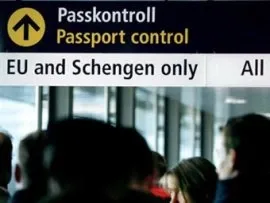
France and Germany decided not to let Bulgaria and Romania into Schengen
Despite the fact that no one named specific deadlines for including Bulgaria and Romania in the Schengen Agreement, the applications of the two youngest members of the European Union were scheduled to be reviewed in March 2011. EU experts were supposed to prepare a report on the readiness of the two countries to become part of the open borders agreement by January-February. However, some Western European countries decided not to wait for the experts' conclusions.
On December 20, the interior ministers of Germany and France, Thomas de Maizière and Brice Hortefeux, sent a letter to EU Commissioner for Home Affairs Cecilia Malmström, in which they stated that they consider the inclusion of Bulgaria and Romania in the Schengen area premature. Copies of the document were sent to the representations of Belgium and Hungary – the current and future EU presiding countries.
The Schengen Agreement (named after the place of signing – the town of Schengen in Luxembourg) was concluded in 1985. The treaty established a visa-free area among its five participants. Since then, the Schengen area has been expanded several times and currently unites 25 states. The agreement was signed by all European Union countries except Great Britain, Ireland, Bulgaria, and Romania, as well as three non-EU countries: Norway, Iceland, and Switzerland.
In the letter, according to AFP journalists who learned of its contents, the ministers warn EU officials against the imprudent expansion of the Schengen area. In the opinion of Hortefeux and de Maizière, accepting Bulgaria and Romania into the visa-free area is fraught with "the most serious consequences" and poses a threat to the security of the Schengen Agreement member states.
According to the heads of the French and German interior ministries, neither Sofia nor Bucharest have achieved sufficient success in the fight against corruption and organized crime. Furthermore, the legal systems of the Eastern European countries still need reform and in their current state are incompatible with the systems of the Schengen Agreement member states.
The concerns of France and Germany are understandable. The Schengen Treaty, which currently includes 25 European states, allows their citizens to move freely within the agreement's borders. More than 400 million residents of Schengen countries can travel from one state to another not only without visas but even without passports (and passport control). Corruption and organized crime in this context are far from abstract things.
As for Bulgaria, the rampant corruption there has long been recognized as a national problem. Sofia officially acknowledged its inability to fight bribery and crime back in 2008. After that, by the way, the European Union suspended financial aid to Bulgaria: upon joining the EU, it had been promised 500 billion euros for the development of various sectors of the economy. In response to the letter from Hortefeux and de Maizière, Sofia stated that it would "do everything possible to dispel the concerns of some EU members."
In Romania, things are also not great with corruption and crime, but Bucharest reacted much less restrainedly. Romanian President Traian Băsescu stated that his country had fulfilled all the "technical" requirements for joining Schengen, and called the comments of the French and German ministers "discrimination against Romanians."
As for "bringing the legislative framework in line with European norms," that was precisely the condition for accepting Bulgaria and Romania into the EU in 2007. If four years later this question arises again – well, it may indeed cause quite predictable bewilderment.
On the other hand, France, for example, may have more specific grievances against Romania and Bulgaria. In particular, how can one not recall the summer scandal with the deportation of Roma, which almost led to legal prosecution for the government of Nicolas Sarkozy. Without exception, all the illegal immigrants expelled from the country under the slogan of fighting crime thriving in the Roma camps were citizens of Romania and Bulgaria.
True, German Chancellor Angela Merkel during her visit to Sofia and Bucharest in October promised that the deportation story would not affect the Schengen prospects of Bulgaria and Romania. Yet it is hard to assume that France's decision to block the inclusion of the two Eastern European countries in the Schengen area is in no way connected with the Roma story.
In accordance with the Schengen Agreement charter, the decision to admit new members must be approved unanimously. Thus, if Bulgaria and Romania fail to persuade France and Germany, they can forget about joining the visa-free area in the spring of 2011. Unofficially, representatives of the two governments have already admitted that the previous deadlines look "unrealistic" and are naming a new date: 2013.
As Lenta.ru notes, joining Schengen is often considered the "last barrier" on the path to integration into the structures of the European Union. Bulgaria and Romania have been quite unambiguously made to understand that they have not yet grown to the status of full European countries. Today, only France and Germany have decided to take responsibility for such a bold statement, but it is very likely that a similar conclusion will be contained in the upcoming EU report.