
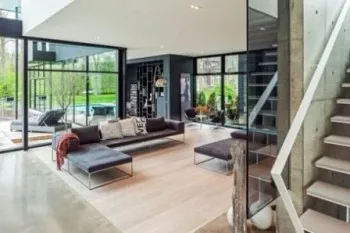
If we talk about types of houses, usually two are distinguished – a single-story bungalow (bungalow) and a two-story house (two-storeys house).
Bungalow is a detached single-story house, usually having 3-4 bedrooms, with one or two bathrooms and a garage for two or three cars, with an area of about 150-200 square meters. It should be said that if we are talking about bungalows built 40-50 years ago, they were built mainly for economy, and these are generally very small and completely unprepossessing houses. However, in the last 10-15 years, a bungalow has become rather a sign of special luxury, and this type of house can no longer be called cheap housing, rather the opposite.
Two-storey house. In principle, this type of house may not necessarily have only two floors; it could also be one and a half or two and a half floors (for example, split-back concept), three floors, and so on. The common thing is that living quarters (excluding the basement) are located on more than one level.
An ordinary house typically has two floors and three or four bedrooms, which are located on the upper floor. On the lower floor are the kitchen, living room, common area, studies, library, and so on. A garage for 1-3 cars can be built as part of the house or as a separate building. Such a house usually has several toilets and shower rooms, and always a separate toilet and bathroom in the master bedroom. The house also always has large wall closets and storage rooms (closet).
Many houses built in recent years have a "sunroof" – part of the roof made of special glass, which gives much more natural light inside. Also, an almost indispensable attribute of every house is the presence of a basement (basement or semi-basement space), suitable for living – basement. The basement usually serves as a third, lower floor. Often the basement rooms are used as a home office, recreation room, or converted into living space for subsequent rental. Usually the area of the basement is 40-60 square meters.
The cost of a house mainly depends on the following parameters: the location of the house, i.e., the area where it is located; the size of the lot on which the house stands; the usable area of the house; the number of bedrooms.
Other factors affecting its cost, although not as strongly as those listed above, are the age of the house, its condition, the sophistication of the landscape design, the quality of interior finishing, the level of technical equipment of the house, etc.
Usually the area of houses in Toronto ranges from 150 to 400 sq. m. The plot on which the house stands usually has dimensions of 8-15 meters in width and 30-40 meters in length. A large plot adds greater value to the house. It should be said that houses become morally obsolete over time, primarily in terms of their technical content – wiring, pipes, autonomous heating and air conditioning systems, telecommunications connections. Over time, the appearance of the house also begins to show its age and require updating. Therefore, it is common nowadays to demolish old small houses and build new ones in their place with a much larger area.
• By the way, if you have planned the construction of a new house or renovation of old housing, we recommend paying attention to the online store of building materials http:\/\/alkiv.ua<\/a>, where you can order certified and quality products.
What costs are involved in owning a house?
• Every year the homeowner must pay Property tax. Depending on the size of the house, its value and municipal affiliation, this tax can be 3-6 thousand or more.
• Additionally, utilities (water, electricity, gas) are paid – about $200-$400 per month.
• House maintenance costs, which include repair work. Usually, roof replacement is mandatory every 16-20 years (costs about 4-6 thousand dollars). Everything else needs to be repaired if it breaks, deteriorates, or if there is a desire to update (for example, install new windows, modern-looking doors, etc.). Otherwise, you can do without repairs.
• Lawn care (snow removal, grass cutting) also falls on the homeowner. Owning a house also requires being prepared for additional costs - paying for lawn treatment annually, carrying out minor repairs in the house and preventive work to keep it in good condition.
• Property insurance, about $500-$600 per year.
Actually, of all the above, the mandatory payments are only property tax and property insurance. The owner can regulate the rest of the expenses themselves.
How to rent out a house
If the house is located near transport routes, close to the subway or central streets, it can be rented out quite profitably, especially if renting out by individual rooms, of which there are many more than in a condo, for example, and unlike a condo, there are no mandatory monthly condo fees. Moreover, it is not at all necessary to rent out the entire house; you can use only part of the rooms for this purpose. For example, renting out the basement (basement), equipped as living space, is widely used.
Pros of a detached house:
– best value for money/area;
– the main advantage is that the house has a plot of land, which appreciates first and foremost;
– large area, which makes living comfortable and also allows organizing a workplace and running a business from home;
– the owner decides what to do with the house (what repairs, what updates) and can plan maintenance costs themselves, without the need to make monthly mandatory payments (condo fee);
– with a good location, the house can be rented out (whole or part) significantly more profitably than other types of housing.
Disadvantages of a detached house:
– the price of a detached house is higher than an apartment in a condominium or an apartment in a townhouse – although this is not always the case, and sometimes it is the opposite;
– requires constant maintenance. To keep the house looking decent, you need to renovate, paint, repair, and maintain the landscape design. All this requires investment of money, time, and effort;
– houses are usually located within residential blocks, not very close to main roads, and living in houses implies using a personal car. Public transport is often not conveniently available near the house;
– although renting out rooms in a house is significantly more profitable, finding tenants is more difficult than in a condominium. The house must meet a number of requirements, the main one being a good location.
Also, it is not always possible to rent out space in a house to a large number of people; in some cases, special permits are required. Moreover, maintaining a rental house in proper order and condition is much more difficult than an apartment in a high-rise condominium or a townhouse.
As you can see, a detached house has its strengths and weaknesses. What to choose depends on many factors, including your financial situation and life priorities. The main thing is to approach the decision very carefully, trying to gather as much information as possible.