
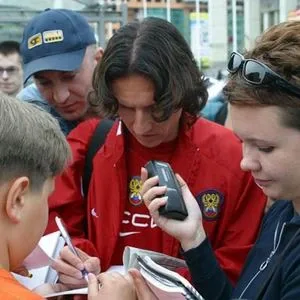
Today Alexei Smertin is a kind of role model for aspiring footballers, a useful example, because he achieved everything he has on his own. Probably it is not surprising that he is the captain of the Russian national team, one of the most respected players in the country of our eastern neighbors. And besides, he is the only Russian national team player playing abroad.
Smertin's "foreign assignment" began in 2001. Representatives of French "Bordeaux" approached Moscow's "Lokomotiv". They, by the way, were not alone in their desire to acquire a versatile midfielder. Among potential buyers were British "Leeds" and "Manchester United", Belgian "Anderlecht" and Kyiv "Dynamo".
"Bordeaux won me over with its specificity and geography," recalls Alexei. "I always liked France. Even though at that time it was a platonic sympathy. As for the team, Bordeaux, which I got to know during their confrontation with Moscow's Spartak, seemed to me a good squad. But about other contenders, honestly, I cannot say anything. Because I don't know about their offers. Though I had heard about their interest in me."
The Russian midfielder spent three and a half years at the club from the capital of Gironde (a province in southwestern France). Bordeaux did not perform miracles, but they also had no disastrous seasons. The French championship is generally one of the most even in terms of team strength in Europe. But the French league has another characteristic feature. There are no superclubs in this country. There are teams that are strong by European standards, which from time to time manage to "make a splash." But immediately after that, the leaders of such clubs are quickly snapped up by representatives of financially more prosperous championships (Italy, England, Spain). France is famous for its ability to nurture young players—both its own and foreign ones. The level of football managers in this country is very high, and therefore it is not surprising that rumors about Smertin's possible move somewhere began to appear as soon as Alexei managed to secure a place in Bordeaux's starting lineup. However, the Russian did not need much time to become "one of their own." On the football field, he is a real workhorse, never tries to hog the limelight, on the contrary, he tries to take on more dirty work.
"In principle, Bordeaux is not against selling footballers. The whole question is the terms of the deal. Newcastle showed interest in me, but the French were not satisfied with the sum offered by the Englishmen. Personally, I was a little sad because I thought that the English Premier League could become a new step forward in my career. At that time, it seemed to me that it was the right time to make this step. Although I was not striving to leave Bordeaux, where I felt great, at any cost. It was about making a new step in my career. I have always respected the teams I played for, but I was never afraid to try myself at a new level."
The journalist who spoke with Smertin about the peculiarities of the French championship could not help but ask about one significant difference. Like, for us it is an incredible scene: players and coaches give live television interviews a few minutes before the start of a match or during the interval...
"Here this is a common thing," Smertin explains. "They treat the game more simply, not as tensely as we do. Many, especially players of African origin, can calmly listen to music, eat fruit or chocolate 10 minutes before a match. A defeat is not a reason for prolonged despondency: after 10 minutes it is already forgotten by many, jokes are heard in the dressing room. I will not undertake to judge whether it is good or bad. But that is how it is."
And to the question about age, Alexei answered not as a Russian, but as a resident of Western Europe: "In May I should turn only 28. In Russia I would say 'already 28,' but here there are completely different ideas about age. Thirty is the prime of a player, not a pre-retirement period; coaches here trust veterans. On the other hand, older players in France are usually in better shape than in Russia; here there is a more gentle training load. No one will ever force you to play with an injury, even one that seems minor at first glance. The concept of 'playing on injections' practically does not exist. Again, I don't know whether it's good or bad: after all, sometimes the period of 'sick leave' for leading players falls on key matches. The total duration of training camps is a maximum of 40 days. Although what kind of camps are these by Russian standards? In the summer, I rented a house on the coast with my family, in Cap Ferrat, and after training I managed to return there every night to sleep.
Gradually I began to get used to the fact that every French person, by our standards, is a gourmet. I tried not to lag behind them in learning l'arte de vivre—the "art of living." After all, if you order wine in a restaurant that does not match the dish, they will, of course, bring it to you, but it is bad manners! Two years after arriving in France, I can give the most detailed recommendations on many Bordeaux wines. In my free time, I traveled all over Médoc and visited many châteaux. Although I have not fully become accustomed to the local tradition of lunches or dinners that stretch for 3-4 hours. Here they are very reverent about, so to speak, the ritual part of the meal; it is considered almost unacceptable to turn on the TV in such situations. My own small cellar? No, I did not get one, although I keep my wine collection at a friend's house who has all the conditions for proper wine storage. By the way, wine is not considered alcoholic in France. At any team party, you can easily share a couple of glasses with the head coach, and at the same time discuss with him the nuances of the wines of Languedoc and the success of the harvest in Burgundy. In France, this is normal."
It was in France that Smertin became keen on reading books - Fowles, Kundera, Murakami, Pelevin, Maurois. According to him, this was most likely an imprint of French life (though, possibly, the consequences of school life mixed with football: when everyone read, Alexei trained).
However, France is France, but Alexei already dreamed of the Premier League, of England. And even the failed transfer to Newcastle did not shake his persistence. In the summer of 2003, Smertin was bought by... Roman Abramovich, who shortly before had become the owner of Chelsea. But Alexei did not stay long at the London club. To adapt to English football, he was offered to spend a year gaining experience at a team of lower standing (but from the Premier League!) - Portsmouth. And after the unsuccessful Euro 2004 for the Russian national team, its captain received an invitation from the Portuguese coach of Chelsea, Jose Mourinho.
"To some extent, the European Championship turned out to be a showcase for me, since just before it the term of my loan at Portsmouth ended," says Smertin. "But I least of all thought that Euro 2004 would become a springboard to Chelsea. Football is not boxing; it is a team sport. I really wanted the Russian national team to play successfully, but I cannot credit our performance to myself. And yet the venue turned out to be fortunate. In Lisbon, all interested parties were present - me, Mourinho, the club president, who arrived in Portugal on his yacht, the 120-meter Pelorus. On board the vessel my meeting with Mourinho took place, as well as with the Serb Kezman - my current partner at Chelsea. By the way, Abramovich understands football well. He often comes to our training sessions, attends team meetings, and tries to delve into every detail. But at the same time, no pressure. A very tactful person. For him, Chelsea is not a toy, as the newspapers claim, but a business that he does professionally."
In France, Smertin had to leave his wine collection - several hundred rare bottles - with that same friend in a cellar. He said that in England there was nowhere to store them, because a special room with a particular temperature regime is required. Moreover, Alexei was afraid to transport the bottles across the English Channel. It is said that shaking is harmful for wine.
He also had to restructure his daily life, study English, and get used to English cuisine. The Russian, who simply adores a good entrecote with red wine, grew very fond of French food, but he did not like English beer. The easiest thing turned out to be getting used to the new environment for Vladik, Smertin's son. He went to a school at the embassy in England and got a place to play and walk - the well-known London Hyde Park (in Bordeaux, the Smertins lived near a forest). But the hardest time adjusting to the move to London was Alexei's wife, Larisa. In France she had girlfriends, but in England at first there was no one to talk to because of the language barrier. However, now everything has improved. And Smertin himself remained true to himself and continued to study the country he found himself in.
"One meeting in England stunned me," Alexei told a Russian journalist from Sport-Express. "My favorite writer was John Fowles, author of The French Lieutenant's Woman and Daniel Martin. When I played for Portsmouth, I got into a conversation on this topic with my English teacher. This professor was acquainted with Fowles. I got excited, and we drove to visit him without calling ahead. Fowles's wife met us; it turned out he was very old, in poor health, and not receiving anyone. But upon learning that I was a footballer from Russia, I was invited into the house as a rare guest. We chatted a bit, and the writer's wife gave me a couple of books from his personal library - translations of Fowles into Russian. And he signed: 'Score more, Alexei!' The writer's wife then became interested in football, watched Chelsea matches, followed my performances, and we call each other from time to time."
Here the attitude to football is completely different, not like in Russia. People come to the stadium as if to a performance. Everyone is football-mad. Even my London English teacher turned out to be a Chelsea fan. He gives me homework assignments about our team. What can I say, even my wife has become interested in football. Previously she was completely indifferent to it. I remember I used to drag her to Lokomotiv, then ask: 'Did you see the goal I scored?' She is surprised: 'I didn't even notice!' At first I was offended. But here she learned to appreciate the beauty of the game, applauds along with everyone, like in a theater box.
During the time I have lived in London, I try to walk around the city with my son more often. We are constantly discovering something new for ourselves. I like walking. You constantly see buildings previously unknown to you, you understand how interesting and contrasting this city is, which you like more and more every day. I should take a walking tour with a guide sometime; I want to learn the history of some buildings. I also like traveling around England. True, I only set off when my family leaves for Russia."
Alexei is a very inquisitive person. Having lived in England for a year and a half, he was not shy about resorting to the help of new acquaintances in further studying the English language. In the park, he happened to meet a local resident who speaks Russian and is married to a Russian woman. He turned out to be a Chelsea fan and volunteered, along with two friends, to give language lessons. Why does Alexei need this? To this question he answers very simply and at the same time extremely clearly: 'And who can say they know a foreign language perfectly? In France, even in the third year of my stay, I studied with a teacher. It is useful for any of our compatriots to study even Russian, let alone a foreign language. Besides, my lessons are quite rare. Before a match there is no time for study, after it even more so. So I cannot call my study of English all that intensive.'
As for relations in the new team - a strong team laying claim to the highest places not only in England but also in Europe - Smertin is completely satisfied with his surroundings. He says that the English are characterized by friendship in our sense of the word. And, although he has no real friends in the team, he maintains good relations with practically everyone. Chelsea has a good microclimate; footballers often meet outside the training base or stadium. Probably, not least because of this, the Londoners are strong in their team play, rather than the presence of stars.
Whether Smertin will remain in this team for long is unknown. News feeds contain reports that a number of Premier League clubs are interested in the services of the Russian midfielder. In other words, a footballer who, by Western standards, is in the prime of his career will not be left without work. But he will be able to stay in England, where he already likes it very much: "In the first year of my stay in this country, I would go to France at the first opportunity. But gradually I settled in and stopped shuttling across the English Channel. Although I am sure that if I come to Bordeaux, I will feel at home. And yet, at the first opportunity, I would go not to France, but to Russia."