
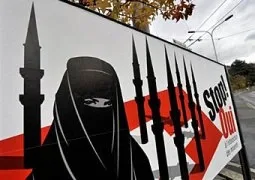
The campaign committee for banning minarets in Switzerland used rather aggressive agitation
A majority of Swiss who went to the polls on Sunday – 57.5% – voted for a ban on the construction of minarets of Islamic mosques on the territory of the confederation. The citizens' expression of will has the force of law, and the ban will take effect once the referendum results are confirmed. All formal requirements for organizing the referendum were met. Opponents of minaret construction won in most cantons and half-cantons – 22 out of 26.
The Swiss constitution, which enshrines freedom of religion, will be supplemented with a provision banning the construction of prayer towers. "Consequently, the construction of new minarets in Switzerland is no longer permitted," said a statement from the federal government issued after the voting results were announced.
The ban will not affect the construction of new mosques or prayer houses. It also does not apply to existing minarets in the country.
The head of the Ministry of Justice, Eveline Widmer-Schlumpf, who was responsible for Islamic affairs in the government, said vaguely immediately after the referendum results were announced that the voting results are "an expression of certain concerns among the population regarding Islamist extremist movements." Citizens' opinions should be taken seriously, but "we should not forget that Switzerland remains an open country."
Her colleague in the government, Micheline Calmy-Rey, who heads the Foreign Ministry, tried to explain that by their vote the majority of Swiss did not want to "reject the Muslim community," and in general, such results should be seen in the "general context of the economic crisis."
Around 400,000 people, or about 5% of the total population, consider themselves Muslims in Switzerland. At the same time, there are only four minarets for 150 mosques, and local authorities have refused the Muslim community permission to build new ones for years under various pretexts. The consent of the municipal authorities of the city of Langenthal in 2007 to add a minaret to a mosque that unites about 3,000 Muslim families sparked a nationwide protest campaign.
Support for the ban on minaret construction came not only from far-right organizations fighting "Islamofascism" or those concerned about the rise of Islamic extremism. The largest parliamentary party, the Swiss People's Party, also voiced support.
According to one of its representatives, MP Ulrich Schlüer, a minaret is "a political symbol of opposition to integration, support for segregation, and above all, imposition of Sharia as a norm parallel to Swiss legislation."
The organizing committee of the campaign "Yes to the ban on minarets in Switzerland" used aggressive agitation. Posters were plastered across the country showing minarets bristling like rockets reaching up against the background of the Swiss flag, which, being trimmed at the edges, resembled a coffin. In the foreground, a Muslim girl shrouded from head to toe in black loomed. But until very recently, public opinion polls indicated that the proposal would not pass.
The ruling coalition of Christian Democrats, Social Democrats and Radical Democrats opposed the constitutional amendment. "The Federal Council (government) remains of the opinion that a ban on minaret construction is not an adequate measure to curb extremist tendencies," the British television channel BBC quotes Widmer-Schlumpf.
The validity of the referendum will be challenged. As Manon Schick, head of the Amnesty International office in Geneva, stated, Sunday's decision violates international law and the obligations undertaken by the Swiss Confederation to the world community. In her words, the ban is also meaningless, since 90% of Swiss Muslims come from Turkey and Kosovo, only some of whom observe all the ordinances of the Prophet Muhammad. This also applies to wearing traditional Muslim women's clothing.
The decision of Swiss citizens could seriously complicate Bern's relations with the Islamic world and call into question Switzerland's traditional role as a neutral country and arbiter in international conflicts. Moreover, there could be an outflow of capital that Arab sheikhs keep in Swiss banks, warns the newspaper Tribune de Genève.
The referendum took place just days after the completion of the Hajj, when millions of pilgrims are still in Saudi Arabia and can follow news from Switzerland from pilgrimage centers, notes the newspaper Le Matin, especially since coverage by Arabic-language channels cannot be called favorable. "According to our information, some (Swiss – Gazeta.Ru) embassies on Muslim soil began barricading themselves yesterday," reports Le Matin.
The voting results have displeased both the European left and the American press. French Foreign Minister Bernard Kouchner declared he was shocked by the Swiss decision. "First some German states banned headscarves for Muslim teachers in public schools, then the French deprived Muslim women of the right to wear the hijab, now this. What next? Imprisonment for those who practice Islam?" laments Muhammad Anwar, a columnist for the online publication Examiner.com.
The Wall Street Journal holds a different opinion. "Swiss direct democracy shows its character when Swiss voters use it to oppose their own political elite, as happened this time," says the editorial of the business publication.
Alexander ARTEMYEV.
Gazeta.Ru er="0">