
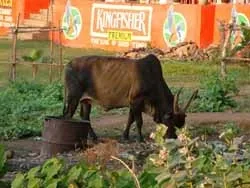
Embodiment of virtue, the cow
“Cows are sacred. They are the embodiment of virtue,” says the Rigveda, a collection of Indian religious hymns, some of which date back to the middle of the 2nd millennium BC. Since then, Hindus have been forbidden to eat beef, kill cows, or commit any violence against them. Cows roam Indian cities without fear; in Delhi, killing them is prohibited by law. Sometimes a male or female herder accompanies them, who, for a coin, will give a willing person some grass to feed the sacred animal. This is a blessing.
But, as usual, there is another side to the coin. Delhi is a large city with an extensive transport system. Unattended livestock wandering on roads and resting on the roadway have become a serious threat to it. Indian cows have a peaceful nature, but easily become frenzied due to inevitable road noise. They cause serious traffic accidents and multi-kilometer traffic jams. Delhi authorities speak of nothing less than a “cow threat”. And they fight it as best they can.
In 2005, a reward of about 23 pounds sterling was promised for each captured stray cow. This measure only led to owners turning in their own cows, collecting the reward, and then demanding the cows back. In 2006, microchips were implanted into the throats of captured livestock. It was assumed that by scanning the belly of a newly discovered cow, employees would learn the animal’s personal number and the owner’s name. Subsequently, this measure was also abandoned.
This year, the Delhi authorities submitted a new plan to the Supreme Court of India. Strictly speaking, the cows roaming the streets are not ownerless. These 28,000 head belong to the owners of about 2,300 illegal dairy farms, who, to save money on feed, prefer to let their cows graze on sparse grass and garbage in the city. The Delhi authorities’ plan provides for the creation of a giant dairy farm in the suburbs. All owners will be required to buy plots there. The city government promises to comfortably house the sacred ungulates there, and then introduce high fines for dairy farmers conducting business outside this farm.
However, Delhi’s dairy farmers are not so simple. They are influential people in the city; many voters listen to their voice. Moreover, well-wishers often warn owners that the “cow truck” is approaching, and the livestock manage to hide. But that’s not all - some cows are caught so often that they easily recognize the catcher’s truck and flee when it approaches. Thus, tradition repeatedly triumphs over common sense, and the authorities’ good intentions remain fruitless.
The monkey god Hanuman
The monkey deity Hanuman, hero of the ancient epic Ramayana, is the embodiment of devotion, courage, justice, and strength. Hanuman is a teacher of sciences and patron of village life. The cult of Hanuman, the noble monkey, is one of the most popular in Hinduism. However, monkeys are one of the most serious problems of modern Delhi.
Rhesus macaques roam the streets, sit on trees, roofs, and fences of government buildings, companies, and private homes. They can even be found in the metro. Windows cannot be left open - the small reddish creatures are just waiting for a chance to get inside to look for something edible. In 2004, a scandal occurred at the Indian Ministry of Defense: top-secret documents were scattered on the street around the ministry building. The blame was placed on rhesus macaques that had somehow gotten inside.
The city authorities tried every effort to deal with the relatives of the god Hanuman, of which there are an estimated 5,000 individuals in the Indian capital. Monkeys were rounded up and locked in a large prison specially built for them in the suburbs of Delhi. Langurs, another type of monkey, were set on the rhesus macaques like guard dogs. Langurs used their sharp teeth and strong tails, whipping the errant macaques to drive them away from windows. The Delhi authorities would have been happy to take the uninvited guests to the jungles outside the state, but there were enough monkeys there. Eventually, the Supreme Court of India took pity on the capital and ordered 300 individuals to be taken to the forests of Madhya Pradesh. But then environmentalists were unhappy: in their opinion, Delhi’s macaques are too urbanized and would not survive in the wild jungle. Moreover, when the monkeys were rounded up, some were injured and many cubs lost their mothers.
Despite the fact that monkeys annoy everyone, not just the government, the authorities are completely alone in fighting the “monkey threat”. As of today, the Delhi administration has only three monkey catchers on staff. Religious Hindus do not want to catch the relatives of a revered god. They prefer to feed rhesus macaques peanuts and bananas, especially on Tuesdays, the day of Hanuman, and keep their windows closed the rest of the time.
Ganesha, the elephant-headed god
Ganesha, the son of Shiva, the elephant-headed god of luck and wisdom, is loved and revered by Hindus no less than Hanuman. It would not be an exaggeration to say that Ganesha is the most popular of India’s deities. Any ritual or ceremony begins with praise to Ganesha. He is the god of writing and is often compared to the Greek Hermes. However, his close relatives, the Indian elephants, are treated in the capital far less respectfully than he is.
And here the Delhi authorities can be understood. An elephant is comparable in size to a large car, but moves much slower. Elephants on the roads are a frequent cause of traffic jams. Fortunately, elephants are not rhesus macaques or even stray cows. There are not so many of them that they need to be taken to another state or put in prisons. Therefore, a solution to the “elephant problem” was found, and not too radical a one.
To begin with, the city authorities obliged drivers and owners to obtain numerous permits to enter Delhi. Then they established special elephant traffic rules. Animal owners and traffic police agreed that elephants, like heavy trucks in some big cities, can move freely around the city from 10 pm to 6:30 am. During the day, elephants are also allowed to move, but only from 12 to 3 pm, between the morning and evening rush hours.
If the city authorities had wanted to completely remove Ganesha's relatives from the streets, nothing would have come of it. Tourists cannot imagine the capital of India without elephants. Moreover, many Hindu religious ceremonies require the presence of this majestic animal. So the god Ganesha protects Indian elephants from complete expulsion from Delhi. Although who knows? Maybe elephants only dream of that.
Religious Hindus, as well as foreign lovers of Indian identity and opponents of cultural globalization, will of course call the Delhi authorities' efforts "betrayal of traditions." But not everything that is suitable for a small village lost in the jungle is suitable for a big modern city. India has surpassed itself - its development as an industrial, technological country does not correspond to the traditional mentality of most Indians. One cannot help but sympathize with the Delhi authorities, as Lenta.ru notes, they have been burdened with the difficult task of maintaining peaceful coexistence of traditions and modernity without secret documents scattered on the street and without casualties on the roads.