
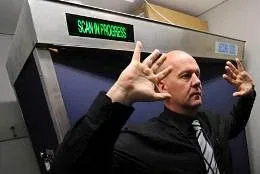
Europeans are dissatisfied with new airport security systems
The first and most meticulous were German doctors, who initiated a full interagency investigation into the safety of various airport screening systems. It should be noted right away that active scanners (booths or special portals) – which operate on a principle similar to medical X-ray, most often used in screening, are largely American-made. For example, the most common scanner in Western airports, the Secure 1000, is produced by the California company Rapiscan.
The Germans, however, are concerned about the health damage inevitably caused by all emitting devices. 'X-rays are ionizing radiation that directly harms the cells of the human body. Therefore, one cannot speak of any safe waves suitable for screening and use in corresponding devices,' says a special statement issued on this matter by the German Ministry of Health. It was preceded by an appeal from physicist Helmut Essen of the Fraunhofer Institute for High-Frequency Physics and Radar Technology, who claims that in practice, real X-ray machines are being used for security purposes, and it is unethical not to inform citizens of the associated risks.
Another aspect of this kind of 'protection' from air terrorism that Europeans categorically dislike is ethical. And this concerns precisely the latest scanners, whose operating principle is closer to computed tomography. The US administration is now insisting on their widespread introduction. In this case, in addition to radiation, there is the ability to screen passengers without their knowledge.
The method allows screening people in motion and requires no special booths or enclosed spaces. As a result, passengers can be fully scanned on the go, without even knowing it. The image quality is simply stunning: the projection can reveal the human body in all detail, including the slightest skin damage or bruises, not to mention moles and birthmarks.
Such 'tomographs,' for example, like the Gen-2, were developed back in 2004 in American Richland and are now undergoing the final stage of testing. If they appear in North American airports, Europeans promise to collectively oppose virtual public 'strip-searching.'