
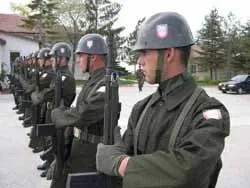
Another striking distinctive feature of the military is the meticulous arrangement of their daily life. If behind some fence you see literally a sea of green spaces, neat paths, fountains - that is the territory of a military unit. In cities, public places for some reason do not abound in vegetation.
Professional military personnel live in closed, well-guarded towns where infrastructure is excellently developed: there are shops, schools, hospitals, recreation areas, household services. Prices for all goods and services are 1.5 to 1.8 times lower than outside the town. You will never hear about a queue of homeless among the military. There everyone has official housing. And only before retirement, using the accumulated funds that are mandatory monthly deducted into a special fund, one can buy a good house.
For example: a colonel before leaving military service will have approximately $180-220 thousand in his account. Plus he will be given several tens of thousands of dollars from an auxiliary fund, and also provided with a job in a structure controlled by the military department. If he wants, of course. Therefore, being a professional military in Turkey is very prestigious.
Today, Turkey is perhaps one of the few countries in the world where professional military feel like true masters of their country. Universal military conscription still exists here, and the concept of alternative service is completely absent. On this ground, in a country with long military traditions, attempts have been made to stir up a scandal with the help of the media. But traditions and foundations laid long ago proved stronger. Therefore, a man who for some reason has not served in the Turkish armed forces does not have the right to hold a leadership position.
And it all started with some historical events of the century before last...
On March 12, 1881, a nondescript boy named Mustafa was born in Thessaloniki. At the age of 12, he entered a military school, where he showed extraordinary abilities in mathematics. For this he received the nickname Kemal ('Maturity and Perfection'). In 1895, he successfully passed exams and entered the Monastir Military Academy, which he graduated in 1905 with the rank of lieutenant. Then there was the General Staff Academy in Istanbul, after which he received the rank of captain and an assignment to Damascus.
Gazi Mustafa Kemal Pasha, from the moment he entered military service, literally became attached to the political processes taking place in the country and Europe. Feeling their destructive influence and trying to save the country from internal squabbles, he subsequently actively used his commanding position in the army for political agitation. Between 1904 and 1908, he organized several secret societies to fight corruption in the government and army. During the 1908 revolution, he disagreed with the leader of the Young Turks, Enver Bey, and withdrew from political activity. He participated in the Italo-Turkish War of 1911–1912 and the Second Balkan War of 1913.
During World War I, Mustafa Kemal commanded the Ottoman troops defending the Dardanelles. After the war, having already acquired the status of an authoritative military leader, he did not recognize the capitulation and partition of the Ottoman Empire under the Treaty of Sèvres. After the landing of Greek troops in Izmir in 1919, Atatürk organized a national resistance movement throughout Anatolia. Because of this, relations between Anatolia and the sultan's government in Istanbul were severed. In 1920, Kemal was elected chairman of the new Grand National Assembly in Ankara. Atatürk recreated the army, drove the Greeks out of Asia Minor, in 1923 forced the Entente countries to sign the more equitable Treaty of Lausanne, abolished the sultanate and caliphate. In the same year, he founded the Turkish Republic and was elected its first president. By the way, he was re-elected to this post three more times in 1927, 1931, and 1935.
At the head of the country, Kemal carried out large-scale reforms aimed at modernizing the country, including gender equality and the transition to the Latin alphabet.
Mustafa Kemal died in Istanbul on November 10, 1938, from liver cirrhosis caused by common alcoholism. However, the latter did not affect his authority in any way. To the question: who is Mustafa Kemal? - one of our compatriots who has been living in Turkey for a long time replied that he is 'cooler' than Lenin.
What is Kemal's 'coolness'? It turns out that in addition to participating in battles, he pursued a policy of modernizing the Turkish state and society along Western lines, reformed the education system, and abolished the institutions of Islamic law. After several rebellion attempts, Kemal was forced to dissolve the opposition Progressive Republican Party (and in 1930 its successor, the Free Republican Party) and move to more authoritarian methods of governance, necessary for effectively carrying out reforms in traditional Turkish society.
Thanks to Mustafa Kemal, in 1928 gender equality was proclaimed in Turkey, women received the right to vote. In the same year, the Latin alphabet was introduced instead of the Arabic one.
During the six years after the proclamation of the republic, reforms very difficult for Turkey at that time were carried out. One of the mentally challenging stages of the reform was the mandatory change of surnames for all citizens. Until then, only names and nicknames were used in the empire, which were usually associated with a person's profession or other characteristic features and were not inherited by children.
On November 24, 1934, President Mustafa Kemal was the first to receive a surname assigned to him by parliament. He was named 'Atatürk,' which translates to 'Father of the Turks.' Also, all titles of the old regime were abolished and replaced with the forms of address 'Mr.' or 'Mrs.' Another law mandated the introduction of a new time system, a new system of measurement units, and a calendar corresponding to international standards.
Difficult and often unacceptable were these changes on the scale of a nation, the absolute majority of which professed Islam. However, despite difficulties and obstacles, Mustafa Kemal sought to revive the Turkish national idea based on the creation of a superpower. Mustafa Kemal was a military man by education, and by no means an economist. But his talent as a state-builder helped him correctly lay the fundamental foundations of economic development. In the economy, he pursued a policy of nationalization and reliance on national capital. Ataturk's foreign policy was aimed at achieving full independence of the country.
Ataturk carried out his planned reforms consistently and quickly, without wasting time. This was also facilitated by his talent as a brilliant orator. The word 'civilization' was constantly repeated in his speeches. 'The path to developed civilization, to renewal' – that was one of the president's main goals.
He loved children very much; he had eight adopted ones – the son of a former shepherd and seven daughters, whom he eventually sent to study at the best schools and universities in the world, where they received a brilliant education.
Mustafa Kemal was a wealthy man and believed that citizens with a poor psychology could not make the state rich. Shortly before his death, Ataturk donated his lands to the treasury, part of his real estate to the municipalities of Ankara and Bursa, the Turkish Linguistic and Historical Societies, and the rest to his sister and adopted children. This step further raised the level of respect in society for the first president of the country.
Under Ataturk's successors, his posthumous personality cult developed, reminiscent of the cult of Lenin in the USSR and generally the founders of many independent states of the 20th century. In every city in Turkey there is a monument to Ataturk, his portraits can be seen in all government institutions, on banknotes.
After his party lost power in 1950, the veneration of Kemal continued. A law was passed according to which desecration of images of Ataturk, criticism of his activities, and denigration of the facts of his biography are recognized as a special kind of crime. In addition, wearing the surname Ataturk is prohibited. To this day, the publication of Kemal's correspondence with his wife is forbidden, as it gives the image of the father of the nation too 'simple' and 'human' appearance.
Today, the Turkish military continues to idolize Ataturk, rightly considering their current high position in society as his merit. It is his versatility as a military commander, politician, diplomat, and a person beloved by the people that is embodied in every Turkish serviceman. And one can take their word for it – none of them consider themselves poor. Perhaps that is why the country is growing rich and prospering.