
The first to pour into their former colony were, of course, the Italians. Their speech can be heard on every street corner, at every market selling leather goods, oriental spices, and North African exotic items. They sigh, tilting their heads back, looking at the small balconies of the whitewashed two-story houses that their ancestors once built here. They probably want to stay.
The capital of Libya is Tripoli. There are no problems with hotels; however, it is not customary here to classify them by a "star" system. All major Libyan hotels correspond to a good five stars. The price of staying in them ranges from $50 to $200 per day for a single room. The room always has soft carpets, air conditioning, and a TV, and the curtain design is specially designed to hide the dwelling from the sun. However, apart from one national channel, there is nothing to watch on TV. This is not Qatar, where hotels have up to 300 satellite television channels. The buffet in hotels abounds with a large number of vegetables and various lamb dishes. Here, as in Egypt, they love to eat.
But lovers of alcohol will have a hard time in Libya: it is strictly prohibited. Even diplomats drive to neighboring countries to buy alcohol and bring it in tightly closed boxes without markings. It is said that once, Russian technicians carrying out commissioning work at one of Libya's energy facilities, to solve the alcohol problem, brought a bag of yeast with them. No explanation is needed for why. At Tripoli airport, the precious bag was safely lost. Only two days later the Russians were told that the luggage had been found. The owners arrived at the airport customs and saw the following: the bag of yeast, in the heat of 35 degrees, had taken the shape of a large soccer ball and, before their eyes, burst with a sinister hiss. The Libyans, as if on command, unanimously plugged their noses.
– What do you have there?
– This is national food.
– Why does it smell so bad? Has it gone rotten?
– No, the food is fine. The Chinese also eat slightly rotten fish, and this is our slightly rotten food.
The Libyans never understood anything, but they asked to take the bag out not through the general airport hall, but through a service corridor.
The national currency of Libya is the Libyan dinar (LD). One LD consists of 1,000 dirhams. Banknotes in denominations of 250 and 500 dirhams, 1, 5, and 10 dinars, and coins of 50 and 100 dirhams are in circulation. Diners Club and Visa credit cards are accepted only on a limited basis in major hotels and at the airport. Traveler's checks, due to sanctions imposed by the U.S. government, are not accepted at all.
The circulation of foreign currency is formally prohibited, but at any market, a trader will gladly accept euros and dollars from you.
Currency can be exchanged at banks and at officially authorized exchange offices. Opening hours: in winter – from 8 a.m. to 12 p.m., Saturday through Thursday; in summer – from 8 a.m. to 12 p.m. Saturday through Thursday and from 4 p.m. to 5 p.m. Saturday through Wednesday. This strange-for-Europeans schedule is explained simply: from 8 to 12 there is no heat. By noon, the sun rises and the lunch break begins: employees go home to wait out the hottest hours. On Thursday, Libyans work only the first half of the day, until 12, and then prepare for Friday. Friday is a day of prayers. On Saturday, not all institutions work in Libya: many take Saturday as an additional day off and use it for household chores.
Since alcohol was banned by the government in 1969, many restaurants have closed, and the existing ones are relatively expensive. Dinner for two in a mid-range restaurant will cost you $45.
Libya has exotic items that you won't find in overused places like Egypt. For example, at the market you can buy a woman's handbag made from the skin of a whole small white crocodile with a clasp made from its head, or some rare handmade fabrics made by Berber women. All this will cost no more than $50-60. In Europe, such goods would be offered to you for $400-500.
Tripoli itself does not stand out with any major ancient structures or monuments. The Italian fort in the city center, on the balcony of which once a year – on the Day of the Libyan Jamahiriya – the permanent leader Muammar Gaddafi appears, and the waterfront with small snack bars and restaurants – that's all.
The main attractions of Libya are ancient Roman cities. The most famous of them is Leptis Magna. It is located 100 km from Tripoli. From Tripoli to Leptis Magna is an hour and a half drive by car. The road runs along the sea coast. A car with a driver will cost $50–100 per day. A tour of the city costs $10.
Beautiful triumphal arches crown the entrance to Leptis Magna. The entire city is just five streets with two-story houses and ruins of thermae, baths, a stadium, a hippodrome, and numerous alleys for walking. The first thing that catches the eye is the mosaics and multi-colored marble of the columns.
Curiously, in Libya, cities were not destroyed by barbarians or Christians. The antiquities have been preserved in the form in which nature has brought them down to our days. Here and there you can see silent restorers and archaeologists from Italy trying to restore the great past of their ancestors. Tourists are still few – no crowds of Japanese, no loud-speaking guides.
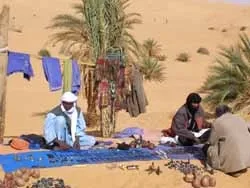
You can also go by jeep to the Libyan desert and stop in a remote Berber village. Here you will be treated to sweets and oriental coffee. It should be remembered that people with high blood pressure should not drink such coffee. The Berbers boil it in large jugs over a fire for 6–12 hours, pouring the liquid into smaller jugs after each cycle. In the end, you will be served a tiny cup of coffee, the caffeine content of which will be equal to a hundred servings of black coffee in Europe. But if it happens that you drink such coffee and feel your heart pounding, ask for a glass of cold mint water – it will bring you back to life.
The most comfortable months for tourism in Libya are April, May, September and October. This is primarily due to the water temperature: the sea is still the Mediterranean and it cools down. Since tourism in Libya is in its infancy, there are not many beaches here. Only here and there the coastline is cleared and turned into paid beaches. The rest of the coast, unfortunately, resembles a large garbage dump. And in the air there is an unusual ringing – it is the coastal surf throwing empty Coca-Cola cans onto the shore. Libyans, like Arabs in general, do not pay enough attention to the garbage problem.
Overall, Libya is an interesting country for the history tourist and the extreme tourist. It cannot be called cheap, but it is free from the noisy crowds of travelers clicking their cameras. The Libyans themselves are very friendly to visitors. Unfortunately, they do not speak foreign languages well, but they will not pass by and, wanting to help, will certainly listen to you with great attention.