
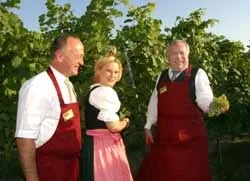
Styria is one of the Austrian wine regions, well known far beyond its national borders for its excellent wines and fantastic landscapes. The wine regions are concentrated in the very south of this Austrian federal state, along the border with Slovenia. There are just under 1,800 hectares of vineyards here, and several dozen wineries of the highest level.
SCHILCHER IS NOT A SURNAME
Gastronomic trips to Styria usually start from its capital. To the ancient city of Graz – just half an hour by plane from Vienna or a couple of hours by car. A day or two can be spent getting acquainted with Styrian life: go to the market and find out why local cheesemakers produce cheeses with pumpkin seeds inside and how they stuff them in, as well as buy a few bottles of the signature radical green Styrian oil made from the same seeds, and try a dozen different types of ham with varying degrees of smokiness. The preliminary program also includes visiting several national cuisine restaurants and wine bars, which will help to get oriented in the realities of a Styrian feast.
Further on, the path usually leads to the city of Deutschlandsberg, quite large by local standards, southwest of Graz. It is known primarily for a real and very old castle standing on a wooded hill. From the windows of the hotel located in it and from the restaurant terraces, a breathtaking panorama of typical Styrian hills with geometric rows of vines opens up. Most likely, this is a special late-ripening variety of dark grape Blauer Wildbacher, from which Schilcher is made – either rosé or red, but a very original dry wine. It is produced only here, on a narrow and long strip of land stretching from north to south – only 450 hectares under vine. On local maps, a special route is marked – Schilcher Weinstrasse, that is, "Schilcher Wine Road". Thematic guides provide a list of winemakers that can be visited (by prior arrangement) for a tasting of the red-pink specialty, and restaurants where traditional Styrian food is offered with it. Schilcher is drunk young and almost all of it is consumed before the next harvest. At the same time, a special sticker with the trademark of real Schilcher – a silhouette of a white horse – is mandatory on the bottle neck. A special pride of these places is sparkling Schilcher, cheerful and festive.
And yet this is only a small part of the wine and gastronomic resources of hospitable Styria. In these parts there are about a dozen "wine roads" developed for the convenience of traveling gourmets, each with its own unique attractions. Road signs at local intersections require time to digest the information: dozens of plaques with names of wineries, hotels and restaurants are usually attached to the posts. Even cycling and horseback riding routes through wine areas are offered to lovers of active recreation.
FIRST TO THE MUSEUM, THEN TO THE CELLAR
In the town of Kitzeck, at the very center of the Sausaler Weinstrasse wine route, a Museum of Viticulture and Winemaking is housed in an old 17th-century village estate. Hundreds of rare exhibits give an idea of technological processes, wine culture and traditions. And quite nearby is the farm of the Wohlmuth family, which has been making wine for the third century. This winery is known for its products from Sauvignon Blanc (by the way, signature for all of Styria), as well as Chardonnay, which in these parts is called differently – Morillon. In 2001, Gerhard Wohlmuth was named "Winemaker of the Year" in Austria, so he certainly knows his craft. If you visit this winemaker, be sure to try the wine from his Steinriegel vineyard, which is located at an altitude of 450 to 520 m above sea level.
After visits to the museum and the wine cellar, you will certainly want to have lunch. This can be done nearby, at the Steirerland restaurant. Especially good there are various dishes with Styrian pumpkin – from soup to dessert. The restaurant has a hotel where you can stay overnight, and the whole complex stands on a high hill, from which a wonderful panorama opens up for many, many kilometers.
The central point of the South Styrian Wine Road is the small town of Gamlitz and, again, with a wine museum. You can stay overnight here at a hotel with a name typical for these places, Weinlandhof, which can be translated as "Wine Estate". In addition to the standard set of services for a four-star establishment, guests are offered various packages for 4, 6, or even 8 days, which include, for example, a bicycle tour of the local vineyards, visits to wineries and wine restaurants, a tasting menu with local wines, as well as a number of general wellness procedures such as massage and infrared sauna, because wine and gastronomic tourism also requires a certain level of endurance.
At the Sattlerhof estate south of Gamlitz, remarkable white wines are made. The local Sauvignon Blanc is especially famous. And it is also a good example of a harmonious combination of winemaking and tourism: guests are received here from mid-March to mid-December, providing them with all the opportunities for a thorough acquaintance with winemaking technology in general and their products in particular. The small hotel and restaurant serve not just national, but regional Styrian cuisine, accompanied by delightful views of the typical Styrian hilly vineyards. Gastronomic travelers are received here in full: tour, tasting, purchase of favorite samples.
NIGHT ON THE VINEYARD
Further south lie the estates of the Polz brothers. This estate is particularly famous because its vineyards are located on the best slopes in the area with proper soils and exceptionally picturesque views. They are called Grassnitzberg and Hochgrassnitzberg. Recently, you can also spend the night here: right among the vineyard, at the very top of the unique hill, the Polz brothers built a luxurious hotel. And in the morning, you can walk from there to the nearby Tement winery. Connoisseurs come from far away especially to admire the local Zieregg vineyard, which cascades like an amphitheater towards the Slovenian border. It's easy to view: for this, a special open terrace is provided in the new winery complex, which is well integrated into the hilly landscape.
In the very south of Styria, almost on the border with Slovenia, there is a small wine road with the funny name Klapotetz-Strasse. The word 'Klapotetz' has become established in German, although it is of Slovenian origin and on both sides of the border means the same thing: a huge rattle-weather vane on a high pole that scares away birds from the vineyards.
But for connoisseurs and lovers of stronger drinks, the direct road leads to the town of Wernersdorf, to the family business Jobstl, known for its schnapps far beyond Austria. For many years it has been led by Waltraud Jobstl. This fragile woman, when necessary, easily pours a bucket of fresh schnapps into a metal barrel, while explaining the basic principles of blending fruit and berry spirits. The bar counter at this enterprise would do credit to many pretentious restaurants around the world, and the collection of gold medals received at the most prestigious alcohol competitions in different parts of the world is truly unique.
P.S. A small but useful tip. Politely ask every winemaker you meet about wine from the Gelber Muskateller grape. Even if a particular estate does not have such wine, the Styrians will still appreciate your knowledge: this is a very old variety, but it is rare and quite finicky. However, the presence of such wine in the product line is a sure sign of a high-class winemaker.