Padua is a relatively small city in northeastern Italy. It has long been famous for the openness and friendliness of its inhabitants: 'Paduan hospitality' for Italians is the same as 'Caucasian hospitality' for us. Perhaps that is why several years ago one of the immigrant reception centers was built here – and it was with this that the story of the 'Paduan wall' began.
The management of the Center pays for Italian language courses for its charges. The company providing these services accordingly rents premises from one of the local schools. For a long time, this did not bother anyone, but in mid-2007, complaints began to arrive at the school principal from parents of some students. They did not like that in the schoolyard, children were literally surrounded by a crowd of adult migrants – students of the language courses.
A crowd – because the number of migrants accepted in Padua has sharply increased in recent years, and it is no longer a couple of dozen people constantly at the school, but about a hundred, – as the newspaper Reppublica wrote, with a tendency for this number to increase. Moreover, 'outsiders' began to appear in the schoolyard, having no direct relation to either the center or the language courses – illegal refugees who had chosen the school as a meeting place.
They did nothing wrong and did not harm the children. However, worried parents decided to be on the safe side and demanded that the school management take measures so that during breaks their children would remain among their own. Thus the school administration found itself in a stalemate: the lease agreement with the company teaching immigrants Italian is, as they say, 'serious and long-term', and the money it pays for rent is far from superfluous in the school budget. But the demands of the angry parents cannot be ignored either, otherwise the school will simply lose its students and its good name as well.
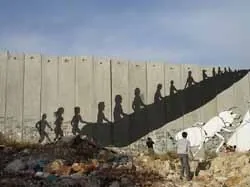
And then a truly Solomonic solution was found: to build a concrete wall in the schoolyard that would separate the Italian children from the adult immigrants. Such construction is not cheap, but it is still an acceptable loss compared to other options. And the parents promised to help – some with money, some with physical labor for the common good... Interestingly, one such wall already exists in Padua – a solid steel structure 80 meters long and 3 meters high, erected by order of the local municipality in August 2006. It has no direct relation to migrants, but separates one of the city's troubled areas, turning it into a kind of 'colony for the poor'.
It is hard to blame the good people of Padua for xenophobia or arrogance: after all, a school should remain a school, and its main job is to teach children. And a hundred adult 'students' constantly milling around in the schoolyard hardly contributes to the educational process – any teacher will say that. In all this turmoil, the only thing irretrievably lost was the legendary Paduan hospitality. Obviously, such concepts are indeed becoming a thing of the past in modern society. Instead, on the erected 'Paduan wall', one should inscribe the title of a famous Soviet feature film – 'Strangers Do Not Walk Here'.
Boris ALTNER.