
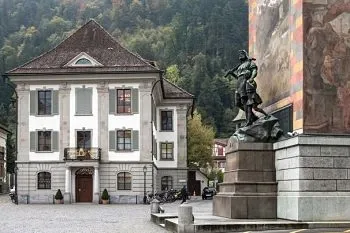
City Hall of Altdorf (Canton Uri): here citizens can by law be compelled to take on a political office
That is why, as Swissinfo.ch writes, in a referendum on June 5, 2016, for example, the people of the canton of Uri voted to amend local legislation so that a citizen who refuses to take a political office can be fined up to 5,000 francs.
Johanna Tschumi was elected in 2008 to the council of the municipality of Bauen in the canton of Uri, even though politics was never part of her life plans under any circumstances. She was unable to decline this honorary position. Even relevant medical certificates did not help. So she had only one option: move to a neighboring village six kilometers from Bauen and return home only on weekends.
Soon, two more "reluctant ministers" followed her example, which caused the municipal council to lose its quorum and the right to make any decisions. A plot of an absurd comedy? But in many Swiss cantons of German-speaking Switzerland, such a situation is not a bad joke but a real reality. The order allowing citizens to be "compelled" to engage in politics in certain positions in local executive or legislative bodies is now in effect in the cantons of Zurich, Schaffhausen, Nidwalden, Solothurn, Graubünden, Valais, Uri, and Appenzell Innerrhoden.
Switzerland's political system is based on the so-called "militia principle." This means that citizens engage in political activity as if in an "amateur format," holding various posts, including parliamentary mandates at the federal level, while keeping their main job. This kind of "militia system" is one of the main pillars of Swiss direct democracy. It prevents politicians from turning into a "political class" detached from life and ordinary citizens, and on the other hand, it opens up "social elevators" for all citizens, through which any cook can truly govern the country.
Let us clarify – indeed can! Because by default, everyone in Switzerland still assumes that a person will want to engage in politics on their own, and there is no need to compel them. And in fact – never once has anyone in Switzerland had to be forced to run for the federal parliament.
A completely different situation is now developing at the local level, primarily at the municipal level, where democracy actually lives, where what sociologists call the "social base" is formed and operates. In Switzerland, it is well understood that without strong municipalities, without a powerful local/municipal level equipped with political, financial, and economic resources, democracy in the country cannot survive. And now it turns out that even in Switzerland, people are increasingly inclined to sit on the couch, drink beer, and wait for what "those at the top" will say.
"The Swiss 'militia system' emerged and took shape during the period of the Old Regime that existed in Switzerland from roughly the end of the 15th century until Napoleon's invasion in 1798. It was a form of 'fraternization' between the ruling class and the common people," says political scientist and expert Claude Longchamp. "Then under Napoleon's blows, the Old Regime fell, and the country began contradictory processes of democratization that led to the creation of the modern federal Swiss state in 1848. But the militia system, strangely enough, survived all these events and proved quite suitable for the New Regime as well."
Yes, it survived wars and revolutions because both in the Middle Ages and now, it was a social elevator without which no society can exist. However, today this elevator is at risk of getting stuck somewhere between the floors of the Swiss political system. The burden on members of municipal and communal councils is growing, while earnings remain quite modest.
"Finding people who could fill vacant positions in local legislative and executive bodies is most difficult in medium-sized communities and municipalities with a population of 5,000 to 10,000. It is there that there are often not enough volunteers ready to take on these indeed quite burdensome duties," says Claude Longchamp.
This is largely due to the features of modern life, new standards defining attitudes towards housing, family planning, connections with other people, and so on. The mobility of the population has sharply increased; people no longer feel inextricably linked to their historical homeland. Modern society and economy imply the emergence of alternative living spaces and projects, which of course imply a greater degree of individualism among citizens.
Incidentally, in a recent interview with Swissinfo.ch, former Swiss President Adolf Ogi also complained about the difficulties his hometown of Kandersteg faces in finding people willing to engage in politics at the local level. According to him, the situation has changed for the worse since the 1950s: "At the last municipal assembly, one board member resigned, and a replacement has still not been found.
And it is precisely in this situation that many cantons and municipalities of Switzerland decide to introduce a system of compulsory recruitment and appointment of citizens to responsible political posts, even though many criticize this procedure for forming local authorities as 'a veritable anachronism.'
But this happened, for example, in the canton of Uri, where based on the results of a referendum held on June 5, 2016, the people voted to introduce amendments to local legislation, according to which a citizen who refuses to take a particular political post can be fined up to 5,000 francs. In fairness, it should be noted that not everything is as scary as it seems at first glance.
First, the obligation to hold political posts ends upon reaching the age of 65, which was not the case before. In addition, a person can refuse election by citing truly 'valid reasons and insurmountable circumstances.' And if such a law had come into effect as early as 2008, Johanna Tschumi would not have had to move to a neighboring village. By the way, she eventually took a position on the board of the municipality of Bauen – but voluntarily, after retiring.
'If everyone just sits around and watches TV, we won't achieve anything; the community will simply die. Everyone must contribute what they can to the common cause,' she says, emphasizing that forcing 'civic virtue' is nonetheless an overreach. Other ways must be found to increase the attractiveness of political activity at the local level, especially since 'in today's society with all its stress factors and the need to work and earn, preferably well, many simply cannot afford to engage in municipal politics.'
Meanwhile, in the municipality of Bauen with a population of 150, a vacant seat on the board has appeared again. And if no volunteers are found, then at the autumn general assembly, citizens will be forced to simply appoint someone to the post. Then that unlucky person who draws the 'short straw' will have only three options: agree to work for the benefit of society, pay 5,000 francs in 'hush money', or start packing their bags.
Sybilla BONDOLFI.
Translation by Igor Petrov.