
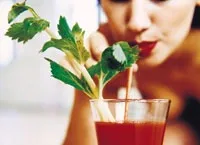
Strictly speaking, the holiday's date is chosen quite arbitrarily. After all, 1933 is not the time the cocktail was created, but the time it appeared in the USA. "Bloody Mary" came to the country along with the repeal of Prohibition, which in itself makes this drink very symbolic for Americans. Moreover, as already mentioned, the appearance of "Mary" coincided with the Great Depression - a period when US citizens had plenty to drown in a glass. Perhaps even now, the main reason for honoring the drink is not some calendar date, but the global financial crisis?
But let's return to the history. It is believed that the "Bloody Mary" was first prepared in the 1920s in Paris. Even within this version, different sources name two different people as the authors of the cocktail: Fernand Petiot and Ligue Pstio. In addition, there is another version according to which "Bloody Mary" was created by American George Jessel even later than 1933 - in 1939.
The origin of the cocktail's name is also ambiguous. "Officially" it is associated with the name of the English queen Mary I Tudor. This ruler was known for her brutal repressions and earned the nickname "Bloody Mary" during her lifetime in the 16th century. Obviously, the person who gave this name to the cocktail in the 20th century was familiar with the nickname, at least as a set phrase. However, sometimes it is said that the name of the cocktail is connected not so much with the queen's personality as with the name of a waitress named Mary from the Chicago bar "Bucket of Blood".
• No matter where the best alcoholic cocktails were invented, you can taste them today without even going abroad. In the same nightclubs and bars of Moscow, they prepare excellent drinks using both traditional and new cocktail recipes. And judging by the popularity of some establishments, certain bartenders significantly surpass their foreign colleagues in skill.
By the way, there is information that originally "Mary", despite its obviously "bloody" appearance and taste, was simply called "Red Lucian".
"Bloody Mary" with its complex "biography" is no exception among cocktails. On one hand, this is explained by objective reasons: before a certain mixture of drinks gains popularity and people start to think about its origin, all the threads leading to the beginning of its history often get lost. On the other hand, regular bar patrons, being well-known lovers of improbable stories, themselves contribute significantly to the confusion.
It is not entirely clear when and where the type of drink known as the cocktail first appeared. If we compare data from different sources, we can only say that cocktails began to be made in the 15th-18th centuries in either England, France, or the USA. 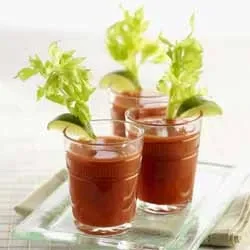
The origin of the word "cocktail" is also described by many versions. Most of them agree that the word comes from the English phrase "cock tail". Exactly how that happened is a separate question. For example, they tell a story about a girl whose father married her off to a man who had returned his lost rooster (without a tail). The girl was supposedly so agitated by the prospect of becoming payment for the capture of the bird that at her unexpected wedding she accidentally mixed all the drinks.
A less poetic version states that the cocktail is compared to a rooster's tail because of its "variegation". And sometimes it is assumed that horse racing enthusiasts noticed the kinship of the "mixed drink" with impurebred horses, which, in turn, are called "cock tails" because of their sticking-up tail.
If we set aside roosters, it is worth mentioning the version according to which the word "cocktail" comes from the English "cock tailings" (scraps piled together). Supporters of this theory of the word's origin believe that the first cocktail enthusiasts simply, due to a lack of "pure" alcohol of one type, poured into one glass all the remnants left at the bottom of several bottles.
Finally, some sources indicate that the word "cocktail" comes from the French "coquetelle". That was the name of a vessel in which the French once served a mixture of strong spirits and wine - the "progenitor" of the modern cocktail.
Currently, the recipes of classic cocktails are recorded in the list of official cocktails of the International Bartenders Association. In addition to "Bloody Mary", this list includes, for example, Black Russian - a mixture of vodka and coffee liqueur. The history of the cocktail is again complex: it is believed that, despite its "Russian" name, it was first prepared in Brussels in honor of the American ambassador. Also on the list are cocktails such as "Sex on the Beach", mojito, "Margarita", "Cosmopolitan" (which once featured singer Madonna on camera), and many others.
It must be said that even the simplest "folk" cocktails not included in the IBA list have quite interesting "biographies". These are the "Screwdriver" and the gin and tonic.
In the 19th century, the British in India were forced to drink tonic containing quinine to avoid contracting malaria. And to make the tonic not too bitter, they began to add gin to it. According to another version, initially, cinchona bark was infused in gin, and then, to avoid alcoholism, this preventive remedy was attempted to be replaced with a non-alcoholic tonic with quinine. Over time, gin and tonic turned into an ordinary popular drink. Nowadays, the tonic used in the cocktail has become much less bitter, and moreover, lemon or lime is often added to it.
The "Screwdriver" was invented in the mid-20th century. According to legend, American engineers working in Iran had a habit of drinking the concentrated orange juice and vodka that were part of their rations, mixing them with screwdrivers they always carried with them. Subsequently, this simple cocktail, in all likelihood, became a kind of compromise between "healthy" and "unhealthy" drinks for adherents of the healthy lifestyle that was beginning to come into fashion.
However, it is not at all necessary to go for such a compromise. Let us recall that cocktails can also be non-alcoholic. Unlike, for example, non-alcoholic beer, they occupy a completely legitimate place among traditional drinks and are not considered by most people as "the first step to a rubber woman."
In particular, the "teetotaler's" version of the same "Bloody Mary" is romantically called "Virgin Mary." It contains all the same ingredients as the regular cocktail, except vodka. The taste of this drink is, in all likelihood, quite strange... But the name is brilliantly invented.