
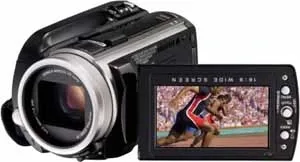
Ultra compact AVCHD camcorder JVC GZ-HD10ER
These characteristics were combined in the amateur-class camcorders Panasonic H50 and JVC GZ MS120, whose performance qualities and features can be compared in more detail.
Both cameras have a 2.7-inch LCD display, standard and slow-motion shooting modes, and nearly identical dimensions. They are not competitors in this regard, so let's consider other parameters.
The first and quite significant difference between these camcorders is the video shooting formats. The JVC GZ-MS120 only allows shooting in standard 4:3 format. In turn, the Panasonic SDR-H50 also supports widescreen 16:9 shooting, which is very relevant since most people today have televisions in that format.
In addition to traditional shooting modes, the camcorders have additional settings. For example, the Panasonic SDR-H50 allows macro shooting from a minimum distance to the subject, as well as night shooting in twilight and complete darkness. Instead of macro shooting, the JVC GZ-MS120 has sports and portrait modes. The former allows you to capture sharp movements without blur, while the latter is used for shooting people. This mode reflects faces more brightly, highlighting them against the general background.
Using the JVC GZ-MS120 and Panasonic SDR-H50 camcorders, you can also take JPEG photos. They will be stored along with the rest of the information on the media included in the kit.
On the JVC GZ-MS120, the photo quality is 0.52 megapixels, while on the Panasonic SDR-H50 it is only 0.3 megapixels. The manufacturers are essentially saying: 'If you want to take high-quality photos, buy a separate camera.'
A special place should be given to the type of data storage. The compared camcorders use a memory card for this. The Panasonic SDR-H50 has a special slot that supports SD and SDHC memory cards, while the JVC GZ-MS120 has two such slots, so you can install two cards at once and thereby significantly increase the available storage. However, the Panasonic SDR-H50 also has a built-in 60 GB hard drive, which is often more convenient than removable memory cards.
The camcorders have both optical and digital zoom. The Panasonic SDR-H50 has 42x optical and 2000x digital zoom, respectively, while the JVC GZ-MS120 has 35x optical and 800x digital zoom, respectively.
Naturally, it won't be possible to store all information on memory cards and hard drives, so you should periodically transfer data to discs. For this, you can use the USB port or a dedicated AV output. Both are present on both camcorders and standardly allow you to transfer data in different quality. Via USB is the worst option, via AV is of higher quality, though not the simplest.
Corresponding prices were set based on the described characteristics. The Panasonic SDR-H50 camcorder is sold for at least 13,000 rubles. In comparison, the JVC GZ-MS120 is available from 10,000 rubles. This price spread is a bit unclear, since the compared camcorders do not have such significant differences.
As an advertisement