
Špekáčky have been listed by the European Commission as a traditional Czech specialty
As the authors of Radio Prague note, for Czechs of different generations, this is the taste of childhood and summer, when friends sit around a fire until late at night, chatting and grilling špekáčky, while someone nearby strums a guitar.
"I must admit that I absolutely love špekáčky, it's my favorite food. Sometimes I cook them on the grill, but it's much nicer when you sit by a campfire with friends. I often go with friends to a country house or out into nature. One of my friends has a summer cottage in the Orlické Mountains. There we grill špekáčky, talk, drink, sing, and rejoice that we finally managed to get together. It's such a very personal and pleasant pastime," says Barbora from Prague.
"Like any Czech, I've been grilling sausages since childhood. However, špekáček is not just an ordinary sausage. Once you try a špekáček, you become attached to it for the rest of your life," believes Mr. Jaroslav, who thinks his favorite dish is more than just food.
"In the Czech Republic, špekáčky serve as an element of social life, because they taste better when you eat them together, when people sit together by the fire, sing, play guitar, and have fun. That's when it makes sense, and the taste becomes twice as good," concludes Mr. Jaroslav.
The word "špekáčky" — which is how Czechs pronounce it — has long taken root in the Russian language. Only in Russian, "shpikachka" is feminine, while in Hašek's language, "špekáček" is masculine.
In the Czech Republic, špekáčky as we know them today have been produced for over 100 years — they appeared in the mid-19th century, and compared to heavier sausages boiled in water, špekáčky were considered a refined delicacy.
In 1891, the so-called Jubilee Provincial Exhibition was held in Prague, which became an important milestone in history — it showcased various economic achievements, demonstrating that the Czechs are an independent and modern nation. It was at this exhibition that a previously unseen wonder was presented — a mechanical sausage workshop, which was hugely popular with visitors. Špekáčky were smoked right on the spot and served still warm with horseradish and a salted roll on beautiful paper plates. This pleasure cost 8 kreuzers. This date is considered the beginning of the history of classic Czech špekáčky.
At that time, a classic Czech špekáček had to consist of 50% beef shank, 20% skinless pork, and 30% was allotted to pieces of bacon. Spices included garlic, pepper, and sometimes nutmeg. This appetizing mixture was placed in a casing — a thin beef intestine four centimeters in diameter, which was tied into individual parts about seven centimeters long.
In the Czechoslovak Socialist Republic, they developed their own GOST: 38.5% beef, 17.5% pork, 17% smoked bacon, 23% water or ice, salt, spices, and flavorings. Nowadays, the recipes by which this type of sausage is produced have become more diverse, and in the sausage section you can find several types of špekáčky.
 "Špekáčky vary in quality and price. The best product today has the label 'specialty of guaranteed traditional quality.' You can easily distinguish it — the packaging has a blue 'sun' sticker with the inscription 'traditional Czech specialty,' sometimes in English," explains Professor Petr Pipek from the University of Chemistry and Technology.
Of course, špekáčky cannot be called dietary food, especially since they are usually served with beer. There is also an opinion that these fatty sausages have carcinogenic properties. Professor Pipek is confident that industrially produced špekáčky do not pose such a danger, but if they are fried incorrectly, harmful properties may appear.
"Some summer residents skewer a špekáček on a stick; its 'cremation' takes two minutes, and there is no trace of the špekáček left. Instead, a black crackling appears. Of course, carcinogens form there. My recipe: fry near the fire when it is already dying down. In this case, the process takes a little longer, about a quarter of an hour, but you will get a juicy, tasty špekáček with a very low level of carcinogens. The same rule applies to barbecue and shashlik," explains the specialist.
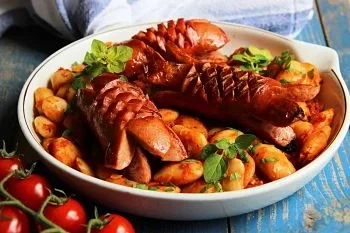
During frying, excess fat flows out of the špekáček, and the meat is saturated with the aroma of bacon. Sometimes špekáčky are stewed with onions, potatoes, spices, and sweet peppers — this dish is called "burštguláš." And if špekáčky are marinated, they turn into the famous Czech "utopenci" (drowned men). However, that is another page in the Czech cookbook.
In 2011, špekáčky were listed by the European Commission as a traditional Czech specialty. On the market, you can find many meat products imitating real špekáčky, but their composition does not meet the required meat content and quality. Such sausages will be called differently: "buřt," "vuřt," or "opékáček."