
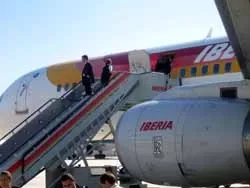
Naturally, we are not talking about a plane falling from the sky - it is practically impossible to survive in a machine falling from an altitude of 10,000 meters. However, the number of incidents that occur already on the ground is significantly higher, and one should not forget that people also die in them. Suffice it to recall the recent disaster in Irkutsk in July 2006, when an A-310 airliner with 200 people on board veered off the runway, crashed into garages, and caught fire. Then 124 people died, although the plane landed without problems, it merely failed to stop properly.
At the same time, according to statistics, from 1983 to 2000, 95% of passengers survived aviation accidents. For example, in 2005, on board an Air France airliner that caught fire while landing at Toronto airport were 309 people, and all were saved. This incident was called the 'Miracle in Toronto'.
How to survive a plane crash on the ground? A professor from Australia, who himself was in an aviation accident that nearly cost him his life, tried to answer this question. Ed Galea in 1985 was on board a plane that veered off the runway and caught fire. Since then, he has been studying self-rescue rules on board. During his work, he interviewed more than 2,000 survivors of 105 aviation accidents. Based on their stories, he derived a set of simple rules.
Traveling with family, stick together
Half of all air passengers travel in a group - most often with family members. Naturally, in an extreme situation, people try to find their loved ones. If a fire is raging in the cabin and the family is separated, people will not try to escape but will look for each other. And in such a situation, every extra minute in the smoke multiplies the chances of survival.
Therefore, a family, especially with children, should stay together and at the same time be ready to split up. If it's a family of two adults and two children, Galea advises acting as follows: 'For example, one adult is responsible for one child, and the other for the other child. Thus, you get two groups of two people. If necessary, these groups should be able to evacuate separately.'
Another not very pleasant but effective piece of advice: 'Each child should know which parent will look for them in an emergency.' Of course, it is extremely unpleasant to explain emergency behavior rules to a child before a flight, but it can save their life.
Know how to unfasten the seat belt
Before the flight, the passenger should study the seat belts and practice unfastening them. Amazingly, in an emergency, even the crew cannot always quickly free themselves from them. One should not forget that aviation belts are designed differently than car belts. Seconds spent struggling with the belt can cost a life.
Sit closer to the aisle and count seats to the exit
In fact, there are no more or less safe zones on a plane. Seats in the tail of the airliner can be fatal if a fire breaks out there, so there are no general rules for choosing them. However, there are a number of tips.
First, when taking your seat, you should count and memorize the number of rows you will have to pass to the nearest two emergency exits. This knowledge will help you quickly find the exit in the dark. Moreover, you should remember the location of at least two exits, as the nearest one may be blocked or inaccessible.
Second, the chances of survival are somewhat higher for a passenger sitting closer to the aisle. The faster a person starts moving and the fewer obstacles in their path, the higher their chances of survival.
It would be safest to sit facing the rear of the plane (this is only possible on military aircraft), but on passenger airliners this is impossible. The problem is that retrofitting and completely reconfiguring airliner cabins requires huge financial investments. However, this rule can be applied during rail travel. It is always better to sit facing the rear of the train, and it is also advisable that there are no people or objects in front of you that could cause injury during sudden braking.
Take a smoke hood
'Smoke contains harmful and narcotic gases, irritants. Inhaling a certain dose is enough to die,' says Galea. Therefore, on any trip he takes a portable smoke hood. However, one should not forget that you also need to know how to use it, and it should be kept as close as possible. Time spent searching for it and trying to open and put it on can cost a life.
Bracing and preparation
The most important thing is to never neglect the information provided by the flight attendants before the flight. Carefully studying the card that outlines the evacuation rules can indeed save a life.
Bracing - the position recommended to assume in an emergency - may seem ridiculous or silly, but it will save the passenger from the worst thing in a ground accident and fire - loss of consciousness. During sudden braking or collision with a ground obstacle, a person who has not braced will inevitably suffer a head injury, which will most likely lead to loss of consciousness. In a fire, no one will rescue an unconscious person in a panic, so if you do not take care of yourself, your chances of survival are minimal.