
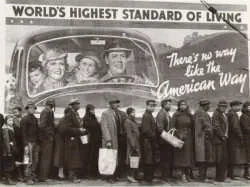
During the Great Depression, more people left the United States than at any other time in American history.
In his interview with Washington ProFile, Tim Tsuliadis discusses the little-known topic of American immigration to the USSR.
– Why did you become interested in the topic of American immigration to the USSR?
– From my point of view, the criminal nature of Nazi totalitarianism is well understood, this topic has been thoroughly researched and has a strong public resonance, especially in Europe and the United States. However, Stalinism – a communist totalitarian regime – has been clearly insufficiently described. Yes, there was Solzhenitsyn, but it seems to me that there are still many blank spots that need their researchers.
I began studying the Stalinist period and learned that during the Great Depression, representatives of many peoples moved to the Soviet Union. Some did so for political reasons, others for economic ones. Among these people were Americans. Then I found a photograph showing American teams playing baseball in Gorky Park. It was astonishing – in the early 1930s, Americans were trying to follow their own cultural traditions in the center of Moscow. And this topic allowed me to tell more about US-USSR relations before the Cold War.
– Few people know that baseball was played in Soviet Russia...
– In Soviet Russia, American colonies sprang up not only in Moscow, but also in Gorky (modern Nizhny Novgorod), Karelia, Nizhny Tagil, Magnitogorsk, Ukraine... And everywhere that Americans settled, they created baseball teams and taught the game to their Soviet colleagues. As a result, a baseball league was created – at first this idea was supported by the Soviet authorities, who were then planning to make baseball a new national sport. Several Americans created the newspaper Moscow Daily News, which published the results of baseball games in the USSR and the USA weekly. And, of course, as soon as the Great Terror campaign began, all the baseball players were arrested. And from Soviet history disappeared the fact that an attempt had once been made to make an American sport Soviet, even newspapers and magazines of the USSR practically did not write about it.
– How many Americans moved to the Soviet Union?
– Different sources give different figures. According to my estimates, from 6,000 to 10,000 people moved to the USSR in the early 1930s. The peak of this process came in 1931. At that time, Amtorg – the Soviet trade representation in New York – published an advertisement stating that the USSR needed 6,000 American specialists. In response, Amtorg received more than 100,000 applications.
However, no one – neither in the USA nor in the USSR – analyzed these statistics. There were many Americans who did not appear in official reports. They were told that to move to the USSR, they only needed a tourist visa, and upon arrival in Moscow they would immediately get a job. That is, Amtorg did not officially invite them; they came at their own risk.
– So why did Americans leave the USA?
– The peak of the Great Depression came in 1931; the poverty level in the USA was terrifying. A quarter of the country's able-bodied residents were unemployed. I don't know how many Americans worked in agriculture, but it seems they were 20-25%. During the depression, farmers found themselves in an absolutely catastrophic situation; they could barely support themselves by farming. Not only factories but also farms were closing. Slum districts appeared in every American city.
At that time, a widespread opinion, shared by many thoughtful people, was that they were witnessing the collapse of capitalism, and that socialism would replace it. Why did people go to the USSR? Because they were given a chance to get a job that could not be lost; their children could get a free education; their families could use medical care for free – that is, the level of social security promised to them was simply stunning. Moreover, many of them received free tickets to Russia.
There were intellectuals like Bernard Shaw who visited Russia and spoke on American radio, saying that the future belonged to the Soviet Union. Walter Duranty, the Moscow correspondent for the New York Times, published articles of similar content (Duranty worked in Moscow from 1922 to 1936; in his publications he consistently pursued a pro-Soviet line, in particular, denied the reality of the Holodomor. In 2003, there was a posthumous attempt to strip him of the Pulitzer Prize – the most prestigious award an American journalist can receive. – ed. Washington ProFile). Some people really wanted to believe that there was a country in the world where a person could work honestly. They were blinded by their own dreams. In those days, the number of immigrants moving to the USA was less than the number of people leaving the United States – this was the first time in all of American history.
– Why did the USSR accept American immigrants?
– Many of them had valuable skills and abilities; for example, they worked in Detroit factories. Stalin was industrializing the Soviet Union. In the era of the first five-year plans, there were colossal plans to buy entire factories from people like Henry Ford to create the Soviet automobile industry. By my estimates, from 1929 to 1936, the USSR spent about $40 million on purchasing American technology. It is little known that Ford, who became an icon of American industrialization, played about the same role for the industrialization of the USSR.
And, naturally, the USSR needed American specialists who had knowledge of how to make cars. Approximately 700-800 Americans worked at the automobile plant in Nizhny Novgorod, and the same thing happened at the tractor plant in Stalingrad. They were invited because they knew how to do what was needed for the construction of socialism. Of course, after the Americans passed on their knowledge to Soviet specialists, they became less valuable and easily replaceable.
– What was the fate of the Americans who moved to Soviet Russia?
– Foreigners who moved to the USSR often had their passports confiscated. American passports were used by the Soviet authorities, sometimes for espionage purposes – some people could impersonate these Americans and visit the United States.
Some of the Americans who arrived in the early 1930s returned to the United States – if, of course, they acted quickly enough, protested loudly, and had money to buy a return ticket. The fact is that many of them – if not the majority – arrived in the USSR penniless. They were promised that in Russia they would get a job and housing, so they would not need any savings – therefore they bought a one-way ticket. However, when they expressed a desire to return, it turned out that buying a steamship ticket required from $60 to $150, which they simply did not have.
In 1934, the first US ambassador to the USSR, William Bullitt, sent a request to the State Department, in which he told about such destitute Americans and asked how it was possible to help them? His letter was forwarded to the Red Cross Society, which stated that it was not obligated to handle the return of Americans to their homeland.
If a person could not return in the early 1930s, when repressions were relatively mild, then by the late 1930s a sad fate awaited him. In 1937-1938 there was the peak of terror, and many Americans were arrested. Quite often this happened according to the following scenario: they entered the US embassy, and upon leaving it, were immediately arrested by NKVD agents, because the paranoid regime considered foreign embassies to be centers of espionage.
The arrested had two possible fates. One group was interrogated and executed within months or even weeks after arrest. Those who managed to avoid execution were herded into a railway car and sent to some remote part of the USSR.
For example, Thomas Sgovio was sent from Moscow to Magadan, his journey took 28 days. Sgovio was sent to a mine to extract gold. In winter, the temperature in Magadan dropped below minus forty degrees, which, combined with poor clothing and food, caused prisoners to quickly die. Sgovio miraculously survived: at one period of his imprisonment he weighed less than 50 kg – he tattooed his name on his skin so that he could be identified after death. He was saved by the fact that he managed to find work outside the mine – Sgovio was an artist and painted propaganda posters. Victor Herman also survived – he was incredibly strong and passionately loved life. However, these were only exceptions – most Americans died in Soviet concentration camps.
Of course, the Moscow leadership of the Gulag knew very well about the incredibly high mortality rate among prisoners and that the system needed constant replenishment. This was one of the reasons for the acceleration of the terror machine: prisoners were constantly dying, and other people were arrested and took their place. One of the accountants working at the Lubyanka was himself arrested – he told another prisoner who managed to survive that prisoners were considered merely a type of industrial raw material.
Of all the aspects of the history of Americans in the Soviet Union in the 1930s, this turned out to be one of the most shocking discoveries for me. In the West, it is generally believed that the events in Russia were not genocide, however, from my point of view, it was certainly a policy of genocide. The Soviet authorities knew perfectly well that millions of people were dying in these camps. These deaths were organized by the top NKVD authorities and controlled by Stalin.
Another interesting fact. During World War II, when the USSR and the USA were allies, ships used by the NKVD often crossed the Pacific Ocean for repairs at American shipyards. Often, after returning to the USSR, their first cargo was prisoners. The gold mined by prisoners at Kolyma was supplied to the United States. The then US Treasury Secretary Henry Morgenthau conducted these negotiations and decided what to do with the Soviet gold. In the archives, I found evidence that Morgenthau knew how the gold was mined, but ignored these facts for reasons that only he could specify.
– Did the Americans who went through the concentration camps remain in the USSR or return to the USA?
– Of the thousands who left, only a few returned in the 1970s. Some returned to the USA already in the era of glasnost, after 1985. In one case, a very elderly American returned to Chicago after half a century and found that everything in his hometown had changed. His fate resembled the story of Rip Van Winkle (the main character of the eponymous story by American writer Washington Irving, published in 1819. The village dweller Rip went hunting and slept for 20 years. Returning home, he found that everything around had changed incredibly. This literary character became a symbol of a person who has fallen behind his time – translator's note from Washington ProFile). This man spoke using speech patterns and slang from the 1930s.
Immigrants who left the USA in the 1930s and Americans who ended up in the Gulag after World War II and the Korean War were equally victims of the Soviet system and victims of the American-Soviet confrontation. Very little was done in the interests of these people, too often their fates were neglected. Soviet-American relations remained classified for decades, and only recently have we been able to gain access to archives and learn anything.
– Why were the United States unable to help its citizens?
– There are a number of reasons. For starters, the State Department tended to view them as people who had chosen their own fate. They left the United States for political or economic reasons, so they were seen as suspicious individuals, leftists, or radicals. Therefore, it seemed to them that those who left did not deserve political intervention.
These views were especially prevalent in the early 1930s. The archives contain a letter written by George Kennan (American diplomat and thinker whose ideas had a tremendous impact on US foreign policy. Kennan spoke Russian fluently. He worked as an employee of the US embassy in the USSR and in 1946 sent to Washington the so-called "Long Telegram," which became perhaps the most frequently cited document on the history of the Cold War. In the "Long Telegram," Kennan argued that the Soviet leadership did not seek peaceful coexistence with the West and therefore the West should pursue a policy of "containment" against it using economic and diplomatic means, and if necessary, military means – note by Washington ProFile). Kennan wrote that American communists renounce their American origins the moment their foot touches Soviet territory.
State Department officials knew perfectly well that these people were often arrested right after leaving the American embassy, but they did nothing about it. Sometimes newly arrived diplomats – often holding lower positions in the service hierarchy – tried to change something.
William Bullitt became the first American ambassador to the USSR. When he arrived in Moscow in 1934, Bullitt was largely sympathetic to the Bolshevik experiment. The diplomat believed that it differed little from the "New Deal" reforms being implemented by President Franklin Roosevelt. However, by the time Bullitt was preparing to leave his post, he was completely disillusioned. He even tried to raise money for American immigrants so they could leave the USSR – that is, he wanted to do something, anything.
In 1937, Bullitt was replaced by Joseph Davies, whose most important task was to establish political ties with Joseph Stalin. Therefore, the ambassador did not try to do anything that could complicate his contacts and harm Soviet-American relations. He did not want to risk asking Stalin to spare the lives of American immigrants, who sometimes stopped the ambassador's car moving through Moscow with an American flag; who came to the embassy asking for a passport and who had no political means to remind him of themselves. Davies got the impression that he had to choose between friendship with Stalin and these immigrants. And he made, in my view, a pernicious decision, because as a result, most of the immigrants died.
If someone at the highest level of power in the United States had tried to save these people, it would quite likely have been possible. The Austrian ambassador at that time made tremendous efforts to save Austrian immigrants who found themselves in Moscow. At the height of the Great Terror, he hid two dozen people in the basement of the Austrian embassy. Davies did not try to do anything similar.
Later, when the Soviet-American alliance was created, a chance for successful Washington intervention came in July 1941, when Harry Hopkins arrived in Moscow (Harry Hopkins - one of the closest advisors to US President Franklin Roosevelt, his personal representative in negotiations with the USSR – note by Washington ProFile). At that time, it would have been extremely easy to strike a deal with Stalin. However, saving these people was not among the main priorities of US foreign policy. And after the end of World War II and the beginning of the Cold War, concluding such an agreement became absolutely impossible.
Interestingly, Americans were arrested not only during the Great Terror, but also when relations between the two countries were at their peak. Averell Harriman was the US ambassador in Moscow during the war. Under him, an American immigrant family worked at the embassy. These people were suddenly arrested and accused of espionage. Harriman immediately wrote to Washington, asking what could be done to try to save them. He was told that US intervention would have no prospects. This all resembles a collective unwillingness to take responsibility.
– What surprised you the most in the course of your research?
– Before I started digging into this topic, I already had some idea of what was happening in Russia during Stalin’s time. I thought I understood that era. But it turned out I had neither understanding, nor deep knowledge, nor a real sense of the scale of human suffering. Reading the memoirs of people who went through concentration camps and the letters of those trying to find out the fate of their arrested relatives, you feel the pain that reaches across the decades after the described events and compassion for those who went through it all. A normal person cannot shake off the horror when reading such things.
By chance, while looking through archival photographs, I discovered cards made by an American officer of Polish origin. He met with Poles who had been through Stalin’s camps and were allowed to leave for Tehran. He photographed emaciated children who looked like skeletons. The officer wrote in his report that these children would most likely die and he could do nothing to help them. At that moment, I realized that was enough for me. You can rationally evaluate information about what happened in the past, but not when you see such photographs....
What happened in Nazi concentration camps is well known: in particular, because the Allies liberated them, and everything was filmed and photographed. As a result, everyone knows about the consequences of Nazism. However, very few photographs of Soviet concentration camps have survived – cameras were banned there. Such photographs could probably provide a real idea of what Stalinism actually was.
_