
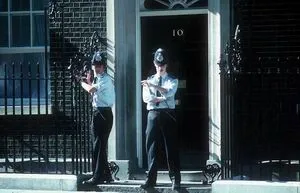
Perhaps no one would have learned of the policemen's carelessness if not for the vigilance of one London motorist who discovered confidential documents on the road near the airport's fourth terminal and immediately took them to Scotland Yard. "I stopped near a car service and saw the wind leafing through the pages of some notebook on the road," the man, who wished to remain unidentified, told journalists of the London newspaper The Sun. "And when I made out the words 'police' and 'secret' on the notebook, I realized this was a very important and serious document."
In the opinion of this law-abiding citizen, who possibly saved the airport from trouble and certainly caused a lot of trouble for Heathrow security personnel, "terrorists simply dream of the information contained in the plan." This is partly true, since the lost document contained data on the most likely targets of a terrorist attack. The plan even included photographs of 62 places from which it would be convenient to shoot at aircraft with a portable surface-to-air missile launcher. In addition, it contained a description of possible escape routes for terrorists from the building and from the airport grounds, diagrams of sniper positions, patrol routes with service dogs, schedules for patrolling the Heathrow area, and even a plan for blocking highways in the event of sabotage.
The document was drawn up on June 26 of this year, yet just a few days later it ended up on the road, with neither the airport nor Scotland Yard even suspecting it. "We take this incident extremely seriously," an official police spokesman said in an interview with English journalists. According to him, a detailed investigation has already been launched, which the chief of police has taken under his personal control.
Notably, this incident is far from the first in the list of blunders by the royal special services. However, previously, English policemen and agents mainly lost computers and floppy disks with secret information. For example, in April 2001, a laptop belonging to the UK Ministry of Defence and containing information about new types of weapons was lost. According to available data, the laptop was simply forgotten on the back seat of a taxi by one of the ministry's officials. The latter did not even notice the loss. And a year before this incident, information emerged that several employees of MI5 and MI6 had also lost their portable computers.
American intelligence officers are also distinguished by negligence regarding secret records. The most scandalous episode in this regard was the loss of documents in the case of Timothy McVeigh, who on April 19, 1995, organized an explosion at the Alfred P. Murrah Federal Building in Oklahoma City. As a result of the terrorist attack, 168 people died, including 19 children. As for the loss of secret papers in less high-profile cases, there is nothing to say; Federal Bureau of Investigation employees lose them almost every year.
The funniest incident occurred on Christmas Eve 2001 in Baltimore. There, 38-year-old American Jim Isbel, while rummaging in a dumpster in search of spare parts for his son's scooter, found two bags with documents from the US FBI. Instead of screws and nuts, Isbel got folders with important papers, crime scene photographs, videotapes with names and addresses of criminals, and even documents marked "Secret. For the International Relations Department." However, oddly enough, the agency's leadership was unable to figure out how the secret documents ended up in the trash.