
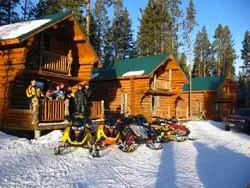
Snowmobile safaris can be a short motorized outing from a forest hotel or a multi-day journey through winter forests with overnight stays in small hotels or village guesthouses. The difficulty of the routes varies from comfortable rides on packed roads and frozen rivers to adventurous expeditions in wild places where tourists participate in clearing forest debris, may travel in the dark, and learn firsthand what it's like to spend a cold night in a tent.
Participating in a regular snowmobile tour does not require special skills or knowledge. Most people handle the machine well right after briefing and training. After all, on snowy expanses there is no dense traffic, no intersections, and no traffic lights.
As a rule, companies organizing tours provide their clients with all necessary equipment: warm overalls, helmets, gloves, and gaiters - special covers for shoes. Such attire will keep you from freezing at the wheel even in severe frost and strong wind. Additionally, the driver is warmed by the heat from the machine’s engine, and many snowmobiles are equipped with heated seats and handlebar grips.
On average, the time spent on the snowmobile is 6-8 hours per day. This includes short stops every half hour for a sip of tea from a thermos and taking photos, a full lunch in the middle of the day, and stops to see sights. That is, tourists usually spend 3-4 hours directly in the saddle.
Safety
Modern snowmobiles are quite safe devices. According to global statistics, people sustain serious injuries while riding snowmobiles in accidents at speeds over 110 km/h. During the tour, instructors do not allow developing extremely high speeds and strictly monitor compliance with safe driving rules.
It should be remembered that both driver and passenger must ride snowmobiles only in protective helmets.
Types of Snowmobiles
People long tried to create a machine for fast and comfortable movement on snow. For this purpose, they modified existing cars or proposed incredible original projects. But a truly successful design was the one proposed in 1959 by the Canadian Joseph-Armand Bombardier. He built a vehicle with two rotatable 1.5-meter (!) skis and a wide track. The machine easily overcame snowdrifts up to 1.5 meters high and reached speeds up to 40 km/h. The snowmobile was named Ski Doo, and all 225 machines of the first batch were quickly sold at a price of $1,000, which was considered extremely expensive at that time. Today, Ski Doo snowmobiles from Bombardier are perhaps the most common in the world.
Modern snowmobiles are divided into three main classes.
Tourist machines are distinguished by increased comfort and ease of control, which is necessary for long trips. In this class, there are models for active riding enthusiasts - with sport suspensions and very powerful (up to 170 hp) engines providing speeds near 200 km/h. For calmer riding, less powerful and not as expensive tourist modifications are produced. Typically, the snowmobile fleet of tour operators consists of machines of this class.
Utility snowmobiles are designed for heavy work. In addition to forward and reverse gears, they have a low gear that allows them to overcome difficult sections of the route with a load. Such snowmobiles are more adapted to riding in deep snow and have good cross-country ability even when fully loaded. These 'workhorses' are popular among professionals: reindeer herders, rescuers, and military. Many companies prefer to take tourists on machines of this class - they are suitable for routes in highly rugged terrain.
Sport snowmobiles stand apart. They have high power and develop ultra-high speeds. The main purpose of such machines is high-speed riding on specially prepared tracks in competitions, or simply for pleasure. Such machines are not suitable for moving in loose snow in the forest; as a rule, they are designed for a single rider.
Where to Ride
Karelia. It has the densest network of snowmobile tourist routes in Russia. Picturesque northern landscapes, long winters, an abundance of natural and cultural monuments, decent tourist infrastructure and proximity to the largest cities of the country are the reasons for the region's popularity. Local companies offer both simple two- or three-day trips to the legendary islands of Kizhi and Valaam, as well as extended tours, for example, the five-day route 'East-West' crossing all of Karelia from the east to the border with Finland.
Baikal Region (Russia). Lake Baikal itself in winter is an ideal snowmobile track where record speeds can be developed. The main thing is not to hit ice hummocks. Here they offer tempting trips to picturesque Baikal bays and to Olkhon Island; along the way, it is customary to stop in Siberian villages, leave colorful scraps on shamanic altars, spin Buddhist prayer wheels, and admire petroglyphs carved on rocks. Extremely adventure-minded people are taken to Buryatia, where they ride for a week through deserted mountains, make them cook food on campfires, and sleep in cramped hunting huts.
Kamchatka (Russia). As is known, this is a land of volcanoes. Here they offer to ride around volcanoes on a snowmobile, meanwhile swim in hot springs, and in the evenings - gorge on red caviar.
Finland. This country has been developing snowmobile tourism for a long time and very successfully. Almost every Finnish village has a base where snowmobiles are rented. Instructors lead groups of motorized tourists across numerous frozen lakes, forests and low hills. However, it is not customary to lay complex extreme routes here. You can ride a snowmobile to visit Santa Claus and feed his reindeer, and stop for the night at an ice hotel, where you will even have to drink martini from ice glasses.
Poland. This Eastern European country is somehow not associated with winter recreation, but here are the wonderful Tatra Mountains, whose gentle forested slopes are ideal for snowmobiling. At the same time, there are also harsh rocky landscapes in the mountains, more reminiscent of Arctic Scandinavia. Tours usually follow a program: several days and nights in the mountains and a final sightseeing day in old Krakow.
Svalbard, Norway. The Svalbard archipelago is the northernmost outskirts of Europe. You can ride snowmobiles over fantastically lifeless landscapes here from February to June. Earlier, it is too cold and dark. All routes on the archipelago are looped: by evening you return to the same place you left in the morning. Overnight stays in hotels in rare settlements or 'in the style of Shackleton' - on a ship specially frozen into the ice. An obligatory part of any tour is watching polar bears in their natural habitat.
Iceland. The same Kamchatka, but neatly European-style. The program includes snowmobiling on glaciers and volcano slopes, contemplation of Martian landscapes, baking bread in hot ground and bathing in thermal waters. An additional plus is a mild winter without severe frosts.