
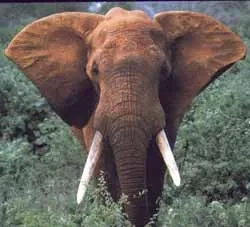
In Sudan, ecologists recently stumbled upon a 'lost world' – a small island in the middle of a large swampy plain. Here, far from people, several dozen wild elephants live peacefully. The location of the unique population had to be urgently kept secret so that neither hunters nor locals could get to the valuable ivory.
The mysterious island is located in South Sudan, where the upper reaches of the Nile turn the flat terrain into the vast Sudd swamp. Fortunately for local flora and fauna, people rarely appear here. Even the researchers themselves stumbled upon the elephants completely by accident, noticing a treeless patch of savanna during an aerial survey. Tom Catterson, a representative of the South Sudan environmental program and one of those who found this nature reserve, described living conditions in this area to Reuters: 'You and I wouldn't have a chance here – amidst mosquitoes and crocodiles.' But the elephants somehow get along with these neighbors: ecologists counted several dozen individuals on the island in the middle of the Sudd swamps.
Now the most important thing for ecologists is to keep the exact location of the lost world secret. Otherwise, the elephants there could be wiped out within a few months. The fact is that in this part of Sudan there are currently no authorities or laws. After several years of civil war, the region gained status as a self-governing territory, but the local population still has a large number of weapons. Add to this the extreme poverty of the Sudanese, and we get ideal conditions for spontaneous poaching. If, for example, in East African countries the authorities somehow manage to restrain hunters and maintain their famous national parks, then in Sudan the government clearly has no time for wild fauna.
Tom Catterson believes that war, looting, and devastation have done enormous damage to the nature of South Sudan. In particular, poaching and the black market for ivory flourish here: traders in this illegal commodity can easily obtain tusks. Interestingly, some animals, seeking refuge from the warring representatives of Homo sapiens, chose the well-known path of emigration and, crossing the border, hid in neighboring states. Because of all these difficulties, ecologists do not disclose the island's coordinates, although Catterson believes that in the Sudd swamps one can find several more such 'spontaneous reserves' that people with rifles and machine guns have not yet reached.
However, what war has not yet accomplished, the economy may complete. The fact is that Sudan is a country rich in oil. Moreover, it is almost the only region in the world where there are still poorly explored and virtually untouched hydrocarbon deposits. Naturally, oilmen from all over the world are eyeing them, and only civil war and instability prevent the development of these riches. However, as Reuters reports, the government of the South Sudanese autonomy has already issued two concessions for exploration in the Sudd swamps. Ecologists fear that these activities could disrupt the fragile ecological balance in this unique region.