
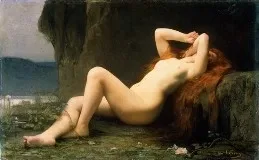
Exhibits of the exhibition «Tears of Eros» can be seen at the Thyssen-Bornemisza Museum in Madrid
Besides the frozen canals and lakes of Avercamp, on which all humanity frolics, falls, skates on the ice, works, experiences poverty and humiliation, literally all mankind from young to old, several exhibitions that opened recently and are opening in November are of interest. Let us highlight expressionist Herbert Boeckl in Vienna, several thematic «Chinese» exhibitions in Brussels, avant-garde sculpture Wild Thing in London, and traditional Spanish polychrome sculpture («Living Saints») in the same city.
Some will certainly be attracted by «Delvaux and Antiquity» in Brussels and «Tears of Eros» shed in Madrid (a project doomed to success, as it energetically exploits the theme of «Eros and Thanatos»).
AUSTRIA
Retrospective exhibition of Herbert Boeckl, October 21 – January 31, Vienna. The Belvedere Gallery in Vienna recently opened a retrospective exhibition of the famous Austrian expressionist artist Herbert Boeckl (1894–1966). Boeckl's biography remarkably fits into the historical context: a self-taught artist who went to the front during World War I, studied painting in Berlin and Paris in the 1920s, became a highly influential figure in Austrian visual art, and at the end of his life, head of the Vienna Academy of Fine Arts. The exhibition will feature about 150 works by the artist, created between 1914 and 1964, from European museums and private collections. These include portraits, including the artist's famous self-portraits, still lifes, landscapes, watercolors, drawings, sketches for the cycle of frescoes created for Seckau Abbey, and collages that had a strong influence on decorative art in the mid-20th century. //www.belvedere.at
BELGIUM
Delvaux and Antiquity, October 23 – January 31, Brussels. The antique theme actively entered the painting of Belgian artist Paul Delvaux (1897–1994) in the 1930s – precisely during these years Delvaux actively participated in surrealist exhibitions and actions, although he formally did not belong to this movement and considered himself a «lonely artist.» In 1937 and 1939, the artist traveled to Italy, and since then the ancient world became a leitmotif of his work. An ancient temple whimsically enters his painting, becoming a symbol of a tragic city; the harmonious tranquility and «metaphysical eroticism» of his heroines refer us to antique sculpture. An exhibition dedicated to the theme of antiquity in the work of Paul Delvaux recently opened at the Royal Museum of Fine Arts. It presents about 70 works by the artist from European museums – paintings, sketches, watercolors, drawings. //www.fine-arts-museum.be
Exhibitions within the Europalia culture festival, until February 14, Brussels. Undoubtedly, the main event of autumn and winter in the Belgian capital is the Europalia arts festival, this year dedicated to the culture and art of China. The festival will include 40 exhibitions on a wide variety of themes: from an exhibition on Chinese folk medicine at the Museum of Medicine to exhibitions of contemporary Chinese art. Theaters, museums, squares, and exhibition halls will serve as venues for the exhibition events. Among them, one can note the exhibition «Ancient and Modern Chinese Porcelain» (October 24 – February 14, Museum of Decorative Arts), «Sons of Heaven» (until January 24, Palace of Fine Arts), dedicated to the magical rituals of medieval China, «Orchid Pavilion» (until January 31, Royal Museum of Fine Arts), dedicated to Chinese calligraphy, «Tea. A Story of Life» (November 14 – February 21, Royal Museum of Mariemont), which will present ceramic tea collections from various eras. //www.europalia.be
UNITED KINGDOM
Wild Thing: Epstein, Gaudier-Brzeska, Gill, October 24 – January 24, London. From 1905 to 1915, three «rebel sculptors» appeared in London, whose works would fully impact the history of the British school of avant-garde sculpture. «Wild Thing» – that is what the poet Ezra Pound called one of them, a young sculptor who came from Paris to London in 1911: Henri Gaudier-Brzeska (1891–1915). In the same year, Jacob Epstein (1880–1959) also arrived from Paris to London, whose work would spark heated debates and provoke scandals until the mid-20th century. Shortly before the outbreak of World War I, Gaudier-Brzeska, Epstein, and the English sculptor Eric Gill (1882–1940) briefly united. They were brought together by an interest in non-European art, primitivism, expressionism, and the avant-garde. During this period, the sculptors actively used the method of «direct carving,» which returned the artist to an archaic contact with the material. For the first time in many years, the exhibition at the Royal Academy of Arts brings together works by these «rebel sculptors» – about 100 sculptures, drawings, and pastels from museums and private collections.
We remind fans of contemporary sculpture that until December 11, the same museum is hosting a solo exhibition of Anish Kapoor, which we covered in our October review of European exhibitions. //www.royalacademy.org.uk
Spanish painting and sculpture of 1600–1700, October 21 – January 24, London. «Living Saints» is the name of the exhibition recently opened at the National Gallery in London. Visitors are given a unique opportunity to contemplate in a single space Christian sculpture and painting of the 17th century, forming a single image and enriching the perception of sacred art.
The focus of the exhibition is nevertheless the famous Spanish polychrome wooden sculpture, whose authors managed to achieve an effect of maximum naturalism. It is curious that many wooden sculptures of this era were painted by the artist Francisco Pacheco (1564-1645), the teacher of Velázquez, Cano, and Zurbarán. That is why the sculptures of Juan Martínez Montañés, Pedro de Mena, Gregorio Fernández, painted by Francisco Pacheco and Alonso Cano, and the paintings of Diego Velázquez and Francisco Zurbarán are so organic in their proximity.
A kind of continuation of the exhibition 'Living Saints' in the adjacent halls of the gallery is an exhibition dedicated to the process and methods of making polychrome sculptures of the 17th century. //www.nationalgallery.org.uk
GERMANY
Exhibition of Georg Baselitz, until February 28, Dresden. Timed to coincide with the 20th anniversary of the fall of the Berlin Wall, the Dresden Gemäldegalerie recently opened a large exhibition of works by German neo-expressionist artist Georg Baselitz (b. 1938). The exhibition has the general title 'Dresden Women,' featuring paintings and sculptures by the artist. The centerpiece of the exhibition is the cycle '45,' consisting of 20 monumental panels and dedicated to the 'apocalypse' of World War II. This cycle was created in 1989 shortly before the fall of the Berlin Wall. The main work in this cycle is considered to be an image of a woman looking out a window at devastated Dresden. In the same hall is a cycle of wooden sculptures painted yellow under the general title 'Dresden Women.' Other halls feature Baselitz's paintings, including those based on Christian themes (for example, 'Supper in Dresden' from 1983). //www.skd-dresden.de
You and Your World, November 14–22, Hamburg. This exhibition-fair in Hamburg has been held since 1955, and is visited annually by over 200,000 people. The main focus of the exhibition is everyday life, so exhibits are presented in the following sections: 'Leisure and Hobbies,' 'Fashion Accessories,' 'Health and Fitness,' 'Furniture and Decorative Design Novelties,' 'Your Kitchen,' 'Christmas Gifts,' 'Electronics.' Also at the exhibition, you can check out kitchen furniture, go on a 'culinary journey' and learn the secrets of traditional cuisine of five continents, visit an 'enchanted forest,' and finally see an exhibition of silhouette appliqué and shadow theater. Ticket price – €6. //www.hamburg-messe.de
SPAIN
Feriarte 2009 Art and Antiques Fair, November 21–29, Madrid. At the end of November, the IFEMA exhibition center will host the annual 33rd International Art and Antiques Fair. The theme of this year's exhibition is 'From Classicism to Abstractionism,' so the main exhibits will undoubtedly be paintings, drawings, and sculpture. Thus, at this fair you can see rare paintings that are rarely exhibited. European painting and sculpture of the 15th–16th centuries will be presented by the Bernat gallery, painting of the late 19th–early 20th centuries will be presented by the Lorenart gallery – in this section visitors will be able to see several paintings by Joaquín Sorolla, whose exhibition recently enjoyed great success at the Prado. Other sections will feature avant-garde painting of the 1930s and abstract expressionist painting of the mid-century. //www.ifema.es
Tears of Eros, October 20 – January 31, Madrid. The title of this exhibition, recently opened at the Museo Thyssen-Bornemisza in Madrid, refers the advanced lover of art and philosophy to the book by French philosopher and writer Georges Bataille, who was at the origins of postmodernism. That is why the seasoned visitor to the exhibition will be able to read the following plot in the arrangement of the exhibits: innocent seduction – temptation – passion – redemption – death, that is, to make a traditional route 'between Eros and Thanatos.' For the uninitiated lovers of erotic art, the idea voiced by the exhibition curator Guillermo Solana will be obvious: 'Passion has been and always will be, it interests and inspires artists today, just as it did five centuries ago or five thousand years ago.' The exhibition features works by Giovanni Bernini, José de Ribera, Gustave Moreau, Auguste Rodin, Henri Rousseau, Camille Corot, Gustave Courbet, Paul Cézanne, Pablo Picasso, Salvador Dalí, Edvard Munch, as well as paintings, photographs, video installations by contemporary artists – John Currin, James White, Marc Quinn, Bill Viola. //www.museothyssen.org
NETHERLANDS
Exhibition of the Bruegel brothers, until February 28; Winter Landscapes of Hendrick Avercamp, November 20 – February 15, Amsterdam. At the end of November, the Rijksmuseum in Amsterdam will open an exhibition of winter landscapes by the famous Dutch painter Hendrick Avercamp (1585–1634). The exhibition is called 'Little Ice Age' not by chance – it is believed that from the 16th to the mid-17th century there was a global cooling in Europe, and in Holland all canals were covered with a thick layer of ice in winter. By the way, one of the proofs of this theory is the winter Dutch landscapes. Hendrick Avercamp managed to bring amusing genre scenes into such landscapes and even encode narrative stories in them. The exhibition will feature 20 paintings from the Rijksmuseum's own collection, and another 25 paintings by Avercamp will be borrowed from European museums. The exhibition will then move to the National Gallery of Art in Washington.
And at the Rijksmuseum branch at Amsterdam's Schiphol airport, until the end of February, an exhibition of nine paintings by the sons of the famous Pieter Bruegel the Elder will be open. The exhibition explores issues of continuity, imitation, and independence of the Bruegel sons' canvases, as well as the problem of the commercial success of their painting. //www.rijksmuseum.nl
Nyuta KUKUSHKINA.
Gazeta.Ru er="0">