
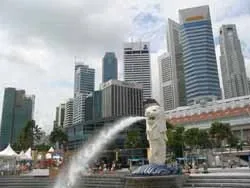
Land of the Merlion
The mythical lion that appeared to Prince Srivijaya has taken a worthy place in the life of the city – it became its symbol. True, combined with a fish. The result was what it was – either a fish with a lion's head, or a lion with a fish's body. This creature is called the Merlion, and it stands peacefully near Clifford Pier, spouting a stream of water into the sea.
One legend tells of a prince of the Srivijaya empire who was caught in a storm and landed on the island of Tumasik. It was supposedly an uninhabited island, yet its name meant “Sea City.” In short, on the shore the prince encountered a strange beast. The beast had a red body, a black head, and a white chest, but the prince nevertheless took it for a lion. Although lions had never been found in these parts. Further, the accounts again diverge. The prince supposedly simply waited out the storm on Tumasik, but he founded a city here, named Singapore. Because “singa” in Sanskrit means lion. “Pura” in Sanskrit means temple, but the legend is silent on that altogether.
Be that as it may, the fishing village of Singapore became part of the Buddhist Srivijaya empire, then the Majapahit empire, and then the Islamic sultanate of Johor. At times pirates were in charge, at times Chinese merchants rested there. This went on for a long time – until the British appeared in Southeast Asia.
The true discovery of Singapore took place in 1819. On a hot January day, Sir Stamford Raffles – a classic British colonialist and future governor of Singapore – landed near a shabby fishing village. Now a monument stands at the spot where Sir Raffles stepped ashore. The stone governor sternly looks at the city entrusted to him, at the bustle around the Empress Place buildings, at the junks scurrying along the river.
When Singaporeans say that their city was built by Sir Raffles, they are not exaggerating in the least. Taking as the center a flat green lawn, called padang in Malay and becoming Padang Square, the governor first drew on paper and then built up this sultry tropical island overgrown with jungle. He understood that the population of the new city would be diverse, and he planned districts for Europeans, Chinese, Malays, Indians, and Arabs, not forgetting the administrative center. The Chinese were given the largest territory – the entire space southwest of the river, which was also named Singapore.
Sir Raffles built his city neatly and thoroughly, as befits a true Englishman. All his roads and streets were paved, houses were brick with tiled roofs, like London townhouses. The governor even thought out how to protect residents from the equatorial sun: in the squares he ordered trees with spreading canopies to be planted, and on narrow streets he provided gallery-passages.
Under Sir Raffles, the island entered a period of prosperity. In four months, its population increased by 5,000 people, and 13 years later Singapore became the administrative center of the British Indian possessions in the Strait of Malacca.
In the 20th century, Singapore prospered until World War II. Then it was not so interesting: Japanese occupation, the status of a self-governing state under British tutelage, unification with Malaysia. Singapore became an independent state quite recently, in 1965. And what a state! A country of high technology and air-conditioned skyscrapers amid the exuberance of tropical nature, beautiful and convenient for living. Apparently, Singapore was born under a lucky star...
Chinatown
Geographically, Singapore is located within Malaysia, but most of its inhabitants are Chinese. They make up 75% of the population of the city-island. Therefore, Chinatown is the largest and most picturesque district of Singapore, the abode of dragons and a hotbed of the laws of feng shui.
The Chinese quarter historically was supposed to be between New Bridge Road and South Bridge Road, but it does not fit within those bounds, sprawling in all directions, creeping up to the skyscrapers of the Financial District. Its two-story Victorian houses give themselves away with signs bearing hieroglyphs; its squares are not cluttered with monuments, and only huge Indian laurels adorn them, while also sheltering passersby from the equatorial sun.
One must wander through Chinatown at random, without a guidebook and without a goal, little by little discovering an unfamiliar and not very comprehensible world. In this world, freshly washed laundry dries on bamboo poles right above one's head; in small open cafes people have breakfast and read the morning newspapers; over brazier fires, fatty ducks and pork ribs “char siu bow” brown; fresh vegetables are piled in mountains on trays. Here dried jellyfish and live turtles, meat, shark fins and swallows' nests, slimming teas, baldness ointments, jade cubes, bronze bells, cardboard money, paper Rolls-Royces, the philosopher's stone, and mandrake root are bought and sold. This world is inhabited by astrologers, fortune-tellers, interpreters of dreams, and fortune-tellers using Tarot cards and the Book of Changes; white-bearded calligraphers, sitting on low stools, paint “scrolls of luck,” writing names in gold on red ribbons. In the far corners of Chinatown, mirrors hang at intersections to scare away evil spirits.
The center of Chinatown, which surrounds Trengganu and Pagoda Street, is intended for tourists. Here the same Victorian houses are painted in the most idyllic colors, decorated with little flowers and stars. Tiny shops offer a tourist set – T-shirts with the inscription “Singapore – a clean city,” paper umbrellas, pearls painted with ink, and jade figurines. In open cafes, tables are covered with tablecloths matching the walls, and the pavement shines like the floor of a ballroom. In this tourist paradise is located the Chinese Educational Gallery – a museum where the life of a family from the 20s of the last century is recreated, old photographs hang, and folk instruments stand on which some famous performer plays from time to time.
Tourists do not suspect that just a few steps away lies a quiet little lane, Sago Lane, which old-timers still call “Death Street,” because Chinese families once brought their elderly here and left them to die, because there was not enough living space for everyone.
Club Street is indeed a “club” street, where all the local families and clans have their headquarters, where all events are celebrated, and where prodigal sons come for help when returning home. You can almost always catch some celebration there. Among the festively dressed people, acrobats tumble, jugglers toss porcelain sticks into the sky, magicians join paper scraps into a whole sheet, take lotus flowers out of an empty cup, and light thick red candles with hieroglyphs with their fingers.
The neighboring Ann Siang Hill consists of small workshops whose doors are always wide open. There they make ritual masks and paper heads for “lion” dances, and glue together from cardboard houses, cars, refrigerators, and telephones that could be very useful in the afterlife. The Chinese burn them at funerals to ensure a decent afterlife for deceased relatives.
Hot Mosaic
Chinatown does not close in on its Chinese essence: temples of many different religions peacefully coexist here. A muezzin calls out from the mosque; nearby, in a temple decorated with a whole heap of painted cows and many-armed goddesses, Hindus break sacred coconuts; next door, Taoists feed their turtles, and green Chinese dogs with balls in their clawed paws smile slyly. You can enter any of these temples if you do not violate traditions. It is easy to do, you just need to look at the signs for tourists. Somewhere you need to take off your shoes, somewhere cover your head, somewhere your knees.
In the Hindu temple, you can test your fate. Make a wish, for a small coin take one nut from a pile of coconuts and try to break it. If the coconut breaks, your wish will come true. Chinatown is home to the two largest and oldest temples on the island. One is Hindu, the other is Muslim. This is the best place to feel the fullness of being: on the right an Arab funeral procession moves, on the left the music of a Krishna wedding roars. The oldest (built in 1820) Hindu temple is called Sri Mariamman and is located on South Bridge Road. Closer to the shore, on Telok Ayer Street, is the Buddhist Temple of Heavenly Bliss - Thian Hock Keng, dedicated to the goddess of the sea. Up and down the street are two mosques built by Indian Muslims. The oldest in the city is the Jamae Mosque, whose white-and-green minarets resemble pagodas.
City of Sir Raffles
Colonial Singapore is located on the other side of the river. It once began with the green lawn of Padang. In this quarter today are the city magistrate, the parliament building, St. Andrew's Cathedral, and a statue of Sir Stamford Raffles at the site of his landing. Much better than the statue, his memory is immortalized by two grand structures - the Westin Stamford and Raffles hotels. They represent two eras of Singapore: its past and future. If Raffles is a monument to the colonial era, then the Westin Stamford is a worthy neighbor to Singapore's magnificent skyscrapers. It is one of the tallest hotels in the world, its 73 floors culminating in a panoramic restaurant.
The colonial quarter is the most spacious and greenest in the city. Its wide streets are lined with administrative buildings in the imperial style; between them stand snow-white Catholic churches built by Indian convicts from Madras “chunam” - a mixture of egg white, shells, lime, sugar, coconut shell, and water. The oldest church in the city is Armenian, where the founders of the Raffles Hotel, the Sarkies brothers, are buried. Snow-white mansions and Victorian houses surrounded by tall palm trees are also found in the colonial quarter. Above all of this, the shining skyscrapers of Downtown on the other side of the river rise to the heavens.
Downtown
On the other side of the river, only neat two-story houses on Boat Quay remain from those times, converted into restaurants and shops. Once Sir Raffles decided to change the island's topography and climate, ridding its inhabitants of swamps and malaria. Shortly after beginning construction, he leveled one of the hills and used the resulting earth to fill in the swamps by the river. As a result, Raffles Place appeared in place of the hill, and in place of the swamp - the charming Boat Quay.
Since then, the scale of island transformation has increased significantly: Singaporeans even bought several islands from Indonesia, leveled them, and shipped the soil to themselves. For example, Changi Airport is located on artificially created land. This is obvious: the too-flat coastline betrays its artificial origin.
If from Boat Quay you turn deeper into Downtown along Telok Ayer Street, you will discover an unusual structure - a magnificent pavilion made of Victorian wrought-iron latticework. It nestles among gleaming skyscrapers and tall palm trees on a small square. This is a Chinese market known as Telok Ayer Market or Lau Pa Sat (in Hokkien, “old market”). The latticework around it is genuinely authentic, made in Scotland and brought over by ship a hundred years ago. This delightful place is a temple of food: countless stalls offer an insane number of dishes from all Chinese cantons, all provinces of Thailand, Malaysia, Indonesia, and India. There are especially many Chinese stalls. The food here is very cheap, but in taste it rivals the cuisine of the city's best restaurants. It is a most worthy place to conclude a walk through central Singapore.
Singaporeans
Singapore is imbued with a spirit of freedom and cosmopolitanism. On its streets, the smells of Indian spices and Chinese seasonings, incense sticks and tropical flowers mingle. Its residents always smile - joyfully and sincerely, and this expression unites light and dark faces. People of different nationalities, different cultures and beliefs live together in harmony and peace.
The first inhabitants of these places were Malay fishermen, so Malay remains the state language. The majority of the population are Chinese. Those born from marriages of Chinese and Malays are called Peranakan. Peranakan men are called babas, and women - nyonyas. Local Indians are mostly from South India, about 6%. The rest of Singaporeans are people from all over the world, who came on business and stayed for life.
The cocktail "Singapore Sling", invented by the bartender of the Raffles Hotel in 1915, is considered the best local drink, a historical relic and a national treasure. It is mixed from the following ingredients: gin, liqueurs "Benedictine", "Cointreau" and Peter Heering, angostura bitters, pineapple juice and fresh lemon. The proportions are kept strictly secret.