Personal experience
Singapore: City of Fines
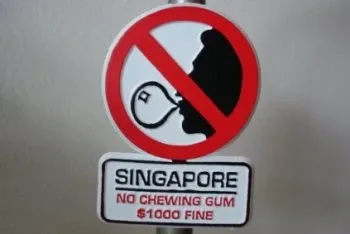
Read the beginning of the article:<\/em>
SINGAPORE: A COUNTRY IN A CITY<\/a><\/p>
The list could go on for a long time. Chewing gum is completely banned. For a long time I did not understand why. Until I stepped in a sticky, hard-to-wash substance that gum turns into at a temperature of +30 degrees in a neighboring hot country.<\/p>
A FRIENDLY police officer said that the response time for an emergency in Singapore should not exceed 15 minutes, and for a routine incident – half an hour. But police are usually not visible in the city; most offenses are prevented through round-the-clock surveillance. Near metro stations, it is easy to notice clusters of hanging round-the-clock "eyes" of the local police. Of course, as they like to repeat here, "low crime doesn't mean no crime" ("low crime doesn't mean no crime"), but crimes are mostly committed by visitors, low-skilled workers.<\/p>
In the first place, these are Indians on construction sites. They are paid a little here, but significantly more than in their historical homeland. This group of workers starts their workday before sunrise and ends late in the evening. 10-12 hours a day, six days a week. On their legal day off, the working mass covers the local ethnic district – Little India (Little India). I'm not exaggerating – they cover it literally.<\/p>
Naturally, after a bottle or five of beer, internal conflicts can easily flare up. Last year, a tourist bus ran over such a reveler, and locals decided to stand up for their own... The mini-riot was only suppressed the next morning with the help of police special forces. Five hundred people were deported or punished. A fairly common punishment is caning with sugar cane sticks on the buttocks. This fate does not spare foreigners either.<\/p>
In second place, these are Filipina domestic workers. Of course, there are not only Filipinas, but they are the most numerous. On average, with full board, a local domestic worker earns about 500 Singapore dollars, which is very little for Singapore but a lot for third-world countries like the Philippines and Indonesia. Many employers abuse their position, may give maids errands on their day off, apply physical punishment. Also, Filipina girls often become the cause of family breakups, which no one welcomes, of course, but it is hard to go against nature.<\/p>
None of the hired employees will ever file an official complaint against the employer. Of course, the guilty party will be punished, but the worker will end up on an unofficial blacklist and will not soon be able to count on a similar, even low-paid, position. In this niche, there are also agents who require a fairly substantial entry fee for their services. Usually, few can pay for their services in one go, and a kind of credit is provided. This kind of relationship leads to the fact that for about six months, the hired worker gives almost all of his not-so-large salary to the agency.<\/p>
All described above, in my understanding, leads to a kind of local form of slavery, a vicious circle that is very difficult for the worker to break. Constant pressure, separation from loved ones and relatives leads to periodic suicides and crimes. This is the dark side of this beautiful city.<\/p>
Although it is not advertised, prostitution is legalized in Singapore with very democratic prices. I don't go to such places myself, but natural curiosity gets the better of me and, naturally, I read about what happens in such establishments. There are many visitors from the same Philippines or Indonesia who are eager to earn money by any means. There are European women, who traditionally are popular in Asian countries, but that is more of an exotic "product".<\/p>
LOCAL residents really don't like to leave the city, but when they do, it's usually for shopping, some specific food, or other entertainment. But not for sightseeing. The usual questions my acquaintances ask after learning that I have been somewhere: "How is the local food?", "How is the shopping there?", "What kind of massage do they do?"<\/p>
For many, shopping has long become entertainment and therapy. Locals can easily spend entire weekends searching for the right clothes and accessories. But they have plenty to choose from – from luxurious, branded stores to very cheap "bargain bins". Of course, preference is given to expensive brands. If you see a Louis Vuitton wallet or bag, in 90% of cases it will be an original item. The largest concentration of such stores is in the Marina Bay Sands shopping center, along with the famous hotel and casino. The hotel itself seemed to me another factory of impressions. There is a beautiful pool and a view, but no personal approach or courtesy. Want something extra (even breakfast) – pay.<\/p>
Another distinguishing feature of local residents is slowness. They say that in the local language there is a special word for haste, speed, but I haven't had to use it. Electricians being half an hour late is completely normal. Canceling a meeting half an hour before it starts is also a matter of course. In the metro, everyone walks very slowly, glued to their phones. But at the same time, everyone is emphatically polite – if you are in a hurry, they will always let you pass, apologize, and give way.<\/p>
ABOUT 20 YEARS AGO, an article by the famous American writer William Gibson about Singapore was published with the title "Disneyland with the Death Penalty" ("Disneyland with the Death Penalty"), in which the author criticizes Singapore as a democracy with an authoritarian lining. Indeed, the cabinet of ministers headed by Mr. Lee Kuan Yew ruled for about 40 years, which allowed the state to move from a third-world country to a first-world one.<\/p>
But the point is that people love their rulers; these are the people to whom they entrusted their country, and they did not entrust in vain. Just look at photographs of Singapore with a difference of 20 years, and everything will become clear immediately.<\/p>
About six months ago, I was very lucky: the current Prime Minister of Singapore was speaking in the courtyard of my house. I don't know why this condo was chosen, probably because of its large courtyard. Anyway, he came out to a crowd of 100-150 people alone and without security! Can you imagine that in Russia? No! Representatives of the authorities are usually separated by a cordon of police and personal security. In my opinion, the attitude of the people towards their leader shows how democratic a country is.
What else does the government do? There are many programs encouraging locals to save money for old age and medical treatment, and a lot of social advertising. And people believe in these things. Money is invested in local infrastructure projects. As a result, the city has excellent infrastructure with fully automated metro and bus lines that work as reliably as Swiss watches.
About 15 years ago, an interesting social experiment was conducted. In one of Singapore's parks, an arena was opened where any resident could publicly criticize the government. All criticism ended within the first couple of weeks due to lack of public support. Now the park is only used as a venue for various public performances.
It's interesting how the government defends its honor and dignity. During Lee Kuan Yew's rule, there were many complaints against him, particularly regarding his use of his position for personal enrichment and advancing his family. Many of his relatives hold important positions in large government or private corporations. In response to statements and complaints, lawsuits for defamation were filed personally on behalf of the Prime Minister, all of which were upheld. One opposition leader, a qualified lawyer, was ruined after a couple of high-profile epithets and now lives a miserable existence. The same situation applies to the press. When the authorities are criticized, the government sends an official response to the magazine, and if the material is not published, sanctions are imposed on the magazine. For example, the circulation of some newspapers was significantly cut at one time, leading to their closure.
Of course, due to all the fines and restrictions mentioned, it's hard to say that Singapore is a free state, but living here is very cozy and comfortable.
Alexander MAKAROV,
Singapore.
