
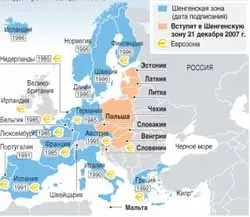
In fact, the decision to admit new members to the Schengen Agreement, taken three years ago, spurred the newcomer countries to set up protection of their external borders as quickly as possible. Some did it on their own, some with financial and technical assistance from Western European countries. The eastern neighbors of Schengen have more or less put their borders "along the perimeter" in order, so now they do not want to wait an extra day to join Schengen. They can be understood: every day outside the Schengen Zone brings them quite tangible losses. Losses from differences in customs duty tariffs, opacity of "internal" borders – all this costs Eastern European countries a pretty penny. Therefore, the EU interior ministers, meeting in Brussels for another conference, gave the "green light" to the early accession of newcomers to Schengen.
Let us recall that currently the members of this customs union are 13 EU countries (Germany, Austria, the Benelux countries, Denmark, Sweden, Finland, Italy, Spain, Portugal, Greece), as well as Norway and Iceland. In addition, Switzerland is expected to receive associate member status next year.
The decision to expand the Schengen Zone itself has its supporters and opponents. For example, German Interior Minister Wolfgang Schäuble said: 'What is to happen at the end of this year is a real stroke of luck for Germany.' The lifting of border and customs controls between Germany, Poland and the Czech Republic will even be marked by a separate celebration at the so-called 'point of three borders.' This is a very serious step: according to statistics, on the German-Polish border alone in the first nine months of this year, 9 million crossings were registered in both directions, and on the German-Czech border – 91 million, that is, ten times more. Besides these countries, Hungary, Slovakia, Slovenia, Estonia, Latvia, Lithuania and Malta are joining Schengen from the end of December. However, the latter country will be in Schengen, so to speak, with only one foot: the fact is that border controls are lifted only on land and sea borders, while at airports it will remain until March 2008. Since the island state of Malta receives and sends about half of its cargo and passenger traffic by air, 'full Schengen' will have to wait a bit.
Another EU island state – Cyprus – is, if not an opponent, then at least a skeptic of the Schengen process. Having joined the EU in 2004, Cyprus is in no hurry to open its internal borders. A long-time member of the Schengen Agreement, Austria, has generally decided not to open its borders with the Czech Republic, but on the contrary to strengthen them even more. This greatly offended the Czechs, but they can do nothing: the external borders of the Czech Republic, running partially through the rugged passes of the High Tatras, represent a classic 'hole in the fence' – a loophole that can easily be used by smugglers transporting illegal migrants. Since Austria has always been a desirable destination for these people, it is no wonder that the Austrian authorities are trying to erect as many fences as possible in their path.
In addition, the EU newcomers who joined the Union at the beginning of this year, Bulgaria and Romania, are simply not ready for Schengen – even local authorities admit this. Nevertheless, they have stated their desire to join Schengen 'as soon as possible.' However, many experts express serious concerns that this 'as soon as possible' for these two EU newcomer countries will ever come in the foreseeable future – too many problems have accumulated for local border guards. Rather, it is assumed that Bulgaria and Romania can count on the so-called association agreement, similar to the one that Switzerland signed with the Schengen Zone countries.
Boris ALTNER.
IA Rosbalt